A private equity sponsor signs a purchase agreement for a $120 million acquisition. The seller wants a clean exit with no indemnity tail. The buyer needs protection against breaches of the seller's representations. A decade ago, this impasse might have killed the deal. Today, transaction liability insurance resolves it in a matter of weeks, transferring the risk of unknown breaches to an insurer and letting both sides move forward. Whether you are a mid-market company acquiring a competitor or a founder selling your first business, understanding how deal risk transfer, escrow replacement, contingent exposure coverage, and underwriting diligence requirements work together can materially change the economics of your transaction. This guide breaks down each component so you can evaluate whether an insurance-backed deal structure fits your next closing.
The Role of Transaction Liability Insurance in Modern M&A
Transaction liability insurance is a category of coverage designed to protect buyers, sellers, or both from financial losses arising out of a merger or acquisition. The most common form is representations and warranties (R&W) insurance, but the category also includes tax liability policies, litigation buyout coverage, and environmental cost-cap policies. Each product targets a different source of deal risk, and each has its own underwriting process.
Representations and Warranties (R&W) Insurance Basics
An R&W policy responds when the representations made by the seller in the purchase agreement turn out to be inaccurate. If, for example, the seller represented that it had no pending employment claims and a wage-and-hour lawsuit surfaces six months post-close, the buyer can submit a claim to the insurer rather than pursuing the seller for indemnification. Policies are typically structured as "buy-side" placements, meaning the buyer is the named insured. Coverage limits commonly range from 10% to 30% of enterprise value, and U.S. primary R&W insurance premium rates averaged between 2.4% and 3.0% of the policy limit in early 2024, a figure that has remained relatively stable into 2026 as competition among underwriters has kept pricing in check.
Shifting Risk from Seller to Insurer
Without insurance, the buyer's recourse for a breach of representations runs directly against the seller. That creates friction: the seller wants to cap indemnity obligations and shorten survival periods, while the buyer wants broad, long-lasting protection. R&W insurance breaks this tension. The insurer steps into the seller's shoes for covered breaches, and the seller's indemnity obligation can be reduced to a nominal amount, sometimes as low as $1, for all but fraud. This dynamic has made insurance-backed deal structures the norm rather than the exception in U.S. middle-market M&A.

By: Caden Braly
Founder of Bloc Cyber Insurance
INDEX
The Role of Transaction Liability Insurance in Modern M&A
Strategic Benefits: Escrow Replacement and Closing Support
Addressing Known Risks with Contingent Exposure Coverage
Comparison: Traditional Indemnity vs. Insurance-Backed Deals
Underwriting Diligence and Policy Requirements
Bloc Cyber and Its Licensed Producers Are Authorized to Place Cyber Coverage in All 50 U.S. States and The District of Columbia.
Cyber liability insurance covers the financial losses your business faces after a cyberattack or data breach. This page explains what the coverage includes, who needs it, what it costs, and how Bloc Cyber helps you get protected fast.
We start with a twenty-minute call to walk through your contracts, your draw process, your tech stack, and the last twelve months of attempted fraud. From there we go to market with ten-plus carriers, benchmark terms side-by-side, and present the options in plain language with recommended limits and retentions. Most intakes get indicative terms within one business day.
Strategic Benefits: Escrow Replacement and Closing Support
Beyond basic indemnity replacement, transaction liability insurance serves two strategic functions that directly affect deal economics: reducing escrow holdbacks and satisfying closing conditions that might otherwise stall a transaction.
Freeing Up Capital by Reducing Escrow Holdbacks
Traditional deal structures require the buyer to hold back a portion of the purchase price in escrow, typically 10% to 15%, as a source of recovery for post-closing indemnity claims. That capital sits idle for 12 to 24 months. With an R&W policy in place, the escrow can often be reduced to 1% or less, because the insurer, not the escrow account, serves as the primary recovery mechanism. For a seller, the difference is significant: on a $50 million deal, reducing the escrow from 10% to 1% frees up $4.5 million at closing. Private equity sellers, in particular, value this structure because it allows faster distribution to limited partners.
Using Insurance to Satisfy Closing Conditions
Some transactions include closing conditions tied to specific risk areas: a pending regulatory inquiry, an unresolved contract dispute, or an environmental remediation obligation. A standalone insurance policy addressing that specific risk can satisfy the condition and allow the deal to close on schedule. This is especially useful in competitive auction processes where delays can cause a buyer to lose the deal entirely.

We start with a twenty-minute call to walk through your contracts, your draw process, your tech stack, and the last twelve months of attempted fraud. From there we go to market with ten-plus carriers, benchmark terms side-by-side, and present the options in plain language with recommended limits and retentions. Most intakes get indicative terms within one business day.
| Coverage Element | General Cyber Policy | Cryptojacking Endorsement |
|---|---|---|
| Unauthorized cloud compute charges | May be excluded or subject to low sublimit | Explicitly covered, often with higher sublimit |
| Incident response and forensics | Typically included | Included |
| Business interruption from degraded performance | Covered if waiting period is met | Covered, sometimes with shorter waiting period |
| Container/Kubernetes remediation | Covered under system restoration if triggered | Explicitly addresses cloud-native environments |
| Cloud bill reimbursement | Varies widely by form | Specifically designed for this loss type |
| Retention (deductible) | Standard retention applies | May have separate, lower retention |
Some regulatory proceedings involve parallel tracks: the regulator's formal action and an internal investigation your company runs simultaneously. Shadow defense counsel represents your company's interests during the regulatory process without formally appearing before the agency. Monitoring counsel may be appointed under a consent order to oversee your compliance.
The costs for these roles can be substantial. Certain policy forms cover shadow counsel fees as part of the defense cost grant, while others exclude them entirely. Court-appointed monitors in state enforcement actions have generated significant fees that strain organizational budgets, and whether your policy responds to those costs depends on how the form defines "defense costs" and "regulatory proceeding."
Shadow Defense and Monitoring Counsel Roles
Addressing Known Risks with Contingent Exposure Coverage
R&W insurance covers unknown breaches, but many deals involve identified risks that fall outside the scope of a standard R&W policy. Contingent exposure coverage fills that gap.
Tax Liability and Opinion-Based Insurance
Tax liability insurance protects against adverse outcomes on specific tax positions taken by the target company. Common examples include Section 338(h)(10) elections, state nexus determinations, and transfer pricing arrangements. The insured obtains a "should" or "will" level tax opinion from counsel, and the insurer underwrites around that opinion. If the IRS or a state taxing authority later challenges the position and prevails, the policy responds. Premiums typically run 3% to 7% of the insured tax benefit, depending on the complexity and jurisdiction.
Managing Specific Litigation and Environmental Risks
Litigation buyout policies cover the cost of an adverse judgment or settlement in a specific pending or threatened lawsuit. Environmental cost-cap policies set a ceiling on the insured's remediation costs at a contaminated site. Both products require detailed underwriting, including review of expert reports, legal opinions, and site assessments. These are not off-the-shelf products. Each policy is manuscript-drafted to match the specific exposure.
Real claims illustrate the exposure more clearly than abstract descriptions. Here are patterns that repeat across the technology sector:
- A SaaS company deploys a billing module that overcharges 12,000 end users over six months. The client demands $410,000 in restitution costs plus $150,000 in legal fees. The tech E&O form responds to the defense and indemnity obligation.
- An MSP fails to complete a server migration on schedule, causing a healthcare client to miss a compliance deadline. The healthcare company faces a regulatory fine and sues the MSP for $275,000. The policy form may respond, but only if the regulatory fine is not excluded as a penalty.
- A custom software vendor delivers an inventory management system that miscounts stock levels. The client loses $600,000 in downstream sales. The vendor's tech E&O policy covers defense costs and settlement, but a sublimit on the policy caps the payout at $500,000.
Average defense costs for technology professional liability claims range from $50,000 to $150,000 depending on complexity and jurisdiction. Settlement amounts vary widely, but six-figure demands are common even for small firms.
We start with a twenty-minute call to walk through your contracts, your draw process, your tech stack, and the last twelve months of attempted fraud. From there we go to market with ten-plus carriers, benchmark terms side-by-side, and present the options in plain language with recommended limits and retentions. Most intakes get indicative terms within one business day.
| Coverage Element | Commercial General Liability | Cyber Insurance |
|---|---|---|
| Data breach notification costs | Not covered | Covered under first-party |
| Ransomware payment | Not covered | Covered (subject to sublimit) |
| Regulatory defense | Not covered | Covered under third-party |
| Business interruption from cyberattack | Not covered | Covered with waiting period |
| Funds transfer fraud | Not covered | Covered via cyber crime endorsement |
| Third-party lawsuit over data loss | Excluded or severely limited | Covered under third-party liability |
| Technology product failure | Not covered | Covered under Tech E&O |
How much does a typical PCI forensic investigation cost?
PFI engagements range from $20,000 for a simple, small-merchant investigation to $120,000 or more for complex environments with multiple locations or e-commerce platforms. The card brands dictate the scope, and the merchant pays.
Comparison: Traditional Indemnity vs. Insurance-Backed Deals
The structural differences between a traditional indemnity deal and an insurance-backed deal affect capital efficiency, seller liability, and the speed of post-closing recovery.
Table: Recovery Mechanisms and Capital Efficiency
| Feature | Traditional Indemnity | Insurance-Backed Deal |
|---|---|---|
| Primary recovery source | Seller indemnity | R&W insurer |
| Escrow holdback | 10%-15% of purchase price | 0%-1% of purchase price |
| Seller's residual liability | Capped at escrow or higher | Limited to fraud |
| Survival period | 12-24 months (general reps) | Policy term: typically 3-6 years |
| Claim process | Negotiate with seller | Submit to insurer |
| Impact on seller relationships | Adversarial post-close disputes | Preserves relationship |
| Cost | No premium; capital tied in escrow | Premium of 2.4%-3.0% of limit |
The table highlights a key tradeoff. The buyer pays a premium, but gains a longer coverage period, a creditworthy counterparty, and a claims process that does not require suing the seller. For deals where the buyer plans to retain management or maintain a commercial relationship with the seller, this distinction matters enormously.
We start with a twenty-minute call to walk through your contracts, your draw process, your tech stack, and the last twelve months of attempted fraud. From there we go to market with ten-plus carriers, benchmark terms side-by-side, and present the options in plain language with recommended limits and retentions. Most intakes get indicative terms within one business day.
No. A data breach or cyberattack is a cyber liability exposure, not a technology E&O exposure. You need a separate cyber liability policy form to cover breach response, notification costs, regulatory defense, and third-party claims arising from a security incident. Many technology companies carry both policies because the exposures are distinct.
FAQ: Does this cover me if I get hacked?
P2PE encrypts cardholder data from the point of interaction (the card reader) to the payment processor's secure decryption environment. A validated P2PE solution removes your systems from PCI scope for those transactions, which directly reduces both your compliance burden and your risk profile. Underwriters recognize P2PE as a meaningful risk reduction and may offer premium credits for merchants using validated solutions.
Implementing Point-to-Point Encryption (P2PE)
Underwriting Diligence and Policy Requirements
Securing a transaction liability policy is not a formality. Underwriters conduct their own diligence, and the rigor of that review directly affects coverage terms, exclusions, and pricing.
The Underwriter's Review of Data Rooms
Underwriters expect access to the buyer's due diligence reports, the virtual data room, and the near-final purchase agreement. They review financial, tax, legal, environmental, intellectual property, and employment diligence. Gaps in diligence translate to broader exclusions on the policy. If the buyer skipped an environmental Phase I assessment, for instance, the underwriter will likely exclude environmental representations from coverage entirely. Firms like Bloc Cyber, whose practice centers on reading policy forms at the insuring-agreement level, often advise clients that the quality of your diligence directly determines the quality of your coverage.
Timeline for Securing a Bindable Quote
The underwriting process typically takes two to three weeks from submission of the data room to delivery of a bindable quote. Non-binding indications can arrive within days if the underwriter receives a clean summary of the deal and a draft purchase agreement. Buyers who engage an insurance broker early in the deal process, ideally at the letter-of-intent stage, give themselves time to negotiate policy terms without delaying closing. Waiting until the final week before signing compresses the timeline and limits your ability to push back on exclusions.
Real claims illustrate the exposure more clearly than abstract descriptions. Here are patterns that repeat across the technology sector:
- A SaaS company deploys a billing module that overcharges 12,000 end users over six months. The client demands $410,000 in restitution costs plus $150,000 in legal fees. The tech E&O form responds to the defense and indemnity obligation.
- An MSP fails to complete a server migration on schedule, causing a healthcare client to miss a compliance deadline. The healthcare company faces a regulatory fine and sues the MSP for $275,000. The policy form may respond, but only if the regulatory fine is not excluded as a penalty.
- A custom software vendor delivers an inventory management system that miscounts stock levels. The client loses $600,000 in downstream sales. The vendor's tech E&O policy covers defense costs and settlement, but a sublimit on the policy caps the payout at $500,000.
Average defense costs for technology professional liability claims range from $50,000 to $150,000 depending on complexity and jurisdiction. Settlement amounts vary widely, but six-figure demands are common even for small firms.
We start with a twenty-minute call to walk through your contracts, your draw process, your tech stack, and the last twelve months of attempted fraud. From there we go to market with ten-plus carriers, benchmark terms side-by-side, and present the options in plain language with recommended limits and retentions. Most intakes get indicative terms within one business day.
| Coverage Element | Commercial General Liability | Cyber Insurance |
|---|---|---|
| Data breach notification costs | Not covered | Covered under first-party |
| Ransomware payment | Not covered | Covered (subject to sublimit) |
| Regulatory defense | Not covered | Covered under third-party |
| Business interruption from cyberattack | Not covered | Covered with waiting period |
| Funds transfer fraud | Not covered | Covered via cyber crime endorsement |
| Third-party lawsuit over data loss | Excluded or severely limited | Covered under third-party liability |
| Technology product failure | Not covered | Covered under Tech E&O |
Will my policy pay for the fines if I'm not compliant?
This depends entirely on the policy form. Some forms cover PCI fines only if the merchant was making good-faith compliance efforts. Others exclude fines arising from known non-compliance. Read the exclusions carefully before binding.
How much does a typical PCI forensic investigation cost?
PFI engagements range from $20,000 for a simple, small-merchant investigation to $120,000 or more for complex environments with multiple locations or e-commerce platforms. The card brands dictate the scope, and the merchant pays.
What is the difference between a fine and an assessment?
A fine is a penalty for non-compliance with PCI DSS standards. An assessment is a cost-recovery mechanism: the card brands and issuing banks recoup their actual losses (fraud charges, card replacement costs) from the breached merchant. Both are financial obligations, but they arise from different triggers and may be treated differently under a policy form.
Frequently Asked Questions About Deal Risk Transfer
Does the seller or the buyer typically pay the R&W insurance premium? Practice varies, but in most U.S. middle-market deals the buyer pays the premium. Some transactions split the cost or allocate it as a purchase price adjustment.
Can R&W insurance cover fraud by the seller? Standard buy-side policies cover seller fraud because the buyer did not commit the fraud. Sell-side policies, which are far less common, exclude fraud by the insured seller.
What is the typical retention (deductible) on an R&W policy? Retentions generally range from 0.75% to 1.5% of enterprise value. Some policies offer a "drop-down" retention that decreases after 12 to 18 months.
Are there deal sizes too small for R&W insurance? Historically, deals below $25 million were difficult to insure. Several underwriters now offer streamlined programs for transactions as small as $10 million, though pricing per dollar of coverage tends to be higher on smaller deals.
How long does coverage last? Most R&W policies provide a three-year term for general representations and a six-year term for fundamental and tax representations, though terms are negotiable.
Does transaction liability insurance replace all due diligence? No. Underwriters require thorough buyer-side diligence as a condition of coverage. The policy supplements diligence; it does not substitute for it.
We start with a twenty-minute call to walk through your contracts, your draw process, your tech stack, and the last twelve months of attempted fraud. From there we go to market with ten-plus carriers, benchmark terms side-by-side, and present the options in plain language with recommended limits and retentions. Most intakes get indicative terms within one business day.
No. A data breach or cyberattack is a cyber liability exposure, not a technology E&O exposure. You need a separate cyber liability policy form to cover breach response, notification costs, regulatory defense, and third-party claims arising from a security incident. Many technology companies carry both policies because the exposures are distinct.
FAQ: Does this cover me if I get hacked?
P2PE encrypts cardholder data from the point of interaction (the card reader) to the payment processor's secure decryption environment. A validated P2PE solution removes your systems from PCI scope for those transactions, which directly reduces both your compliance burden and your risk profile. Underwriters recognize P2PE as a meaningful risk reduction and may offer premium credits for merchants using validated solutions.
Implementing Point-to-Point Encryption (P2PE)
Making the Right Choice for Your Transaction
Transaction liability insurance has become a standard tool in M&A, but it is not a one-size-fits-all product. The right structure depends on deal size, the nature of identified risks, the seller's exit objectives, and the buyer's appetite for retaining exposure. A $15 million acquisition of a SaaS company with clean financials and no litigation history presents a very different underwriting profile than a $200 million carve-out with pending environmental remediation.
For mid-market buyers and sellers, the decision often comes down to whether the premium justifies the capital freed from escrow and the protection gained against unknown breaches. In most competitive processes, the answer is yes. The coverage period extends well beyond a typical escrow survival window, and the claims process runs through a professional insurer rather than a former business partner.
If your company is evaluating an acquisition or preparing for a sale, understanding how transaction liability coverage, escrow replacement, and contingent risk policies fit into your deal structure is worth the time. Bloc Cyber works with commercial buyers across technology, healthcare, and professional services to review policy forms at the coverage-grant level, ensuring you know exactly where protection begins and ends before you sign. If you are approaching a transaction and want a specialist to
review the policy form with you, requesting a consultation early in the process gives you the most room to shape terms in your favor.
ABOUT THE AUTHOR
Caden Braly
— Founder, Bloc Cyber
I'm Caden Braly, founder of Bloc Cyber, the specialty cyber insurance arm of Braly Insurance. I built Bloc Cyber around one idea: businesses deserve coverage that actually responds when a cyberattack happens. I work closely with clients to understand their exposure, place the right policy through specialty carriers, and stand with them through the claim. My goal is simple — give every business straight answers and protection they can trust.
Full profile → caden@bloccyber.com LinkedIn
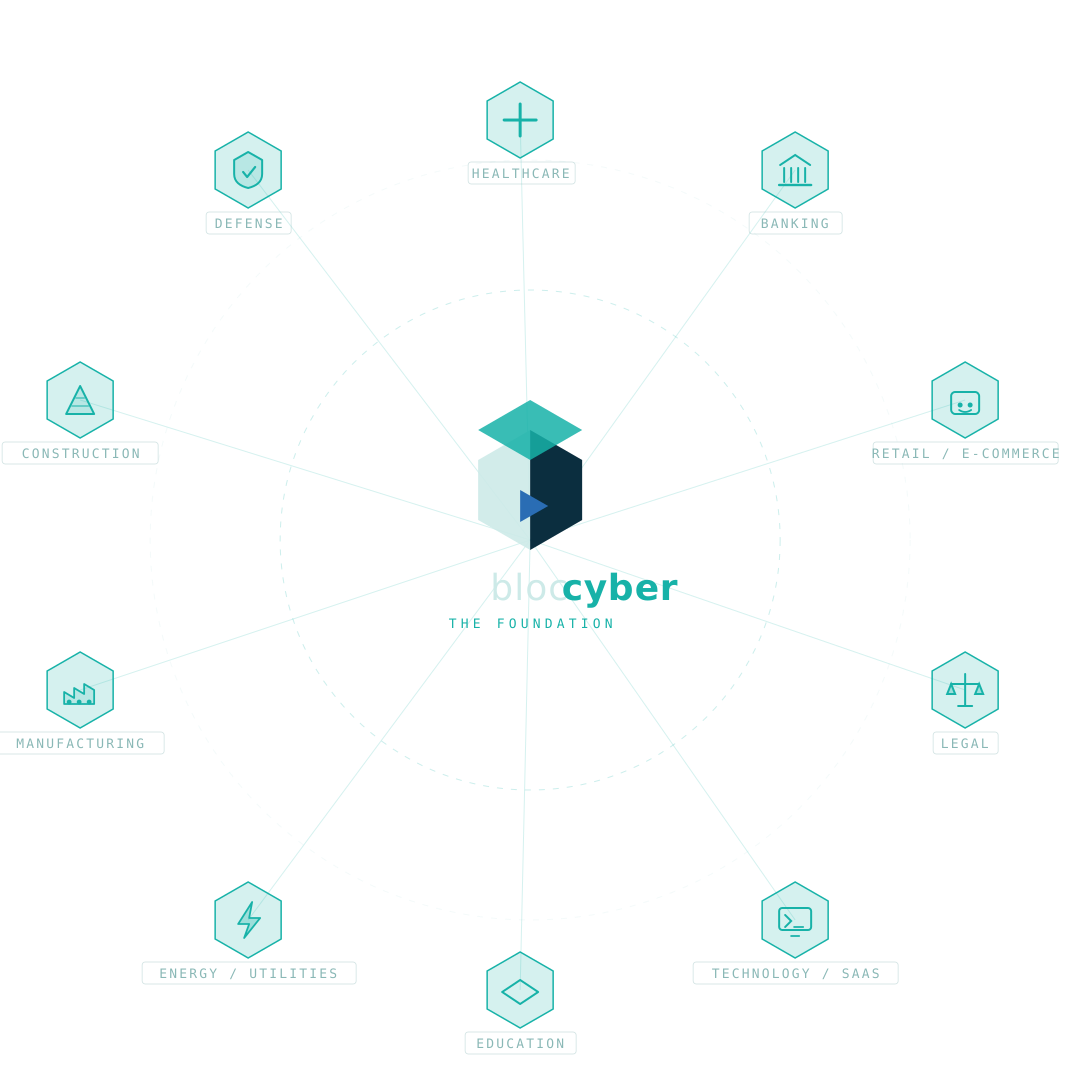
Industries We Protect
Cyber Coverage Built for Your Industry
Every industry faces a different cyber threat, from patient records in healthcare to wire fraud in construction. Bloc Cyber matches coverage to the risks your sector actually faces, drawing on specialty carriers that understand your business. Find your industry below to see how we protect it.
Healthcare
Banking
Retail / E-Commerce
Legal
Technology / SaaS
Education
Energy / Utilities
Manufacturing
Construction
Defense

Healthcare
HIPAA-grade protection for patient data
725
healthcare breaches disclosed in 2024
HIPAA-grade protection for patient data
▣ Ransomware on EHR systems
▣ PHI exfiltration
▣ Medical device exploits
▣ Business email compromise
Sub-sectors we place
Hospitals and health systems
Physician practices and specialty clinics
Dental practices and DSOs
Behavioral health and addiction treatment centers
Medical billing and revenue cycle management firms
Typical turnaround for indication of terms: 1 business day.

Banking
Coverage that meets FFIEC and NYDFS expectations
$5.9M
average cost of a financial sector breach
Common threats we underwrite against
▣ Wire fraud and BEC
▣ Credential stuffing
▣ Third-party vendor risk
▣ Ransomware
Sub-sectors we place
Community banks
Credit unions
Mortgage lenders and loan originators
Wealth management and RIAs
Payment processors and merchant acquirers
Typical turnaround for indication of terms: 1 business day.

Retail / E-Commerce
PCI-DSS aligned coverage for every checkout
42%
of retailers hit by ransomware in the last year
Common threats we underwrite against
▣ Magecart / card skimming
▣ POS malware
▣ Account takeover
▣ Supply-chain intrusion
Sub-sectors we place
Direct-to-consumer (DTC) brands
Shopify and marketplace sellers
Brick-and-mortar multi-location retailers
Restaurants and QSR franchises
Grocery and specialty food retail
Typical turnaround for indication of terms: 1 business day.

Legal
Privilege, client files, and trust-account safeguards
1 in 4
law firms reported a breach in 2024
Common threats we underwrite against
▣ Wire-transfer fraud
▣ Privileged data theft
▣ Email account compromise
▣ Ransomware
Sub-sectors we place
AmLaw / large firms
Boutique litigation firms
Personal injury and plaintiffs’ firms
Estate planning and trust attorneys
Title and real estate closing firms
Typical turnaround for indication of terms: 1 business day.

Technology / SaaS
SOC 2 and ISO-aligned risk transfer
$4.88M
avg. cost of a SaaS breach in 2024
Common threats we underwrite against
▣ Supply-chain attacks
▣ Cloud misconfiguration
▣ Token and key theft
▣ Zero-day exploits
Sub-sectors we place
B2B SaaS platforms
Managed service providers (MSPs) and MSSPs
Fintech startups
AI and machine learning companies
Cloud hosting and infrastructure providers
Typical turnaround for indication of terms: 1 business day.

Education
FERPA-aligned coverage for student and research data
80%
of K–12 districts hit by ransomware since 2022
Common threats we underwrite against
▣ Ransomware on district networks
▣ Student PII theft
▣ Fake invoice fraud
▣ DDoS on exam platforms
Sub-sectors we place
K-12 public school districts
Private and charter schools
Colleges and universities
EdTech platforms
Tutoring, test prep, and online learning providers
Typical turnaround for indication of terms: 1 business day.

Energy / Utilities
OT and IT coverage for critical infrastructure
24/7
operational-tech monitoring requirements
Common threats we underwrite against
▣ ICS/SCADA intrusion
▣ Nation-state actors
▣ Ransomware on OT
▣ Insider threat
Sub-sectors we place
Municipal utilities (water, electric, gas)
Oil and gas operators
Pipeline and midstream companies
Renewable energy (solar, wind) developers
Electric cooperatives and rural utilities
Typical turnaround for indication of terms: 1 business day.

Manufacturing
Business interruption protection for connected plants
25%
of all ransomware attacks target manufacturing
Common threats we underwrite against
▣ Ransomware halting production
▣ IP theft
▣ ICS exploits
▣ Vendor compromise
Sub-sectors we place
Industrial and heavy equipment manufacturers
Food and beverage processing
Pharmaceutical and medical device manufacturers
Automotive and parts suppliers
Aerospace component manufacturers
Typical turnaround for indication of terms: 1 business day.

Construction
Protection for project files, wires, and jobsite tech
$200K+
average wire-fraud loss in construction
Common threats we underwrite against
▣ Wire-transfer diversion
▣ BEC on project payments
▣ Stolen bid data
▣ Ransomware
Sub-sectors we place
General contractors
Commercial HVAC, electrical, and plumbing subs
Civil and infrastructure contractors
Homebuilders and residential developers
Architecture and engineering (A&E) firms
Typical turnaround for indication of terms: 1 business day.

Defense
CMMC, DFARS, and CUI-compliant risk transfer
CMMC
2.0 compliance required by 2026
Common threats we underwrite against
▣ CUI exfiltration
▣ Nation-state APTs
▣ Supply-chain compromise
▣ Cleared-personnel targeting
Sub-sectors we place
DoD prime contractors
CMMC-regulated subcontractors
Defense software and systems integrators
Aerospace and satellite contractors
Federal IT and cleared staffing firms
Typical turnaround for indication of terms: 1 business day.
The Bloc system
One foundation.
Ten industry-specific builds.
The Bloc mark is built from stackable planes — each one a different angle on the same core structure. That’s how we place coverage: one underwriting discipline, tuned and re-tuned for every industry we serve.
Coverage
A policy you can actually read.
Structured in three clean blocs.
01
First-Party
Your direct losses when an incident hits your business.
✓
Incident response & forensics
✓
Business interruption
✓ Data restoration
✓ Cyber extortion / ransomware
✓ Funds transfer fraud
✓ Reputational harm
02
Third-Party
Your liability to clients, partners, and regulators.
✓
Network security liability
✓
Privacy liability (HIPAA, GDPR, state laws)
✓ Regulatory defense & fines
✓ PCI-DSS fines and assessments
✓ Media liability
✓ Breach notification costs
03
Specialty
Advanced coverages for complex risks and contracts.
✓
Technology E&O
✓
Social engineering fraud
✓ Contingent business interruption
✓ Systems failure
✓ Bricking & hardware replacement
✓ CMMC / regulatory-specific endorsements
Typical limits placed
$1M / $1M starter
$5M / $10M mid-market
$25M+ layered towers
Custom retentions
Common Questions
Cyber Liability Insurance, Explained
What does cyber insurance cover?
Cyber insurance covers the financial losses from a data breach or cyberattack. This includes breach response, legal fees, customer notification, ransomware, business interruption, and regulatory fines, depending on your policy.
Does my business really need cyber insurance?
Yes. Any business that stores customer data, processes payments, or relies on connected systems faces cyber risk. Small and mid-sized companies are frequent targets because they often have fewer defenses.
How much does cyber insurance cost?
Cost depends on your industry, revenue, data volume, and security practices. We market your risk to multiple carriers to find strong coverage at a competitive price. Request a quote for an exact figure.
What is the difference between first-party and third-party cyber coverage?
First-party coverage pays for your own losses, like data recovery and lost income. Third-party coverage pays for claims from others harmed by a breach on your systems.
How fast can I get a quote?
Most clients receive a quote in under 24 hours after we review the details of their business and exposure.
What should I do first after a cyberattack?
Contact us right away. We help you start breach response, connect you with forensic and legal support, and guide your claim so you contain the damage quickly.
Insights
Field notes from the placement desk.
What carriers are asking right now.



Start a quote
Tell us about your business.
We’ll come back with terms.
We’ll review your stack, your contracts, and your exposure — then place the program against the right markets. Most intakes get indicative terms back within one business day.
01
Quick intake
We only ask what the carriers actually need.
02
Benchmark
Side-by-side terms from 10+ specialty cyber carriers.
03
Bind
Plain-language policy review, e-signed and in force.