SPECIALTIES
Michigan Technology Errors and Omissions
Insurance
Three scenarios dominate the claims data. First, a compromised vendor email chain leads your AP team to redirect a legitimate invoice payment to a new bank account controlled by a criminal. Second, a spoofed executive email instructs your controller to wire funds for a confidential acquisition or urgent tax payment. Third, a threat actor compromises your company's own email system and intercepts outbound payment instructions to your clients, redirecting incoming payments. Each scenario triggers a different coverage grant, and some policies cover only one or two of the three.
Common Wire Transfer Loss Scenarios
The gap between these two policy types is where most uninsured AI losses land. A company that only carries general liability and a basic tech E&O policy may find itself with no coverage for the specific claims AI systems generate.
A Michigan software firm delivers a custom inventory platform to an automotive supplier. The system crashes during a production run, halting the assembly line for 72 hours. The supplier's losses exceed $400,000, and the lawsuit names the developer for negligent code and failure to perform under contract. The developer's general liability policy? It does not respond. This is the exact scenario that technology errors and omissions insurance exists to address, and Michigan tech companies operating in Detroit, Grand Rapids, and Ann Arbor face these exposures every week.
Tech E&O coverage for Michigan businesses is not a commodity product you grab off a shelf. The policy form matters: the insuring agreements, the exclusions, the sublimits, and the retention structure all determine whether a claim gets paid or denied. For firms building software, managing IT infrastructure, or delivering SaaS products, understanding how failure-to-perform claims and negligent development allegations interact with your policy is essential before you sign your next client contract.
Small Michigan tech firms typically pay between $1,200 and $5,000 annually for this coverage, while scaling companies with larger revenue and more complex client obligations pay significantly more. The cost is modest relative to the exposure. What follows is a practical breakdown of how these policies work, where the coverage gaps hide, and what Michigan-specific factors shape your purchasing decision.
Understanding Tech E&O for Michigan's Growing IT Sector
Technology errors and omissions insurance responds to claims alleging that your professional services or technology products caused financial harm to a client. This includes allegations of negligent software development, system failures, data migration errors, missed deadlines that cause downstream losses, and failures in the performance of contracted technology services. The policy typically covers defense costs, settlements, and judgments arising from these claims.
Michigan's tech sector has grown steadily, with Detroit's mobility and connected-vehicle ecosystem, Grand Rapids' expanding IT services market, and Ann Arbor's university-adjacent startup corridor all producing companies that carry significant professional liability exposure. Each of these markets creates distinct contractual relationships and risk profiles that a generic insurance product cannot adequately address.
Why Standard General Liability Isn't Enough for Software Developers
General liability insurance covers bodily injury and property damage caused by your business operations. If a visitor slips in your office, GL responds. If your software crashes a client's production environment and they lose $500,000 in revenue, GL does not. The distinction is critical: GL policies contain a professional services exclusion that specifically removes coverage for claims arising from your professional work product.
A software developer who relies solely on GL is exposed to the full cost of defense and damages in any professional negligence claim. Defense costs alone in a Michigan technology dispute can reach $150,000 to $300,000 before a case reaches trial.
The Difference Between General Liability and Tech E&O
| Coverage Element | General Liability | Tech E&O |
|---|---|---|
| Bodily injury | Covered | Not covered |
| Property damage (physical) | Covered | Not covered |
| Negligent software development | Excluded | Covered |
| Failure to perform under contract | Excluded | Covered (subject to policy terms) |
| Data loss caused by your services | Typically excluded | Covered |
| Missed project deadlines causing client loss | Excluded | May be covered |
| Defense costs for professional claims | Not provided | Included (duty to defend or reimburse) |
The two policies protect against entirely different categories of risk. A Michigan tech firm needs both, and confusing one for the other is a mistake that surfaces only after a claim is filed.

By: Caden Braly
Founder of Bloc Cyber Insurance
INDEX
Bloc Cyber and Its Licensed Producers Are Authorized to Place Cyber Coverage in All 50 U.S. States and The District of Columbia.
Cyber liability insurance covers the financial losses your business faces after a cyberattack or data breach. This page explains what the coverage includes, who needs it, what it costs, and how Bloc Cyber helps you get protected fast.
We start with a twenty-minute call to walk through your contracts, your draw process, your tech stack, and the last twelve months of attempted fraud. From there we go to market with ten-plus carriers, benchmark terms side-by-side, and present the options in plain language with recommended limits and retentions. Most intakes get indicative terms within one business day.
Forensic Investigations: Identifying the Source and Scope
Forensic investigators determine how the attacker got in, what data was accessed, whether exfiltration occurred, and whether the threat actor is still present in the network. Their report drives every downstream decision: which individuals must be notified, whether payment card brands must be alerted, and what remediation steps are necessary. Forensic engagements for mid-market companies commonly run between $30,000 and $150,000, depending on the complexity of the environment. The policy form may impose a separate sublimit on forensic costs or bundle them under a single breach response aggregate. Bloc Cyber reviews these sublimits at the insuring-agreement level before binding, so clients understand exactly how much forensic coverage they are purchasing and where the cap sits relative to their actual exposure.
SLA disputes represent a growing category of tech E&O claims, particularly for managed service providers and SaaS companies. When your contract guarantees 99.9% uptime and your platform experiences extended outages, the financial exposure extends beyond the service credits written into the SLA. Clients may claim consequential damages: lost sales, regulatory penalties, or reputational harm tied to the downtime.
Not every tech E&O policy covers SLA-related claims. Some forms treat SLA penalties as liquidated damages, which are typically excluded. Others classify SLA failures as a failure to perform professional services, which brings them within the coverage grant. You need to know which version your policy form uses before you sign a contract that includes uptime guarantees.
Missed Service Level Agreements (SLAs) and Uptime Requirements
Data Restoration and Forensic Investigation
Forensic investigation costs, the expense of hiring a firm to determine what happened, what data was accessed, and how the attacker gained entry, routinely exceed $75,000 for a district-level incident. Data restoration, rebuilding systems and databases from backups, adds another significant line item. Your policy form should cover both without sharing a sublimit that forces you to choose between understanding the breach and recovering from it.
Bloc Cyber's approach to placement involves reviewing these sublimits at the insuring-agreement level before binding, so a district knows exactly where the coverage grant stops and what gaps remain. That form-level review is especially important for education buyers, where a $500,000 aggregate limit can be consumed quickly across forensics, restoration, notification, and regulatory defense.
Navigating Failure-to-Perform and Negligent Development Claims
Failure-to-perform and negligent development represent two distinct claim theories, though they often appear together in the same lawsuit. A failure-to-perform claim alleges that you did not deliver what the contract required: the software does not function as specified, the project was never completed, or the deliverable arrived so late that the client suffered measurable financial harm. A negligent development claim alleges that your work fell below the professional standard of care, resulting in defective code, security vulnerabilities, or system instability.
Both claim types are common in Michigan's technology sector. The state's economic loss doctrine shapes how courts handle these disputes, particularly when the alleged harm is purely financial rather than physical. Understanding how Michigan courts apply this doctrine affects both your contract drafting and your insurance purchasing.
Defining Financial Loss in Failure-to-Perform Disputes
Financial loss in a failure-to-perform dispute typically includes the client's lost revenue, the cost of hiring a replacement vendor, operational downtime, and consequential damages flowing from the failed deliverable. Michigan courts have refined the economic loss doctrine to clarify when a plaintiff can pursue tort claims versus breach-of-contract claims for purely economic harm.
Your Tech E&O policy form may define "loss" or "damages" in ways that include or exclude specific categories of financial harm. Some forms exclude contractual penalties. Others exclude liquidated damages. The insuring agreement language controls what the carrier will actually pay, which is why a form-level review before binding matters more than the premium quote.
Common Triggers for Negligence Claims in Michigan Tech Firms
Real-world claim triggers include deploying code without adequate testing, failing to patch known vulnerabilities in managed systems, migrating client data without proper backup protocols, and delivering a platform that does not meet the functional specifications outlined in the statement of work. One documented pattern involves SaaS providers whose platform outages cause client-facing business interruption, generating claims that can reach seven figures depending on the client's lost revenue.
Michigan MSPs and IT services firms face particular exposure when they manage client infrastructure under service-level agreements with uptime guarantees. A breach of that SLA, combined with a security incident or data loss, can produce overlapping Tech E&O and cyber liability claims that test the boundaries of both policy forms.

The gap between a basic crime policy and a comprehensive fraud protection program is significant. The table below highlights key differences.
We start with a twenty-minute call to walk through your contracts, your draw process, your tech stack, and the last twelve months of attempted fraud. From there we go to market with ten-plus carriers, benchmark terms side-by-side, and present the options in plain language with recommended limits and retentions. Most intakes get indicative terms within one business day.
This comparison illustrates why a general liability policy, even one with a broad "personal and advertising injury" grant, will not respond to a regulatory proceeding. The coverage must be placed specifically under a cyber or technology E&O form that includes regulatory defense as a named insuring agreement.
| Coverage Feature | Basic Crime Policy | Comprehensive Cyber with Fraud Coverage |
|---|---|---|
| Computer Fraud | Typically included | Included |
| Social Engineering | Optional endorsement, low sublimit | Included, higher sublimits available |
| Push Payment Fraud | Often excluded | May be covered as separate grant |
| Account Takeover | May fall under computer fraud | Explicitly covered |
| Forensic Investigation | Not covered | First-party expense coverage |
| Legal and Regulatory Costs | Not covered | Included |
| Callback Verification Required | Yes, strict condition | Yes, but terms vary by form |
| Typical Sublimit Range | $100K - $250K | $250K - $1M+ |
R&W retentions function similarly to a deductible but are typically structured as a percentage of enterprise value. A common retention for mid-market deals sits between 1% and 3% of the transaction value. On a $50 million deal, that means the buyer absorbs the first $500,000 to $1.5 million of covered losses before the insurer pays anything. The retention exists because underwriters expect the buyer's own diligence to catch smaller issues. Retention levels are negotiable and vary by carrier, deal size, and the quality of the diligence package presented during underwriting.
How Retention Works as a Deductible
The Transition from Retention to Drop-Down Coverage
Most R&W policies include a drop-down feature that reduces the retention, often by half, after a specified period, typically 12 months post-closing. If the original retention is $1 million, it drops to $500,000 after the first year. This mechanism reflects the assumption that the most significant breaches surface early. The reduced retention in the later period provides the buyer with more accessible coverage for claims that emerge after the initial post-closing adjustment period. Some policies offer a full drop to zero retention after 18 or 24 months, though this depends on the specific terms negotiated with the underwriter.
| Area | SOC 2 Requirement | Typical Cyber Insurance Requirement |
|---|---|---|
| Multi-Factor Authentication | Required under Security criterion for logical access | Required on all remote access, email, and admin consoles |
| Endpoint Detection & Response | Recommended but not always mandated | Frequently required; some carriers mandate specific vendors |
| Encryption | Required for data in transit; recommended at rest | Required for both in transit and at rest on most applications |
| Incident Response Plan | Required under Security criterion | Required; some carriers want to see tabletop exercise records |
| Backup & Recovery | Covered under Availability criterion | Required with tested restoration procedures |
| Vendor Management | Covered under Confidentiality or Security | Asked about in applications; subcontractor liability coverage may depend on it |
| Employee Training | Required under Security criterion | Required; frequency and phishing simulation results often requested |
A breach-response insuring agreement typically covers the cost of retaining a forensic investigation firm to determine the scope of the intrusion, identify compromised data, and recommend remediation. It also covers breach counsel: attorneys who manage notification obligations, coordinate with regulators, and advise on litigation exposure.
The sequencing matters. Engaging breach counsel first, before the forensic firm, can place the forensic report under attorney-client privilege. This is a practical consideration that affects your litigation posture. Your policy form should not restrict you to a single panel firm if that firm has a conflict or lacks capacity during a widespread event. Bloc Cyber evaluates panel flexibility and pre-approval processes during the placement process so clients are not surprised after an incident.
The Role of Forensic Investigators and Legal Counsel
The difference between these two categories is not academic. A standard professional liability form written for consultants or accountants will contain exclusions that gut coverage for a software company. Technology-specific forms are underwritten with code delivery, SaaS operations, and IT services in mind. The endorsements and exclusion language reflect the actual risk profile of a tech firm.
| Coverage Feature | Standard Professional Liability | Specialized Tech E&O |
|---|---|---|
| Negligent acts/omissions | Covered | Covered |
| Breach of contract (standalone) | Often excluded | Typically included |
| SLA failure claims | Excluded or silent | May be covered depending on form |
| Intellectual property infringement | Rarely included | Usually included |
| Network security liability | Not included | Available as combined form |
| Rectification/mitigation costs | Not included | Available on select forms |
| Defense cost structure | Inside the limit | Inside or outside the limit (varies) |
| Technology-specific exclusions | Broad | Narrower, negotiable |
Many Illinois districts assume their existing commercial general liability (CGL) or school board legal liability policy provides some cyber protection. In most cases, it does not.
| Coverage Element | Basic Cyber Liability | Comprehensive AI Liability |
|---|---|---|
| Data breach response | Included | Included |
| AI hallucination claims | Typically excluded | Covered under errors grant |
| Algorithmic bias defense | Not addressed | Explicit coverage available |
| Agentic AI decisions | Not addressed | Covered if endorsed |
| Regulatory defense (AI-specific) | Limited to privacy laws | Extends to AI regulation |
| First-party remediation | Breach costs only | Includes output correction |
| Typical retention | $5,000-$25,000 | $10,000-$50,000 |
| Policy form basis | Claims-made | Claims-made |
Coverage Comparison Table
| Scenario | General Liability / Property | Standalone Cyber Policy |
|---|---|---|
| Ransomware shuts down production for 5 days | No coverage (no physical damage) | Business interruption after waiting period |
| Customer sues over stolen design files | Likely excluded (electronic data exclusion) | Third-party liability coverage |
| Supplier payment fraud via email compromise | Excluded (voluntary parting of funds) | Social engineering endorsement (sublimited) |
| Regulatory investigation after breach | No coverage | Regulatory defense and fines/penalties |
| Spoiled inventory due to HVAC system hack | Possible property claim (physical damage) | May also respond; coordinate with property form |
| Notification costs for 50,000 affected individuals | No coverage | First-party breach response |
Regional Coverage Considerations: Detroit, Grand Rapids, and Ann Arbor
Michigan's three primary tech markets each present distinct insurance considerations. The type of clients you serve, the contracts you sign, and the regulatory environment you operate within all influence the coverage structure you need.
Detroit's connected-vehicle and mobility technology sector generates some of the most demanding contractual insurance requirements in the state. Grand Rapids' growing IT services and healthcare technology firms face HIPAA-adjacent exposures that intersect with both cyber liability and Tech E&O. Ann Arbor's startup ecosystem produces companies that scale rapidly, often outgrowing their initial policy limits before anyone reviews the coverage.
Contractual Requirements for Detroit Automotive Tech Vendors
Detroit automotive OEMs and Tier 1 suppliers routinely require technology vendors to carry Tech E&O limits of $2 million to $5 million, with the OEM named as an additional insured. These contractual requirements are non-negotiable: if you cannot produce the certificate, you do not win the contract. The connected-vehicle ecosystem is expanding rapidly, and the insurance requirements are expanding with it.
Vendors building ADAS software, telematics platforms, or connected-car data systems face exposure that goes beyond standard Tech E&O. The policy form needs to address embedded software, product recall interaction, and the potential for bodily injury arising from software failure in a vehicle context. These are coverage questions that require reading the actual policy language, not relying on a summary from a generalist broker.
Protecting Ann Arbor Startups During Rapid Scaling
Ann Arbor startups often purchase their first Tech E&O policy with $1 million limits and a $5,000 retention, which is appropriate for a five-person firm with $500,000 in annual revenue. The problem arises 18 months later when the company has 40 employees, $4 million in revenue, and enterprise clients with contractual liability requirements. The original policy no longer fits.
Bloc Cyber works with scaling firms to review coverage annually at the insuring-agreement level, adjusting limits, sublimits, and endorsements as the client base and contract obligations change. A policy that was adequate at founding can become dangerously insufficient within two funding rounds.
We start with a twenty-minute call to walk through your contracts, your draw process, your tech stack, and the last twelve months of attempted fraud. From there we go to market with ten-plus carriers, benchmark terms side-by-side, and present the options in plain language with recommended limits and retentions. Most intakes get indicative terms within one business day.
| Coverage Element | Commercial General Liability | Cyber Insurance |
|---|---|---|
| Data breach notification costs | Not covered | Covered under first-party |
| Ransomware payment | Not covered | Covered (subject to sublimit) |
| Regulatory defense | Not covered | Covered under third-party |
| Business interruption from cyberattack | Not covered | Covered with waiting period |
| Funds transfer fraud | Not covered | Covered via cyber crime endorsement |
| Third-party lawsuit over data loss | Excluded or severely limited | Covered under third-party liability |
| Technology product failure | Not covered | Covered under Tech E&O |
Most states have not passed explicit statutes declaring regulatory fines insurable or uninsurable. Instead, the question turns on public policy: courts in some jurisdictions hold that allowing insurance to pay a punitive or regulatory fine would undermine the fine's deterrent purpose. New York, for example, has case law suggesting that certain regulatory penalties are uninsurable on public policy grounds. Texas and California courts have taken different positions depending on the type of fine and the regulatory scheme involved.
Your policy form will typically include language stating that fines and penalties are covered "to the extent insurable under applicable law." This shifts the jurisdictional analysis to the time of claim. Bloc Cyber maintains state-by-state fluency in breach-notification triggers and regulatory defense exposure, which matters when your operations span multiple states with different public policy positions on fine insurability.
State-by-State Variations in Public Policy and Uninsurable Fines
Companies with operations in the EU, UK, or Asia-Pacific face additional complexity. GDPR fines imposed by European data protection authorities can reach four percent of global annual revenue. Whether a US-placed policy can respond to a GDPR fine depends on the policy's territorial scope, the choice-of-law provisions, and whether the jurisdiction where the fine is imposed permits its insurance.
Many standard cyber forms limit territorial coverage to the United States and its territories. If your company has employees, customers, or data processing activities in Europe, you need a form with international regulatory coverage or a locally admitted policy in the relevant jurisdiction. The cost of getting this wrong is not theoretical: monitor and compliance fees in cross-border enforcement actions can compound rapidly when multiple regulators coordinate investigations.
International Considerations for Multinational Regulatory Risks
Addressing Known Issues and Exclusions
Any issue identified during diligence that is disclosed to the underwriter becomes a known issue and is excluded from coverage. This is a fundamental principle of R&W insurance: it covers unknown breaches, not problems you already know about. Buyers sometimes assume they can disclose a problem and still obtain coverage for it. They cannot. The underwriter will carve out any known matter, and the buyer must negotiate a specific indemnity from the seller or accept the risk. This is where the interplay between your diligence process and your insurance placement becomes critical: thoroughness in diligence improves your coverage, but every issue you find narrows it.
For companies that carry cyber liability or technology E&O policies, this dynamic should feel familiar. At Bloc Cyber, we see a parallel in how cyber insurers evaluate a company's security posture before binding coverage: known vulnerabilities get excluded or trigger higher retentions, just as known issues do in R&W underwriting.
Post-Incident Forensic and Legal Obligations
After a SCADA or OT intrusion, you will likely face parallel investigations: your own internal forensic team, your insurer's panel forensics firm, CISA, and potentially your state public utility commission. A coordinated attack on Minnesota water utilities demonstrated how quickly a regional incident can trigger multi-agency scrutiny.
Your policy should not restrict your choice of forensic investigators to a panel that lacks OT expertise. If the form requires you to use a pre-approved vendor, confirm that vendor has ICS forensic capability. The wrong forensic team can miss artifacts specific to industrial protocols like Modbus or DNP3, leaving you with an incomplete investigation and a disputed claim.
How much does cyber insurance cost for a small firm?
A firm of 10 to 25 attorneys can typically expect premiums in the range of $3,000 to $12,000 annually for $1 million in coverage, depending on practice areas, security controls in place, and claims history. Firms handling real estate closings or M&A work will pay more because of the wire-fraud exposure.
Is bias coverage included by default or as an add-on?
It depends on the form. Some AI liability policies include algorithmic bias as part of the base insuring agreement. Others offer it as an optional endorsement with its own sublimit and retention. Always read the policy form before binding.
What happens if our AI makes a mistake that leads to a lawsuit?
You report the claim to your carrier under the applicable policy. If you carry AI-specific liability coverage, the insurer assigns defense counsel and manages the claim within your policy limits and retention. If you only carry general liability or cyber, the carrier will likely issue a reservation of rights letter or deny the claim outright. Fairness and bias considerations under U.S. law continue to evolve, making it critical that your policy form keeps pace with the regulatory environment.
Determining Appropriate Coverage Limits and Policy Tiers
Selecting the right coverage limit is not a formula: it is a function of your largest client contract, your aggregate annual revenue, the types of data you handle, and the contractual minimums your clients impose. That said, general guidance for Michigan tech firms breaks down roughly as follows:
- Firms under $1 million in revenue with no enterprise clients: $1 million per occurrence / $1 million aggregate is a reasonable starting point.
- Firms between $1 million and $5 million with mid-market clients: $2 million per occurrence / $2 million aggregate, with higher limits if automotive or healthcare clients require them.
- Firms above $5 million or with Fortune 500 contracts: $5 million or higher, often structured with an umbrella or excess layer.
Retention amounts typically range from $2,500 to $25,000 for small and mid-market firms. A higher retention reduces premium but increases your out-of-pocket cost on every claim. The right balance depends on your cash reserves and your tolerance for first-dollar exposure.
Policy forms also vary in how they handle defense costs. Some forms include defense costs within the policy limit, eroding the amount available for settlements or judgments. Others provide defense costs outside the limit. This single structural difference can mean hundreds of thousands of dollars in a contested claim.
We start with a twenty-minute call to walk through your contracts, your draw process, your tech stack, and the last twelve months of attempted fraud. From there we go to market with ten-plus carriers, benchmark terms side-by-side, and present the options in plain language with recommended limits and retentions. Most intakes get indicative terms within one business day.
FAQ: Does my general business insurance cover hacking?
Almost certainly not. Standard CGL and BOP policies contain electronic data exclusions. Even if your policy has a small "data breach" endorsement, it is typically capped at $50,000 to $100,000, which will not cover a meaningful incident. A standalone cyber liability form provides the breadth and limits required for a real claim.
FAQ: How does a consent order affect my future premiums?
A consent order signals increased risk to underwriters. Expect premium increases at renewal, potentially 25 to 100 percent or more depending on the severity of the order and your compliance track record. Some carriers may decline to renew entirely if the consent order reveals systemic compliance failures.
Law firm cyber coverage is not a commodity product you can purchase by checking a box on a general liability application. The risks are specific: trust account fraud, privileged document exposure, deal data theft, multi-state notification obligations, and business interruption measured in lost billable hours. Your policy needs to reflect those risks at the insuring-agreement level, with sub-limits and retentions that match your actual exposure.
Do not wait for a breach to discover that your social engineering sub-limit is $100,000 on a $1.2 million wire or that your business-interruption waiting period is 24 hours when your systems were down for a week. If you are purchasing your first cyber policy or renewing an existing one, have a specialist review the actual policy form with you. Bloc Cyber's practice is built entirely around cyber, technology E&O, and AI liability placement. You can
request a coverage review to have a specialist walk through the insuring agreements, sub-limits, and exclusions specific to your firm's risk profile before you bind.
Matching Limits to Client Contract Requirements
Most enterprise contracts specify minimum E&O limits, commonly $1 million per claim and $2 million aggregate. Government contracts and healthcare clients often require $5 million or higher. Your policy limits should match or exceed the highest contractual requirement you carry, because a limit that falls short leaves you personally exposed for the difference.
If you are bidding on contracts with $5 million indemnification clauses, carrying $1 million in coverage creates a gap that no amount of contract negotiation will fully close. Review your largest three to five client contracts annually and adjust your limits accordingly.
Comparison Table: Standard Tech E&O vs. Comprehensive AI Liability
Does a standard cyber policy cover SCADA system attacks? Most standard forms do not explicitly include OT or SCADA systems in their definitions. You need to confirm that the policy's definition of "computer system" or "network" encompasses industrial control equipment, or obtain an endorsement that adds it.
What happens if we miss a CISA reporting deadline? Penalties for late reporting can be substantial and may not be covered under every cyber policy. Look for a form that includes regulatory penalty coverage with a sublimit adequate for your risk profile.
How long is a typical waiting period for business interruption? Standard policies use 8 to 12 hours. Utility-specific forms can sometimes be negotiated down to 4 to 6 hours, which matters considerably given the revenue and penalty exposure during an outage.
Will cyber insurance pay for damaged OT hardware after an attack? Some industrial cyber forms cover the cost of replacing firmware or hardware bricked by a cyber event. Standard forms typically limit restoration to data only. This distinction can represent hundreds of thousands of dollars in a real claim.
Are ransomware payments covered? Many forms still cover ransomware payments, but OFAC compliance requirements and carrier consent provisions apply. Your policy may require pre-approval from the carrier before any payment, and federal reporting obligations under CIRCIA attach within 24 hours of payment.
Do we need separate coverage for third-party vendor failures? Contingent business interruption is not included in every form. If your SCADA monitoring, cloud historian, or fuel supply chain depends on third-party technology, you should confirm this coverage exists and review the sublimit.
Does North Carolina require businesses to carry cyber insurance? No. NC does not mandate cyber insurance by statute, though the NC Department of Insurance recommends that businesses consider cyber coverage as part of their risk management strategy. Certain industries, such as banking, may face regulatory expectations that functionally require it.
How quickly must I notify individuals after a breach? The Identity Theft Protection Act requires notification "without unreasonable delay." There is no fixed number of days written into the statute, but the Attorney General's office has taken enforcement action against companies that waited longer than 60 days.
Will my cyber policy cover a ransomware payment? It depends on how the extortion insuring agreement is written. Many forms cover ransom payments but impose sublimits, require prior carrier consent, or exclude payments to sanctioned entities.
Are employee errors covered? Most cyber policies cover losses caused by employee negligence, such as clicking a phishing link. Social engineering fraud, where an employee is tricked into wiring funds, requires a specific endorsement on many forms.
What is a typical retention for a mid-market NC company? Retentions for companies with 50 to 500 employees commonly range from $5,000 to $25,000, depending on industry, revenue, and security controls in place.
Does cyber insurance cover regulatory fines? Some policy forms cover regulatory fines and penalties where insurable by law. NC law permits the insurance of certain regulatory penalties, but not all. The policy language and the specific regulation determine whether a fine is covered.
Common Questions About Tech E&O in Michigan
Does my Tech E&O policy cover breach of contract claims? Many forms cover breach of contract allegations when they arise from your professional services, but some exclude breach of contract entirely. The insuring agreement language and exclusion schedule in your specific policy form control this.
Can I bundle Tech E&O with cyber liability? Yes, and many carriers offer combined forms. The risk is that bundled policies sometimes contain sublimits or shared aggregates that reduce the effective coverage for each line. A form-level review from a specialist like Bloc Cyber can identify whether the bundle actually provides adequate protection or creates hidden gaps.
Do I need Tech E&O if I only provide SaaS? Absolutely. SaaS providers face failure-to-perform claims when their platform experiences downtime, data loss, or functionality failures. The subscription model does not eliminate professional liability exposure.
What is the typical claims process timeline in Michigan? Michigan civil lawsuit filing data shows that technology disputes can take 12 to 36 months to resolve, depending on complexity and court backlog. Your policy needs to remain in force or have an extended reporting period to cover claims reported after the policy period ends.
Are AI-related claims covered under Tech E&O? Coverage for AI liability is evolving rapidly. Some Tech E&O forms include AI-related professional services within the definition of covered technology services, while others exclude them. Michigan attorneys are already identifying malpractice and liability risks tied to AI adoption, making this a coverage question you should address before deploying AI-powered products.
We start with a twenty-minute call to walk through your contracts, your draw process, your tech stack, and the last twelve months of attempted fraud. From there we go to market with ten-plus carriers, benchmark terms side-by-side, and present the options in plain language with recommended limits and retentions. Most intakes get indicative terms within one business day.
| Coverage Element | Commercial General Liability | Cyber Insurance |
|---|---|---|
| Data breach notification costs | Not covered | Covered under first-party |
| Ransomware payment | Not covered | Covered (subject to sublimit) |
| Regulatory defense | Not covered | Covered under third-party |
| Business interruption from cyberattack | Not covered | Covered with waiting period |
| Funds transfer fraud | Not covered | Covered via cyber crime endorsement |
| Third-party lawsuit over data loss | Excluded or severely limited | Covered under third-party liability |
| Technology product failure | Not covered | Covered under Tech E&O |
Most states have not passed explicit statutes declaring regulatory fines insurable or uninsurable. Instead, the question turns on public policy: courts in some jurisdictions hold that allowing insurance to pay a punitive or regulatory fine would undermine the fine's deterrent purpose. New York, for example, has case law suggesting that certain regulatory penalties are uninsurable on public policy grounds. Texas and California courts have taken different positions depending on the type of fine and the regulatory scheme involved.
Your policy form will typically include language stating that fines and penalties are covered "to the extent insurable under applicable law." This shifts the jurisdictional analysis to the time of claim. Bloc Cyber maintains state-by-state fluency in breach-notification triggers and regulatory defense exposure, which matters when your operations span multiple states with different public policy positions on fine insurability.
State-by-State Variations in Public Policy and Uninsurable Fines
Companies with operations in the EU, UK, or Asia-Pacific face additional complexity. GDPR fines imposed by European data protection authorities can reach four percent of global annual revenue. Whether a US-placed policy can respond to a GDPR fine depends on the policy's territorial scope, the choice-of-law provisions, and whether the jurisdiction where the fine is imposed permits its insurance.
Many standard cyber forms limit territorial coverage to the United States and its territories. If your company has employees, customers, or data processing activities in Europe, you need a form with international regulatory coverage or a locally admitted policy in the relevant jurisdiction. The cost of getting this wrong is not theoretical: monitor and compliance fees in cross-border enforcement actions can compound rapidly when multiple regulators coordinate investigations.
International Considerations for Multinational Regulatory Risks
Addressing Known Issues and Exclusions
Any issue identified during diligence that is disclosed to the underwriter becomes a known issue and is excluded from coverage. This is a fundamental principle of R&W insurance: it covers unknown breaches, not problems you already know about. Buyers sometimes assume they can disclose a problem and still obtain coverage for it. They cannot. The underwriter will carve out any known matter, and the buyer must negotiate a specific indemnity from the seller or accept the risk. This is where the interplay between your diligence process and your insurance placement becomes critical: thoroughness in diligence improves your coverage, but every issue you find narrows it.
For companies that carry cyber liability or technology E&O policies, this dynamic should feel familiar. At Bloc Cyber, we see a parallel in how cyber insurers evaluate a company's security posture before binding coverage: known vulnerabilities get excluded or trigger higher retentions, just as known issues do in R&W underwriting.
Post-Incident Forensic and Legal Obligations
After a SCADA or OT intrusion, you will likely face parallel investigations: your own internal forensic team, your insurer's panel forensics firm, CISA, and potentially your state public utility commission. A coordinated attack on Minnesota water utilities demonstrated how quickly a regional incident can trigger multi-agency scrutiny.
Your policy should not restrict your choice of forensic investigators to a panel that lacks OT expertise. If the form requires you to use a pre-approved vendor, confirm that vendor has ICS forensic capability. The wrong forensic team can miss artifacts specific to industrial protocols like Modbus or DNP3, leaving you with an incomplete investigation and a disputed claim.
How much does cyber insurance cost for a small firm?
A firm of 10 to 25 attorneys can typically expect premiums in the range of $3,000 to $12,000 annually for $1 million in coverage, depending on practice areas, security controls in place, and claims history. Firms handling real estate closings or M&A work will pay more because of the wire-fraud exposure.
Is bias coverage included by default or as an add-on?
It depends on the form. Some AI liability policies include algorithmic bias as part of the base insuring agreement. Others offer it as an optional endorsement with its own sublimit and retention. Always read the policy form before binding.
What happens if our AI makes a mistake that leads to a lawsuit?
You report the claim to your carrier under the applicable policy. If you carry AI-specific liability coverage, the insurer assigns defense counsel and manages the claim within your policy limits and retention. If you only carry general liability or cyber, the carrier will likely issue a reservation of rights letter or deny the claim outright. Fairness and bias considerations under U.S. law continue to evolve, making it critical that your policy form keeps pace with the regulatory environment.
Making the Right Choice for Your Tech Business
Michigan technology E&O insurance is not a commodity purchase. The difference between a policy that pays a claim and one that denies it comes down to the specific language in the insuring agreements, exclusions, and endorsements. Detroit automotive tech vendors, Grand Rapids IT services firms, and Ann Arbor startups all face real professional liability exposure that general liability cannot touch.
Your purchasing decision should start with your contracts, your client obligations, and your actual risk profile, not with a premium comparison. The form matters more than the price, and a coverage gap discovered during a claim is the most expensive lesson in insurance.
If you are purchasing or renewing a Tech E&O policy, consider having a specialist review the actual policy form before you bind. Bloc Cyber's practice is built around reading the coverage grants, identifying the gaps, and telling you what they will cost before a claim finds them. Request a coverage review to have a specialist walk through your policy form and your specific exposure.
ABOUT THE AUTHOR
Caden Braly
— Founder, Bloc Cyber
I'm Caden Braly, founder of Bloc Cyber, the specialty cyber insurance arm of Braly Insurance. I built Bloc Cyber around one idea: businesses deserve coverage that actually responds when a cyberattack happens. I work closely with clients to understand their exposure, place the right policy through specialty carriers, and stand with them through the claim. My goal is simple — give every business straight answers and protection they can trust.
Full profile → caden@bloccyber.com LinkedIn
Healthcare
Banking
Retail / E-Commerce
Legal
Technology / SaaS
Education
Energy / Utilities
Manufacturing
Construction
Defense

Healthcare
HIPAA-grade protection for patient data
725
healthcare breaches disclosed in 2024
HIPAA-grade protection for patient data
▣ Ransomware on EHR systems
▣ PHI exfiltration
▣ Medical device exploits
▣ Business email compromise
Sub-sectors we place
Hospitals and health systems
Physician practices and specialty clinics
Dental practices and DSOs
Behavioral health and addiction treatment centers
Medical billing and revenue cycle management firms
Typical turnaround for indication of terms: 1 business day.

Banking
Coverage that meets FFIEC and NYDFS expectations
$5.9M
average cost of a financial sector breach
Common threats we underwrite against
▣ Wire fraud and BEC
▣ Credential stuffing
▣ Third-party vendor risk
▣ Ransomware
Sub-sectors we place
Community banks
Credit unions
Mortgage lenders and loan originators
Wealth management and RIAs
Payment processors and merchant acquirers
Typical turnaround for indication of terms: 1 business day.

Retail / E-Commerce
PCI-DSS aligned coverage for every checkout
42%
of retailers hit by ransomware in the last year
Common threats we underwrite against
▣ Magecart / card skimming
▣ POS malware
▣ Account takeover
▣ Supply-chain intrusion
Sub-sectors we place
Direct-to-consumer (DTC) brands
Shopify and marketplace sellers
Brick-and-mortar multi-location retailers
Restaurants and QSR franchises
Grocery and specialty food retail
Typical turnaround for indication of terms: 1 business day.

Legal
Privilege, client files, and trust-account safeguards
1 in 4
law firms reported a breach in 2024
Common threats we underwrite against
▣ Wire-transfer fraud
▣ Privileged data theft
▣ Email account compromise
▣ Ransomware
Sub-sectors we place
AmLaw / large firms
Boutique litigation firms
Personal injury and plaintiffs’ firms
Estate planning and trust attorneys
Title and real estate closing firms
Typical turnaround for indication of terms: 1 business day.

Technology / SaaS
SOC 2 and ISO-aligned risk transfer
$4.88M
avg. cost of a SaaS breach in 2024
Common threats we underwrite against
▣ Supply-chain attacks
▣ Cloud misconfiguration
▣ Token and key theft
▣ Zero-day exploits
Sub-sectors we place
B2B SaaS platforms
Managed service providers (MSPs) and MSSPs
Fintech startups
AI and machine learning companies
Cloud hosting and infrastructure providers
Typical turnaround for indication of terms: 1 business day.

Education
FERPA-aligned coverage for student and research data
80%
of K–12 districts hit by ransomware since 2022
Common threats we underwrite against
▣ Ransomware on district networks
▣ Student PII theft
▣ Fake invoice fraud
▣ DDoS on exam platforms
Sub-sectors we place
K-12 public school districts
Private and charter schools
Colleges and universities
EdTech platforms
Tutoring, test prep, and online learning providers
Typical turnaround for indication of terms: 1 business day.

Energy / Utilities
OT and IT coverage for critical infrastructure
24/7
operational-tech monitoring requirements
Common threats we underwrite against
▣ ICS/SCADA intrusion
▣ Nation-state actors
▣ Ransomware on OT
▣ Insider threat
Sub-sectors we place
Municipal utilities (water, electric, gas)
Oil and gas operators
Pipeline and midstream companies
Renewable energy (solar, wind) developers
Electric cooperatives and rural utilities
Typical turnaround for indication of terms: 1 business day.

Manufacturing
Business interruption protection for connected plants
25%
of all ransomware attacks target manufacturing
Common threats we underwrite against
▣ Ransomware halting production
▣ IP theft
▣ ICS exploits
▣ Vendor compromise
Sub-sectors we place
Industrial and heavy equipment manufacturers
Food and beverage processing
Pharmaceutical and medical device manufacturers
Automotive and parts suppliers
Aerospace component manufacturers
Typical turnaround for indication of terms: 1 business day.

Construction
Protection for project files, wires, and jobsite tech
$200K+
average wire-fraud loss in construction
Common threats we underwrite against
▣ Wire-transfer diversion
▣ BEC on project payments
▣ Stolen bid data
▣ Ransomware
Sub-sectors we place
General contractors
Commercial HVAC, electrical, and plumbing subs
Civil and infrastructure contractors
Homebuilders and residential developers
Architecture and engineering (A&E) firms
Typical turnaround for indication of terms: 1 business day.

Defense
CMMC, DFARS, and CUI-compliant risk transfer
CMMC
2.0 compliance required by 2026
Common threats we underwrite against
▣ CUI exfiltration
▣ Nation-state APTs
▣ Supply-chain compromise
▣ Cleared-personnel targeting
Sub-sectors we place
DoD prime contractors
CMMC-regulated subcontractors
Defense software and systems integrators
Aerospace and satellite contractors
Federal IT and cleared staffing firms
Typical turnaround for indication of terms: 1 business day.
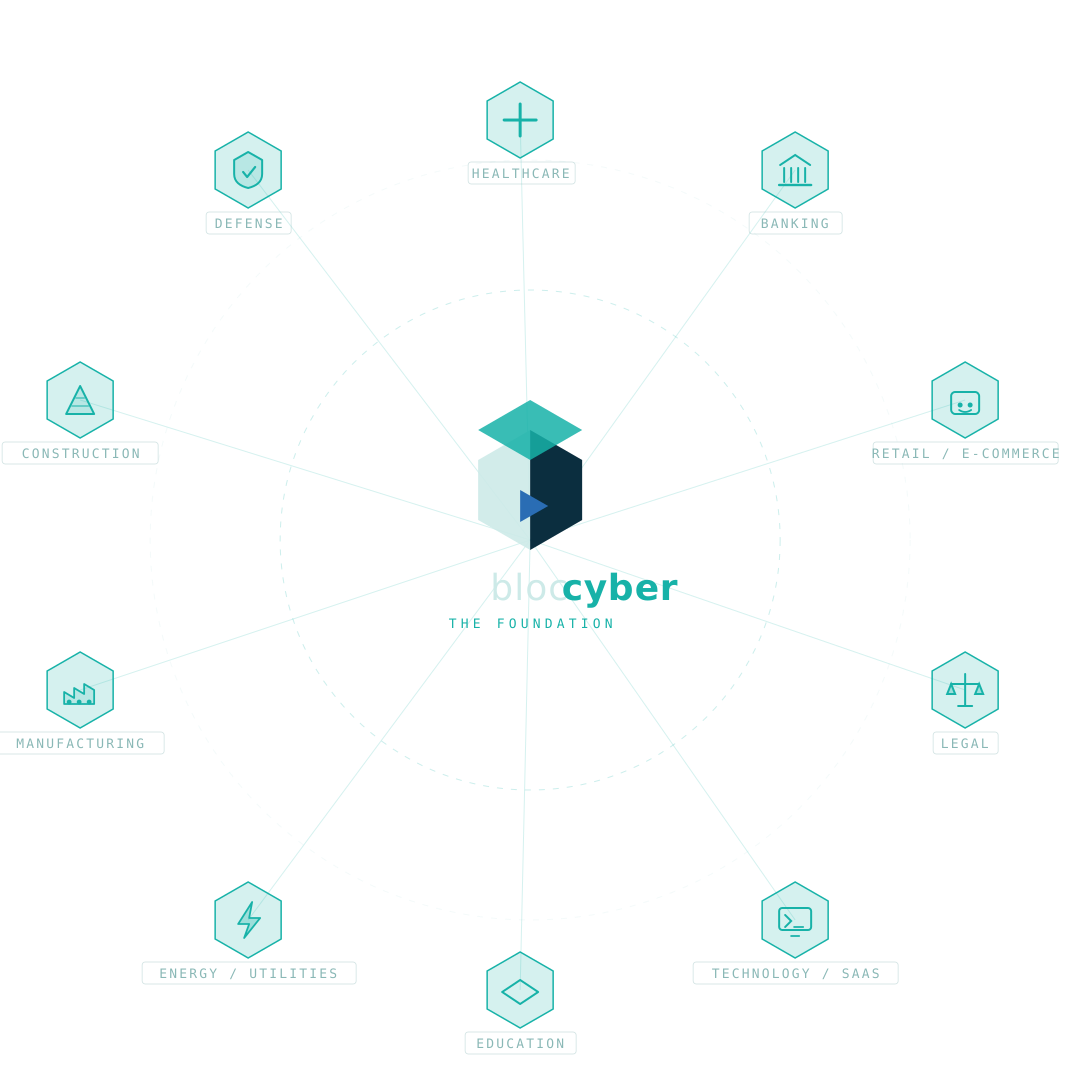
The Bloc system
One foundation.
Ten industry-specific builds.
The Bloc mark is built from stackable planes — each one a different angle on the same core structure. That’s how we place coverage: one underwriting discipline, tuned and re-tuned for every industry we serve.
Coverage
A policy you can actually read.
Structured in three clean blocs.
01
First-Party
Your direct losses when an incident hits your business.
✓
Incident response & forensics
✓
Business interruption
✓ Data restoration
✓ Cyber extortion / ransomware
✓ Funds transfer fraud
✓ Reputational harm
02
Third-Party
Your liability to clients, partners, and regulators.
✓
Network security liability
✓
Privacy liability (HIPAA, GDPR, state laws)
✓ Regulatory defense & fines
✓ PCI-DSS fines and assessments
✓ Media liability
✓ Breach notification costs
03
Specialty
Advanced coverages for complex risks and contracts.
✓
Technology E&O
✓
Social engineering fraud
✓ Contingent business interruption
✓ Systems failure
✓ Bricking & hardware replacement
✓ CMMC / regulatory-specific endorsements
Typical limits placed
$1M / $1M starter
$5M / $10M mid-market
$25M+ layered towers
Custom retentions
Common Questions
Cyber Liability Insurance, Explained
What does cyber insurance cover?
Cyber insurance covers the financial losses from a data breach or cyberattack. This includes breach response, legal fees, customer notification, ransomware, business interruption, and regulatory fines, depending on your policy.
Does my business really need cyber insurance?
Yes. Any business that stores customer data, processes payments, or relies on connected systems faces cyber risk. Small and mid-sized companies are frequent targets because they often have fewer defenses.
How much does cyber insurance cost?
Cost depends on your industry, revenue, data volume, and security practices. We market your risk to multiple carriers to find strong coverage at a competitive price. Request a quote for an exact figure.
What is the difference between first-party and third-party cyber coverage?
First-party coverage pays for your own losses, like data recovery and lost income. Third-party coverage pays for claims from others harmed by a breach on your systems.
How fast can I get a quote?
Most clients receive a quote in under 24 hours after we review the details of their business and exposure.
What should I do first after a cyberattack?
Contact us right away. We help you start breach response, connect you with forensic and legal support, and guide your claim so you contain the damage quickly.
Insights
Field notes from the placement desk.
What carriers are asking right now.



Start a quote
Tell us about your business.
We’ll come back with terms.
We’ll review your stack, your contracts, and your exposure — then place the program against the right markets. Most intakes get indicative terms back within one business day.
01
Quick intake
We only ask what the carriers actually need.
02
Benchmark
Side-by-side terms from 10+ specialty cyber carriers.
03
Bind
Plain-language policy review, e-signed and in force.