A single ransomware event can shut down operations for weeks. A misdirected wire transfer can drain an operating account in minutes. A data breach affecting customer records can trigger regulatory investigations across multiple states simultaneously. These are not hypothetical risks: they are the claims that cross underwriters' desks every day. For small and mid-market companies, the question is no longer whether cyber risk exists but how precisely your insurance program responds when a loss occurs. This guide to cyber liability, technology E&O, AI liability, ransomware, data breach response, and cyber crime coverage breaks down each coverage part so you can evaluate what your business actually needs, where common gaps hide, and what a policy form should include before you bind it.
Understanding the Foundations of Cyber Risk
Cyber insurance is not a single product. It is a collection of insuring agreements, each written to respond to a different type of loss. Some cover your own costs after an incident. Others defend you when a third party sues. A few address situations that have nothing to do with hacking at all, like a professional error in your software that causes a client's system to fail.
Understanding which agreement responds to which loss is the difference between a policy that pays and one that generates a coverage dispute. The sections below separate the four foundational coverage categories so you can see where each one starts and stops.
First-Party vs. Third-Party Cyber Liability
First-party coverage pays your own expenses: forensic investigation, data restoration, lost income during downtime, and crisis communications. Third-party coverage responds when someone else brings a claim against you, typically a customer, regulator, or business partner alleging that your security failure exposed their data or caused them financial harm.
Most policies bundle both into a single form, but the sublimits can vary dramatically between them. A $1 million aggregate might include only $100,000 for regulatory defense or $50,000 for crisis management. Reading the declarations page alone will not tell you this: you need to review the insuring agreements and their individual sublimits.
Technology E&O: Coverage for Professional Errors
Technology errors and omissions coverage applies when your product or service fails to perform as promised and a client suffers a financial loss as a result. This is distinct from cyber liability. A software bug that corrupts a client's database is a tech E&O claim. A hacker who exploits that same bug to steal data triggers the cyber liability section.
Companies that build, sell, or implement technology for others need both. Relying on a general professional liability policy often leaves a gap because most professional liability forms exclude technology-related claims or impose restrictive sub-limits on them.
Cyber Crime vs. Data Breach Response
Cyber crime coverage addresses financial theft: funds transfer fraud, social engineering, invoice manipulation, and similar schemes where a bad actor tricks your organization into sending money. Data breach response coverage handles the aftermath of unauthorized access to personal information: notification letters, credit monitoring, call center setup, and regulatory compliance.
These two coverage parts rarely overlap. A business email compromise that tricks your controller into wiring $200,000 to a fraudulent account is a cyber crime loss. The theft of 10,000 customer Social Security numbers from your server is a data breach. Your policy needs to address both scenarios with adequate limits.

By: Caden Braly
Founder of Bloc Cyber Insurance
INDEX
Understanding the Foundations of Cyber Risk
Core Coverage Comparison: General Liability vs. Cyber Insurance
Why Every Business Needs Dedicated Cyber Coverage
Protecting Against Modern Threats: Ransomware and AI Liability
The Financial Impact of Data Breach Response
Bloc Cyber and Its Licensed Producers Are Authorized to Place Cyber Coverage in All 50 U.S. States and The District of Columbia.
Cyber liability insurance covers the financial losses your business faces after a cyberattack or data breach. This page explains what the coverage includes, who needs it, what it costs, and how Bloc Cyber helps you get protected fast.
We start with a twenty-minute call to walk through your contracts, your draw process, your tech stack, and the last twelve months of attempted fraud. From there we go to market with ten-plus carriers, benchmark terms side-by-side, and present the options in plain language with recommended limits and retentions. Most intakes get indicative terms within one business day.
Core Coverage Comparison: General Liability vs. Cyber Insurance
One of the most common mistakes is assuming that a commercial general liability policy covers cyber events. It does not. CGL forms are written for bodily injury and property damage. Electronic data is explicitly excluded from the definition of "property" in most standard ISO forms.
| Coverage Element | Commercial General Liability | Cyber Insurance |
|---|---|---|
| Data breach notification costs | Not covered | Covered under first-party |
| Ransomware payment | Not covered | Covered (subject to sublimit) |
| Regulatory defense | Not covered | Covered under third-party |
| Business interruption from cyberattack | Not covered | Covered with waiting period |
| Funds transfer fraud | Not covered | Covered via cyber crime endorsement |
| Third-party lawsuit over data loss | Excluded or severely limited | Covered under third-party liability |
| Technology product failure | Not covered | Covered under Tech E&O |
This table makes the gap clear. If your risk profile includes any digital operations, customer data, or technology deliverables, a standalone cyber policy is not optional.

We start with a twenty-minute call to walk through your contracts, your draw process, your tech stack, and the last twelve months of attempted fraud. From there we go to market with ten-plus carriers, benchmark terms side-by-side, and present the options in plain language with recommended limits and retentions. Most intakes get indicative terms within one business day.
Why Every Business Needs Dedicated Cyber Coverage
The financial exposure from a cyber event is growing faster than most companies realize. The global average cost of a data breach reached $6 million per incident in 2026, and the average cost for U.S. organizations climbed to $11.5 million. For a company with 50 employees, even a fraction of that figure can threaten solvency.
Cyber incidents now rank as the top business risk globally, ahead of natural catastrophes and supply chain disruption. That ranking reflects not just the frequency of attacks but the regulatory and legal consequences that follow them. Breach notification laws in nearly every U.S. state impose strict timelines, and missing a deadline can multiply your exposure through statutory penalties.
A dedicated cyber policy is the only coverage form designed to respond across all of these loss categories simultaneously. Bloc Cyber structures placements at the insuring-agreement level specifically because a bundled, checkbox approach often leaves critical sublimits too low or waiting periods too long for a mid-market company's actual risk.
We start with a twenty-minute call to walk through your contracts, your draw process, your tech stack, and the last twelve months of attempted fraud. From there we go to market with ten-plus carriers, benchmark terms side-by-side, and present the options in plain language with recommended limits and retentions. Most intakes get indicative terms within one business day.
| Coverage Element | Commercial General Liability | Cyber Insurance |
|---|---|---|
| Data breach notification costs | Not covered | Covered under first-party |
| Ransomware payment | Not covered | Covered (subject to sublimit) |
| Regulatory defense | Not covered | Covered under third-party |
| Business interruption from cyberattack | Not covered | Covered with waiting period |
| Funds transfer fraud | Not covered | Covered via cyber crime endorsement |
| Third-party lawsuit over data loss | Excluded or severely limited | Covered under third-party liability |
| Technology product failure | Not covered | Covered under Tech E&O |
Protecting Against Modern Threats: Ransomware and AI Liability
The threat environment has shifted significantly in the past two years. Ransomware operators now target companies with annual revenues as low as $5 million, and AI-related liability claims are emerging as a new category that most existing policy forms do not address.
Ransomware Extortion and Business Interruption
Ransomware coverage typically includes two components: the extortion payment itself and the business interruption loss that accumulates while systems are offline. The extortion sublimit is usually capped well below the policy aggregate, and most forms impose a waiting period of 8 to 12 hours before business interruption coverage begins.
That waiting period matters. If your systems go down at 2 a.m. on a Friday and the waiting period is 12 hours, you are absorbing the first half-day of lost revenue yourself. Reviewing the waiting period and the hourly or daily indemnity calculation before binding is essential. This is exactly the kind of form-level detail that Bloc Cyber reviews with clients before a policy is placed.
Emerging AI Liability: Hallucinations and IP Infringement
If your company deploys AI tools that generate content, make recommendations, or interact with customers, you face a new category of exposure. An AI hallucination that provides false medical guidance, fabricates legal citations, or generates content that infringes on a third party's intellectual property can trigger claims that fall outside traditional cyber liability and tech E&O forms.
Most standard cyber policies written before 2025 do not explicitly address AI-generated outputs. Newer forms are beginning to include AI liability endorsements, but the scope varies widely. Some cover only defense costs. Others extend to indemnity for IP infringement claims arising from AI outputs. If your business uses generative AI in any client-facing capacity, confirming whether your policy form addresses this exposure is not optional.
We start with a twenty-minute call to walk through your contracts, your draw process, your tech stack, and the last twelve months of attempted fraud. From there we go to market with ten-plus carriers, benchmark terms side-by-side, and present the options in plain language with recommended limits and retentions. Most intakes get indicative terms within one business day.
The Financial Impact of Data Breach Response
A data breach is not a single event: it is a cascading series of expenses that can stretch over 12 to 18 months. The initial forensic investigation is just the beginning.
Forensic Investigations and Legal Notifications
Forensic investigation costs typically range from $20,000 to $100,000 for a mid-market company, depending on the complexity of the environment and the number of systems affected. Legal notification costs add another layer. Most states require individual written notice to affected residents, and several require notification to the state attorney general within 30 to 60 days.
Multi-state operations face compounding complexity. A company with customers in 15 states must comply with 15 different notification statutes, each with its own timeline, content requirements, and penalties for noncompliance. Bloc Cyber maintains state-by-state fluency in these triggers specifically because a missed deadline in one jurisdiction can escalate a manageable incident into a regulatory enforcement action.
Public Relations and Credit Monitoring Services
Crisis communications and credit monitoring are separate line items in most policy forms. PR costs can run $50,000 or more for a mid-sized breach, and credit monitoring for affected individuals is typically offered for 12 to 24 months. These expenses are often subject to their own sublimits within the policy.
The FBI's IC3 report documented billions in cybercrime losses in 2025, and a significant portion of those losses included post-breach expenses that businesses had not budgeted for. Your policy should cover these costs with sublimits that reflect actual market pricing, not arbitrary caps set years ago.
We start with a twenty-minute call to walk through your contracts, your draw process, your tech stack, and the last twelve months of attempted fraud. From there we go to market with ten-plus carriers, benchmark terms side-by-side, and present the options in plain language with recommended limits and retentions. Most intakes get indicative terms within one business day.
| Coverage Element | Commercial General Liability | Cyber Insurance |
|---|---|---|
| Data breach notification costs | Not covered | Covered under first-party |
| Ransomware payment | Not covered | Covered (subject to sublimit) |
| Regulatory defense | Not covered | Covered under third-party |
| Business interruption from cyberattack | Not covered | Covered with waiting period |
| Funds transfer fraud | Not covered | Covered via cyber crime endorsement |
| Third-party lawsuit over data loss | Excluded or severely limited | Covered under third-party liability |
| Technology product failure | Not covered | Covered under Tech E&O |
Common Questions About Business Cyber Insurance
Do I really need cyber insurance if I use a secure cloud provider?
Even if your provider is secure, your business is responsible for user errors and access management. Most breaches happen due to employee mistakes, not cloud infrastructure failure.
How much does a typical cyber policy cost for a small business?
Costs vary based on your revenue and the type of data you store. Most small businesses can expect to pay between $500 and $2,000 per year for basic coverage.
Does cyber insurance cover social engineering scams?
It depends on your policy. Many standard policies require a specific "Cyber Crime" endorsement to cover losses from being tricked into sending money to a fraudster.
Will my insurance pay the ransom if I get hacked?
Most policies include ransomware coverage that helps with negotiations and payment. However, insurers prefer to focus on data recovery and will only pay the ransom as a last resort.
What is the difference between Cyber Liability and Tech E&O?
Cyber Liability covers data breaches and hacks. Tech E&O covers you if your technology product or service fails to work and causes a financial loss for your client.
We start with a twenty-minute call to walk through your contracts, your draw process, your tech stack, and the last twelve months of attempted fraud. From there we go to market with ten-plus carriers, benchmark terms side-by-side, and present the options in plain language with recommended limits and retentions. Most intakes get indicative terms within one business day.
Public Relations and Credit Monitoring Services
Crisis communications and credit monitoring are separate line items in most policy forms. PR costs can run $50,000 or more for a mid-sized breach, and credit monitoring for affected individuals is typically offered for 12 to 24 months. These expenses are often subject to their own sublimits within the policy.
The FBI's IC3 report documented billions in cybercrime losses in 2025, and a significant portion of those losses included post-breach expenses that businesses had not budgeted for. Your policy should cover these costs with sublimits that reflect actual market pricing, not arbitrary caps set years ago.
Making the Right Choice for Your Risk Profile
Cyber coverage is not a commodity product you can evaluate on price alone. The policy form, its sublimits, its waiting periods, and its specific insuring agreements determine whether a claim gets paid or denied. A $1 million policy with a $25,000 sublimit for regulatory defense is not the same as a $1 million policy with a $500,000 sublimit, even if the premium is identical.
Your risk profile depends on your industry, the data you collect, the technology you deliver, and the states where your customers reside. A healthcare company with patient records faces different regulatory exposure than a SaaS company whose platform processes financial transactions. Both need cyber coverage, but the policy forms should look very different.
If you are purchasing your first cyber policy or renewing one you have not reviewed in detail, consider having a specialist walk through the actual policy form with you. Bloc Cyber's practice is built around this kind of form-level review. Request a coverage review so you understand exactly what your policy will and will not do before a claim tests it.
ABOUT THE AUTHOR
Caden Braly
— Founder, Bloc Cyber
I'm Caden Braly, founder of Bloc Cyber, the specialty cyber insurance arm of Braly Insurance. I built Bloc Cyber around one idea: businesses deserve coverage that actually responds when a cyberattack happens. I work closely with clients to understand their exposure, place the right policy through specialty carriers, and stand with them through the claim. My goal is simple — give every business straight answers and protection they can trust.
Full profile → caden@bloccyber.com LinkedIn
Industries We Protect
Cyber Coverage Built for Your Industry
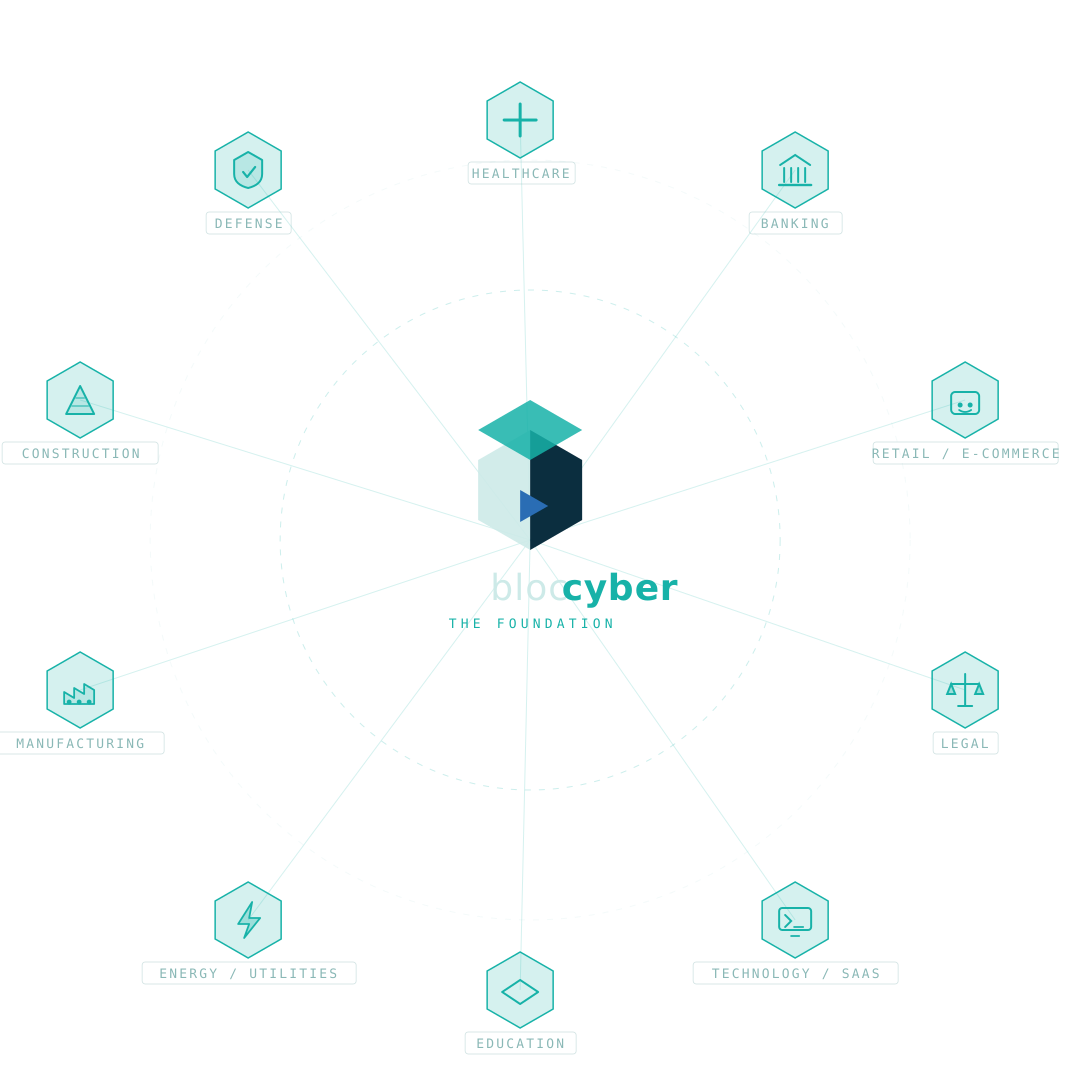
Every industry faces a different cyber threat, from patient records in healthcare to wire fraud in construction. Bloc Cyber matches coverage to the risks your sector actually faces, drawing on specialty carriers that understand your business. Find your industry below to see how we protect it.
Healthcare
Banking
Retail / E-Commerce
Legal
Technology / SaaS
Education
Energy / Utilities
Manufacturing
Construction
Defense

Healthcare
HIPAA-grade protection for patient data
725
healthcare breaches disclosed in 2024
HIPAA-grade protection for patient data
▣ Ransomware on EHR systems
▣ PHI exfiltration
▣ Medical device exploits
▣ Business email compromise
Sub-sectors we place
Hospitals and health systems
Physician practices and specialty clinics
Dental practices and DSOs
Behavioral health and addiction treatment centers
Medical billing and revenue cycle management firms
Typical turnaround for indication of terms: 1 business day.

Banking
Coverage that meets FFIEC and NYDFS expectations
$5.9M
average cost of a financial sector breach
Common threats we underwrite against
▣ Wire fraud and BEC
▣ Credential stuffing
▣ Third-party vendor risk
▣ Ransomware
Sub-sectors we place
Community banks
Credit unions
Mortgage lenders and loan originators
Wealth management and RIAs
Payment processors and merchant acquirers
Typical turnaround for indication of terms: 1 business day.

Retail / E-Commerce
PCI-DSS aligned coverage for every checkout
42%
of retailers hit by ransomware in the last year
Common threats we underwrite against
▣ Magecart / card skimming
▣ POS malware
▣ Account takeover
▣ Supply-chain intrusion
Sub-sectors we place
Direct-to-consumer (DTC) brands
Shopify and marketplace sellers
Brick-and-mortar multi-location retailers
Restaurants and QSR franchises
Grocery and specialty food retail
Typical turnaround for indication of terms: 1 business day.

Legal
Privilege, client files, and trust-account safeguards
1 in 4
law firms reported a breach in 2024
Common threats we underwrite against
▣ Wire-transfer fraud
▣ Privileged data theft
▣ Email account compromise
▣ Ransomware
Sub-sectors we place
AmLaw / large firms
Boutique litigation firms
Personal injury and plaintiffs’ firms
Estate planning and trust attorneys
Title and real estate closing firms
Typical turnaround for indication of terms: 1 business day.

Technology / SaaS
SOC 2 and ISO-aligned risk transfer
$4.88M
avg. cost of a SaaS breach in 2024
Common threats we underwrite against
▣ Supply-chain attacks
▣ Cloud misconfiguration
▣ Token and key theft
▣ Zero-day exploits
Sub-sectors we place
B2B SaaS platforms
Managed service providers (MSPs) and MSSPs
Fintech startups
AI and machine learning companies
Cloud hosting and infrastructure providers
Typical turnaround for indication of terms: 1 business day.

Education
FERPA-aligned coverage for student and research data
80%
of K–12 districts hit by ransomware since 2022
Common threats we underwrite against
▣ Ransomware on district networks
▣ Student PII theft
▣ Fake invoice fraud
▣ DDoS on exam platforms
Sub-sectors we place
K-12 public school districts
Private and charter schools
Colleges and universities
EdTech platforms
Tutoring, test prep, and online learning providers
Typical turnaround for indication of terms: 1 business day.

Energy / Utilities
OT and IT coverage for critical infrastructure
24/7
operational-tech monitoring requirements
Common threats we underwrite against
▣ ICS/SCADA intrusion
▣ Nation-state actors
▣ Ransomware on OT
▣ Insider threat
Sub-sectors we place
Municipal utilities (water, electric, gas)
Oil and gas operators
Pipeline and midstream companies
Renewable energy (solar, wind) developers
Electric cooperatives and rural utilities
Typical turnaround for indication of terms: 1 business day.

Manufacturing
Business interruption protection for connected plants
25%
of all ransomware attacks target manufacturing
Common threats we underwrite against
▣ Ransomware halting production
▣ IP theft
▣ ICS exploits
▣ Vendor compromise
Sub-sectors we place
Industrial and heavy equipment manufacturers
Food and beverage processing
Pharmaceutical and medical device manufacturers
Automotive and parts suppliers
Aerospace component manufacturers
Typical turnaround for indication of terms: 1 business day.

Construction
Protection for project files, wires, and jobsite tech
$200K+
average wire-fraud loss in construction
Common threats we underwrite against
▣ Wire-transfer diversion
▣ BEC on project payments
▣ Stolen bid data
▣ Ransomware
Sub-sectors we place
General contractors
Commercial HVAC, electrical, and plumbing subs
Civil and infrastructure contractors
Homebuilders and residential developers
Architecture and engineering (A&E) firms
Typical turnaround for indication of terms: 1 business day.

Defense
CMMC, DFARS, and CUI-compliant risk transfer
CMMC
2.0 compliance required by 2026
Common threats we underwrite against
▣ CUI exfiltration
▣ Nation-state APTs
▣ Supply-chain compromise
▣ Cleared-personnel targeting
Sub-sectors we place
DoD prime contractors
CMMC-regulated subcontractors
Defense software and systems integrators
Aerospace and satellite contractors
Federal IT and cleared staffing firms
Typical turnaround for indication of terms: 1 business day.
The Bloc system
One foundation.
Ten industry-specific builds.
The Bloc mark is built from stackable planes — each one a different angle on the same core structure. That’s how we place coverage: one underwriting discipline, tuned and re-tuned for every industry we serve.
Coverage
A policy you can actually read.
Structured in three clean blocs.
01
First-Party
Your direct losses when an incident hits your business.
✓
Incident response & forensics
✓
Business interruption
✓ Data restoration
✓ Cyber extortion / ransomware
✓ Funds transfer fraud
✓ Reputational harm
02
Third-Party
Your liability to clients, partners, and regulators.
✓
Network security liability
✓
Privacy liability (HIPAA, GDPR, state laws)
✓ Regulatory defense & fines
✓ PCI-DSS fines and assessments
✓ Media liability
✓ Breach notification costs
03
Specialty
Advanced coverages for complex risks and contracts.
✓
Technology E&O
✓
Social engineering fraud
✓ Contingent business interruption
✓ Systems failure
✓ Bricking & hardware replacement
✓ CMMC / regulatory-specific endorsements
Typical limits placed
$1M / $1M starter
$5M / $10M mid-market
$25M+ layered towers
Custom retentions
Common Questions
Cyber Liability Insurance, Explained
What does cyber insurance cover?
Cyber insurance covers the financial losses from a data breach or cyberattack. This includes breach response, legal fees, customer notification, ransomware, business interruption, and regulatory fines, depending on your policy.
Does my business really need cyber insurance?
Yes. Any business that stores customer data, processes payments, or relies on connected systems faces cyber risk. Small and mid-sized companies are frequent targets because they often have fewer defenses.
How much does cyber insurance cost?
Cost depends on your industry, revenue, data volume, and security practices. We market your risk to multiple carriers to find strong coverage at a competitive price. Request a quote for an exact figure.
What is the difference between first-party and third-party cyber coverage?
First-party coverage pays for your own losses, like data recovery and lost income. Third-party coverage pays for claims from others harmed by a breach on your systems.
How fast can I get a quote?
Most clients receive a quote in under 24 hours after we review the details of their business and exposure.
What should I do first after a cyberattack?
Contact us right away. We help you start breach response, connect you with forensic and legal support, and guide your claim so you contain the damage quickly.
Insights
Field notes from the placement desk.
What carriers are asking right now.



Start a quote
Tell us about your business.
We’ll come back with terms.
We’ll review your stack, your contracts, and your exposure — then place the program against the right markets. Most intakes get indicative terms back within one business day.
01
Quick intake
We only ask what the carriers actually need.
02
Benchmark
Side-by-side terms from 10+ specialty cyber carriers.
03
Bind
Plain-language policy review, e-signed and in force.