A Milwaukee manufacturer deploys a generative AI tool to draft customer-facing product specifications. Within weeks, the model hallucinates a tensile-strength rating that does not exist, a distributor relies on it, and a product fails in the field. The manufacturer's general liability carrier declines the claim, pointing to a technology services exclusion buried on page 14 of the policy form. This scenario is no longer hypothetical. Wisconsin businesses across Milwaukee, Madison, and Green Bay are adopting AI systems faster than their insurance programs can keep pace, and the gap between what a standard policy covers and what an AI-related claim actually costs is widening every quarter. AI liability insurance designed for hallucination errors, algorithmic bias, and agentic decision-making is now a distinct coverage category, and understanding how it works in Wisconsin is essential before a claim forces the lesson.
Navigating the AI Risk Landscape in Wisconsin
Wisconsin's commercial AI adoption has accelerated sharply since 2024. Mid-market firms, from healthcare networks in the Fox Valley to fintech startups on Madison's Capitol Square, are embedding AI into underwriting, hiring, customer service, and supply-chain management. That adoption creates exposures that traditional professional liability and general liability forms were never drafted to address.
Wisconsin became the 24th state to adopt the NAIC Model Bulletin on March 18, 2025, requiring insurers to maintain a written AI governance framework. The bulletin signals that regulators expect companies deploying AI, not just insurers, to demonstrate accountability for algorithmic outputs. If you are building, deploying, or reselling AI tools in this state, regulatory scrutiny is already pointed in your direction.
The Rise of Agentic AI in Milwaukee Tech Hubs
Milwaukee's growing tech corridor, anchored by the Third Ward and the Water Street innovation district, is home to firms building agentic AI systems: models that take actions, execute transactions, or make decisions without waiting for a human to approve each step. An agentic AI system processing insurance claims, for example, can autonomously assess, price, and settle a claim end to end. The liability profile of such a system is fundamentally different from a passive chatbot. When the AI acts on its own, the question of who bears responsibility for a wrong decision shifts from the operator to the software itself, and then back to whoever deployed it.
Why Standard Professional Liability Isn't Enough
Most professional liability and errors-and-omissions policies were written for human professional services. They contemplate a person giving advice, making a mistake, and causing a client financial harm. AI introduces failure modes that fall outside those assumptions: hallucinated outputs, training-data poisoning, prompt-injection attacks, and autonomous actions taken without any human in the loop. A standard E&O form may exclude "automated decision-making" or limit coverage to "professional services rendered by a licensed individual." If your policy form contains language like that, an AI-related claim will likely hit a coverage wall.

By: Caden Braly
Founder of Bloc Cyber Insurance
INDEX
Bloc Cyber and Its Licensed Producers Are Authorized to Place Cyber Coverage in All 50 U.S. States and The District of Columbia.
Cyber liability insurance covers the financial losses your business faces after a cyberattack or data breach. This page explains what the coverage includes, who needs it, what it costs, and how Bloc Cyber helps you get protected fast.
We start with a twenty-minute call to walk through your contracts, your draw process, your tech stack, and the last twelve months of attempted fraud. From there we go to market with ten-plus carriers, benchmark terms side-by-side, and present the options in plain language with recommended limits and retentions. Most intakes get indicative terms within one business day.
Protecting Against LLM Hallucinations and Output Errors
Core Coverage for AI Hallucinations and Output Errors
AI hallucination, where a model generates confident but factually wrong output, is the most common source of AI liability claims in 2026. Coverage for this risk typically sits within an AI-specific errors-and-omissions endorsement or a standalone AI liability policy. The insuring agreement should explicitly reference "erroneous, misleading, or fabricated outputs generated by an artificial intelligence system."
Look for policy language that addresses both first-party costs (your own remediation, notification, and reputational expenses) and third-party liability (claims brought by customers, regulators, or business partners harmed by the bad output). The distinction matters. A policy that covers only third-party claims will leave you paying out of pocket for the forensic investigation needed to identify how the hallucination occurred.
Protecting Madison Startups from Generative AI Errors
Madison's startup ecosystem, particularly SaaS companies deploying large language models, faces a specific exposure: their product is the AI output. If a Madison-based health-tech startup's diagnostic tool hallucinates a drug interaction that does not exist and a clinician acts on it, the resulting claim could involve bodily injury, professional malpractice, and product liability, all from a single erroneous output. A well-structured AI liability form can respond to the technology errors component, but only if the insuring agreement was drafted to include generative AI outputs. Bloc Cyber's approach of reviewing coverage at the insuring-agreement level, rather than relying on a bundled package, is particularly relevant here because a generic tech E&O policy may silently exclude generative AI.
Liability for Factual Inaccuracies and Data Corruption
Hallucination is one failure mode; data corruption is another. If your AI model ingests corrupted training data and produces systematically wrong outputs across thousands of transactions, the aggregate exposure can dwarf a single hallucination event. Policy forms should address both the "bad output" and the "bad input" scenarios. Check whether your form's definition of "wrongful act" or "technology services" includes data processing, data integrity, and model training, not just the delivery of a final output.

We start with a twenty-minute call to walk through your contracts, your draw process, your tech stack, and the last twelve months of attempted fraud. From there we go to market with ten-plus carriers, benchmark terms side-by-side, and present the options in plain language with recommended limits and retentions. Most intakes get indicative terms within one business day.
Addressing Algorithmic Bias and Discrimination Claims
Algorithmic bias claims are rising across financial services, hiring, and housing. When an AI model produces outcomes that disproportionately disadvantage a protected class, the deploying company faces regulatory enforcement, private lawsuits, and reputational damage. Wisconsin does not yet have a standalone algorithmic accountability statute, but federal enforcement through the EEOC, CFPB, and FTC applies to every Wisconsin business using AI in employment or consumer-facing decisions.
Regulatory Compliance for Green Bay Financial Firms
Green Bay's financial services sector, including regional banks, credit unions, and insurance agencies, is increasingly using AI for credit scoring, fraud detection, and claims triage. These applications carry disparate-impact risk under the Equal Credit Opportunity Act and the Fair Housing Act. A regulatory defense endorsement within your AI liability policy can cover the cost of responding to a federal investigation, including legal fees, expert witnesses, and remediation expenses. Without that endorsement, you are funding a six- or seven-figure regulatory defense from your operating budget.
Coverage for Disparate Impact and Hiring Bias Claims
If your company uses an AI-powered hiring tool, you should confirm that your policy form covers claims alleging disparate impact in employment screening. The EEOC has made clear that employers are liable for discriminatory outcomes produced by third-party AI tools, even if the employer did not build the algorithm. Coverage should include defense costs, settlements, and, where insurable, civil penalties. Some forms exclude employment practices liability entirely, so a standalone EPLI endorsement with an AI rider may be necessary.
We start with a twenty-minute call to walk through your contracts, your draw process, your tech stack, and the last twelve months of attempted fraud. From there we go to market with ten-plus carriers, benchmark terms side-by-side, and present the options in plain language with recommended limits and retentions. Most intakes get indicative terms within one business day.
| Coverage Element | Commercial General Liability | Cyber Insurance |
|---|---|---|
| Data breach notification costs | Not covered | Covered under first-party |
| Ransomware payment | Not covered | Covered (subject to sublimit) |
| Regulatory defense | Not covered | Covered under third-party |
| Business interruption from cyberattack | Not covered | Covered with waiting period |
| Funds transfer fraud | Not covered | Covered via cyber crime endorsement |
| Third-party lawsuit over data loss | Excluded or severely limited | Covered under third-party liability |
| Technology product failure | Not covered | Covered under Tech E&O |
Comparing AI Insurance Coverage Options
Not all AI liability products are structured the same way. Some carriers offer a standalone AI liability policy with its own aggregate limit. Others provide an AI endorsement bolted onto an existing technology E&O or cyber liability form. The right structure depends on your risk profile, your AI deployment scale, and how much autonomous decision-making your systems perform.
Comparison Table: Standard vs. AI-Specific Endorsements
| Feature | Standard Tech E&O | AI-Specific Endorsement | Standalone AI Liability |
|---|---|---|---|
| Hallucination / Output Errors | Typically excluded or silent | Covered, subject to sublimit | Covered, full policy limit |
| Algorithmic Bias Claims | Excluded | May include regulatory defense | Included with civil penalty coverage |
| Agentic AI Decisions | Excluded | Partial: may require human-in-the-loop | Covered, including autonomous acts |
| Training Data Liability | Not addressed | Limited | Addressed in definitions |
| Aggregate Limits | Shared with all tech E&O claims | Sublimited (often 25-50% of E&O limit) | Dedicated aggregate |
| Typical Premium Range | Included in E&O premium | $2,000 - $8,000 add-on | $5,000 - $25,000+ standalone |
The first dedicated AI liability insurance products carry up to $25 million in coverage, though only a handful of such products exist worldwide. Most mid-market Wisconsin businesses will find their options in the endorsement or lower-limit standalone category.
We start with a twenty-minute call to walk through your contracts, your draw process, your tech stack, and the last twelve months of attempted fraud. From there we go to market with ten-plus carriers, benchmark terms side-by-side, and present the options in plain language with recommended limits and retentions. Most intakes get indicative terms within one business day.
Determining Limits for Agentic AI Decision Making
Setting appropriate limits for AI liability requires a different calculus than traditional E&O. The key variable is autonomy: how many decisions does your AI system make without human review, and what is the potential financial impact of each one?
When AI Acts Without Human Intervention
Agentic AI systems that approve loans, adjust pricing, or authorize transactions create per-decision exposure. If your system processes 10,000 decisions per month and each carries an average exposure of $5,000, your theoretical maximum monthly loss is $50 million. No mid-market company is buying $50 million in AI liability coverage, but the exercise illustrates why per-occurrence and aggregate limits need to be set with AI transaction volume in mind, not just annual revenue.
Setting Aggregate Limits for Scaled Deployments
For companies scaling AI deployments across multiple business units or geographies, a single aggregate limit shared with your tech E&O may prove inadequate. Consider whether your policy form allows you to purchase a separate AI aggregate. At Bloc Cyber, the form-level review process examines sublimits, retentions, and waiting periods before binding, specifically to ensure that an AI claim does not erode the limit you need for a separate cyber or tech E&O event.
We start with a twenty-minute call to walk through your contracts, your draw process, your tech stack, and the last twelve months of attempted fraud. From there we go to market with ten-plus carriers, benchmark terms side-by-side, and present the options in plain language with recommended limits and retentions. Most intakes get indicative terms within one business day.
| Coverage Element | Commercial General Liability | Cyber Insurance |
|---|---|---|
| Data breach notification costs | Not covered | Covered under first-party |
| Ransomware payment | Not covered | Covered (subject to sublimit) |
| Regulatory defense | Not covered | Covered under third-party |
| Business interruption from cyberattack | Not covered | Covered with waiting period |
| Funds transfer fraud | Not covered | Covered via cyber crime endorsement |
| Third-party lawsuit over data loss | Excluded or severely limited | Covered under third-party liability |
| Technology product failure | Not covered | Covered under Tech E&O |
Common Questions About Wisconsin AI Insurance
FAQ: Does my general liability cover AI-generated bad advice?
Almost certainly not. General liability forms cover bodily injury and property damage, not financial harm from erroneous professional output. You need a technology E&O or AI liability form to respond to claims arising from AI-generated advice.
FAQ: What happens if our AI model shows bias against local applicants?
You face potential enforcement from the EEOC or CFPB, plus private lawsuits. An AI liability policy with a regulatory defense endorsement can cover investigation costs and defense fees. The policy form may also cover civil penalties where state law permits insurability.
FAQ: Are autonomous agents covered differently than chatbots?
Yes. Many AI endorsements require a "human-in-the-loop" for coverage to apply. If your system acts autonomously, you need a form that explicitly covers agentic AI decisions without that restriction. Read the definitions section of your policy carefully.
FAQ: How much does a basic AI policy cost in Madison?
For a Madison-based SaaS company with 20 to 100 employees, an AI endorsement on an existing tech E&O policy typically runs $2,000 to $8,000 annually. A standalone AI liability policy with dedicated limits will cost more, often $5,000 to $25,000 depending on the nature and volume of AI outputs.
We start with a twenty-minute call to walk through your contracts, your draw process, your tech stack, and the last twelve months of attempted fraud. From there we go to market with ten-plus carriers, benchmark terms side-by-side, and present the options in plain language with recommended limits and retentions. Most intakes get indicative terms within one business day.
Before You Buy a Policy
Wisconsin businesses deploying AI systems face a coverage gap that standard policies were not designed to fill. Hallucination errors, algorithmic bias claims, and agentic AI decisions each require specific insuring agreements, and the difference between a policy that responds and one that does not often comes down to a single definition or exclusion clause buried deep in the form.
Your priority before purchasing should be a line-by-line review of the policy form itself: the insuring agreements, the definitions of "AI system" and "wrongful act," the exclusions for autonomous decision-making, and the sublimit structure. A bundled package that checks a box is not the same as a policy placed at the endorsement level with your specific AI risk profile in mind.
If your company is building or deploying AI in Milwaukee, Madison, Green Bay, or anywhere in Wisconsin, request a coverage review so a specialist can walk through the policy form with you and identify where the gaps sit before a claim does it for you.
ABOUT THE AUTHOR
Caden Braly
— Founder, Bloc Cyber
I'm Caden Braly, founder of Bloc Cyber, the specialty cyber insurance arm of Braly Insurance. I built Bloc Cyber around one idea: businesses deserve coverage that actually responds when a cyberattack happens. I work closely with clients to understand their exposure, place the right policy through specialty carriers, and stand with them through the claim. My goal is simple — give every business straight answers and protection they can trust.
Full profile → caden@bloccyber.com LinkedIn
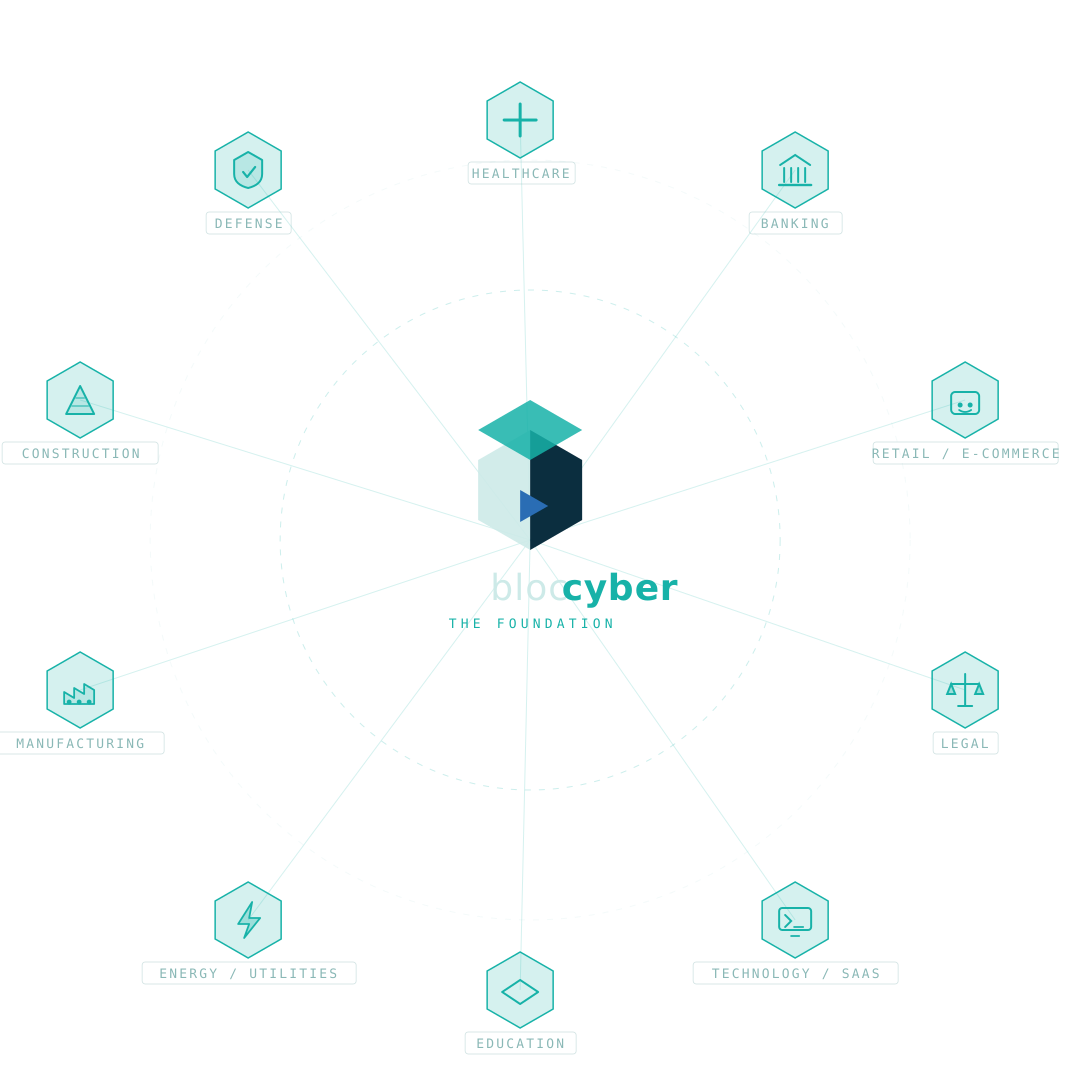
Industries We Protect
Cyber Coverage Built for Your Industry
Every industry faces a different cyber threat, from patient records in healthcare to wire fraud in construction. Bloc Cyber matches coverage to the risks your sector actually faces, drawing on specialty carriers that understand your business. Find your industry below to see how we protect it.
Healthcare
Banking
Retail / E-Commerce
Legal
Technology / SaaS
Education
Energy / Utilities
Manufacturing
Construction
Defense

Healthcare
HIPAA-grade protection for patient data
725
healthcare breaches disclosed in 2024
HIPAA-grade protection for patient data
▣ Ransomware on EHR systems
▣ PHI exfiltration
▣ Medical device exploits
▣ Business email compromise
Sub-sectors we place
Hospitals and health systems
Physician practices and specialty clinics
Dental practices and DSOs
Behavioral health and addiction treatment centers
Medical billing and revenue cycle management firms
Typical turnaround for indication of terms: 1 business day.

Banking
Coverage that meets FFIEC and NYDFS expectations
$5.9M
average cost of a financial sector breach
Common threats we underwrite against
▣ Wire fraud and BEC
▣ Credential stuffing
▣ Third-party vendor risk
▣ Ransomware
Sub-sectors we place
Community banks
Credit unions
Mortgage lenders and loan originators
Wealth management and RIAs
Payment processors and merchant acquirers
Typical turnaround for indication of terms: 1 business day.

Retail / E-Commerce
PCI-DSS aligned coverage for every checkout
42%
of retailers hit by ransomware in the last year
Common threats we underwrite against
▣ Magecart / card skimming
▣ POS malware
▣ Account takeover
▣ Supply-chain intrusion
Sub-sectors we place
Direct-to-consumer (DTC) brands
Shopify and marketplace sellers
Brick-and-mortar multi-location retailers
Restaurants and QSR franchises
Grocery and specialty food retail
Typical turnaround for indication of terms: 1 business day.

Legal
Privilege, client files, and trust-account safeguards
1 in 4
law firms reported a breach in 2024
Common threats we underwrite against
▣ Wire-transfer fraud
▣ Privileged data theft
▣ Email account compromise
▣ Ransomware
Sub-sectors we place
AmLaw / large firms
Boutique litigation firms
Personal injury and plaintiffs’ firms
Estate planning and trust attorneys
Title and real estate closing firms
Typical turnaround for indication of terms: 1 business day.

Technology / SaaS
SOC 2 and ISO-aligned risk transfer
$4.88M
avg. cost of a SaaS breach in 2024
Common threats we underwrite against
▣ Supply-chain attacks
▣ Cloud misconfiguration
▣ Token and key theft
▣ Zero-day exploits
Sub-sectors we place
B2B SaaS platforms
Managed service providers (MSPs) and MSSPs
Fintech startups
AI and machine learning companies
Cloud hosting and infrastructure providers
Typical turnaround for indication of terms: 1 business day.

Education
FERPA-aligned coverage for student and research data
80%
of K–12 districts hit by ransomware since 2022
Common threats we underwrite against
▣ Ransomware on district networks
▣ Student PII theft
▣ Fake invoice fraud
▣ DDoS on exam platforms
Sub-sectors we place
K-12 public school districts
Private and charter schools
Colleges and universities
EdTech platforms
Tutoring, test prep, and online learning providers
Typical turnaround for indication of terms: 1 business day.

Energy / Utilities
OT and IT coverage for critical infrastructure
24/7
operational-tech monitoring requirements
Common threats we underwrite against
▣ ICS/SCADA intrusion
▣ Nation-state actors
▣ Ransomware on OT
▣ Insider threat
Sub-sectors we place
Municipal utilities (water, electric, gas)
Oil and gas operators
Pipeline and midstream companies
Renewable energy (solar, wind) developers
Electric cooperatives and rural utilities
Typical turnaround for indication of terms: 1 business day.

Manufacturing
Business interruption protection for connected plants
25%
of all ransomware attacks target manufacturing
Common threats we underwrite against
▣ Ransomware halting production
▣ IP theft
▣ ICS exploits
▣ Vendor compromise
Sub-sectors we place
Industrial and heavy equipment manufacturers
Food and beverage processing
Pharmaceutical and medical device manufacturers
Automotive and parts suppliers
Aerospace component manufacturers
Typical turnaround for indication of terms: 1 business day.

Construction
Protection for project files, wires, and jobsite tech
$200K+
average wire-fraud loss in construction
Common threats we underwrite against
▣ Wire-transfer diversion
▣ BEC on project payments
▣ Stolen bid data
▣ Ransomware
Sub-sectors we place
General contractors
Commercial HVAC, electrical, and plumbing subs
Civil and infrastructure contractors
Homebuilders and residential developers
Architecture and engineering (A&E) firms
Typical turnaround for indication of terms: 1 business day.

Defense
CMMC, DFARS, and CUI-compliant risk transfer
CMMC
2.0 compliance required by 2026
Common threats we underwrite against
▣ CUI exfiltration
▣ Nation-state APTs
▣ Supply-chain compromise
▣ Cleared-personnel targeting
Sub-sectors we place
DoD prime contractors
CMMC-regulated subcontractors
Defense software and systems integrators
Aerospace and satellite contractors
Federal IT and cleared staffing firms
Typical turnaround for indication of terms: 1 business day.
The Bloc system
One foundation.
Ten industry-specific builds.
The Bloc mark is built from stackable planes — each one a different angle on the same core structure. That’s how we place coverage: one underwriting discipline, tuned and re-tuned for every industry we serve.
Coverage
A policy you can actually read.
Structured in three clean blocs.
01
First-Party
Your direct losses when an incident hits your business.
✓
Incident response & forensics
✓
Business interruption
✓ Data restoration
✓ Cyber extortion / ransomware
✓ Funds transfer fraud
✓ Reputational harm
02
Third-Party
Your liability to clients, partners, and regulators.
✓
Network security liability
✓
Privacy liability (HIPAA, GDPR, state laws)
✓ Regulatory defense & fines
✓ PCI-DSS fines and assessments
✓ Media liability
✓ Breach notification costs
03
Specialty
Advanced coverages for complex risks and contracts.
✓
Technology E&O
✓
Social engineering fraud
✓ Contingent business interruption
✓ Systems failure
✓ Bricking & hardware replacement
✓ CMMC / regulatory-specific endorsements
Typical limits placed
$1M / $1M starter
$5M / $10M mid-market
$25M+ layered towers
Custom retentions
Common Questions
Cyber Liability Insurance, Explained
What does cyber insurance cover?
Cyber insurance covers the financial losses from a data breach or cyberattack. This includes breach response, legal fees, customer notification, ransomware, business interruption, and regulatory fines, depending on your policy.
Does my business really need cyber insurance?
Yes. Any business that stores customer data, processes payments, or relies on connected systems faces cyber risk. Small and mid-sized companies are frequent targets because they often have fewer defenses.
How much does cyber insurance cost?
Cost depends on your industry, revenue, data volume, and security practices. We market your risk to multiple carriers to find strong coverage at a competitive price. Request a quote for an exact figure.
What is the difference between first-party and third-party cyber coverage?
First-party coverage pays for your own losses, like data recovery and lost income. Third-party coverage pays for claims from others harmed by a breach on your systems.
How fast can I get a quote?
Most clients receive a quote in under 24 hours after we review the details of their business and exposure.
What should I do first after a cyberattack?
Contact us right away. We help you start breach response, connect you with forensic and legal support, and guide your claim so you contain the damage quickly.
Insights
Field notes from the placement desk.
What carriers are asking right now.



Start a quote
Tell us about your business.
We’ll come back with terms.
We’ll review your stack, your contracts, and your exposure — then place the program against the right markets. Most intakes get indicative terms back within one business day.
01
Quick intake
We only ask what the carriers actually need.
02
Benchmark
Side-by-side terms from 10+ specialty cyber carriers.
03
Bind
Plain-language policy review, e-signed and in force.