| Feature | Commercial General Liability (CGL) | Cyber Privacy Liability |
|---|---|---|
| Covers bodily injury/property damage | Yes | No |
| Covers wrongful collection of data | No (excluded by most ISO forms) | Yes |
| Responds to BIPA claims | Typically excluded or sublimited | Yes, if biometric coverage is included |
| Covers regulatory defense | No | Yes, under most forms |
| Covers class action defense costs | Only for covered claims (rare for privacy) | Yes, subject to policy terms |
| Duty to defend vs. duty to reimburse | Duty to defend (standard) | Varies by form: check your policy |
A single viral post, a mishandled product recall, or a regulatory investigation can strip years of goodwill from a company in hours. The financial fallout from reputational damage is not hypothetical: lost business costs tied to data breaches alone reached $1.47 million on average in 2024, with customer attrition and diminished trust driving the bulk of that figure. For small and mid-market companies, that kind of loss can threaten survival. Reputational harm insurance exists to address precisely this exposure, covering the revenue decline, customer loss, crisis management costs, and forensic accounting work that follow a reputation-damaging event. Yet most business owners have never seen these provisions on a policy form, and many confuse them with standard cyber or general liability coverage. This guide breaks down each component of reputational harm coverage: post-incident revenue decline, customer attrition loss, brand rehabilitation expense, forensic accounting proof, and indemnity periods, so you can evaluate whether your current program actually responds to a reputational crisis or leaves you exposed.
Understanding Reputational Harm Insurance and Why It Matters
Reputational harm insurance is a specialized coverage grant, sometimes written as a standalone insuring agreement and sometimes attached as an endorsement to a cyber liability or management liability policy. Its purpose is narrow and specific: to indemnify the insured for measurable financial losses that result from damage to the company's public reputation after a covered event. This is not a catch-all for bad press. The trigger is typically a defined incident, such as a data breach, a regulatory action, or a covered wrongful act, that causes quantifiable harm to the business's standing and, by extension, its revenue.
What makes this coverage distinct from business interruption or general liability is the nature of the loss. A fire shuts down operations. A reputational crisis keeps the doors open but drives customers away. The policy form needs to address that gap explicitly, or it will not respond.
Defining Post-Incident Revenue Decline and Customer Attrition
Post-incident revenue decline refers to the measurable drop in gross revenue that follows a reputation-damaging event. Insurers typically compare pre-incident revenue baselines against post-incident actuals over a defined period. The gap, after accounting for normal market fluctuations, represents the covered loss.
Customer attrition loss is a subset of revenue decline, but it targets a specific driver: the departure of existing customers who leave because of the incident. A healthcare SaaS company that suffers a patient data breach, for example, may see contract non-renewals spike in the 90 days following public disclosure. The policy form may require the insured to demonstrate a causal link between the incident and the attrition, which is where forensic accounting becomes critical.
Common Triggers: Data Breaches, Ethical Scandals, and Product Recalls
Not every reputational hit triggers coverage. The policy form defines which events qualify, and the list is usually narrower than you would expect. Common covered triggers include:
- Data breaches involving personally identifiable information or protected health information
- Public disclosure of a regulatory investigation or enforcement action
- Product recalls that generate sustained negative media coverage
- Executive misconduct that becomes a matter of public record
A social media backlash over a marketing campaign, on the other hand, may not qualify unless the policy form specifically includes "adverse media events" as a trigger. This is exactly the kind of gap that shows up only when you read the insuring agreements line by line. Bloc Cyber's approach to policy placement starts at this level, reviewing whether the defined triggers on the form match the actual risk profile of the business before binding.

By: Caden Braly
Founder of Bloc Cyber Insurance
INDEX
Bloc Cyber and Its Licensed Producers Are Authorized to Place Cyber Coverage in All 50 U.S. States and The District of Columbia.
Cyber liability insurance covers the financial losses your business faces after a cyberattack or data breach. This page explains what the coverage includes, who needs it, what it costs, and how Bloc Cyber helps you get protected fast.
We start with a twenty-minute call to walk through your contracts, your draw process, your tech stack, and the last twelve months of attempted fraud. From there we go to market with ten-plus carriers, benchmark terms side-by-side, and present the options in plain language with recommended limits and retentions. Most intakes get indicative terms within one business day.
This comparison underscores why relying on a single policy form without reading the endorsements creates dangerous gaps. A thorough form-level review, the kind Bloc Cyber performs before placement, identifies whether your social engineering sublimit actually matches your average outbound wire size.
This comparison underscores why relying on a single policy form without reading the endorsements creates dangerous gaps. A thorough form-level review, the kind Bloc Cyber performs before placement, identifies whether your social engineering sublimit actually matches your average outbound wire size.
Core Coverage Components and Financial Protections
A well-structured reputational harm endorsement typically addresses three categories of loss: direct financial decline, crisis response costs, and the evidentiary burden of proving the loss. Each one operates under its own sublimit, retention, and conditions.
The financial decline component covers lost revenue and, in some forms, lost net income. Crisis response costs cover the expenses of managing the public fallout. The evidentiary component, often overlooked, covers the cost of hiring forensic accountants to build the proof the insurer itself will require before paying the claim. Understanding how these three interact is essential to knowing whether a policy form will actually perform under stress.
Brand Rehabilitation and Crisis Management Expenses
Brand rehabilitation expense coverage pays for the professional services needed to restore public confidence after a covered event. This typically includes crisis communications firms, public relations consultants, digital reputation management services, and in some cases, advertising campaigns designed to counteract negative coverage.
Most policy forms cap this coverage with a sublimit, often between $100,000 and $500,000, that sits well below the aggregate limit. If your company operates in a consumer-facing industry where brand perception directly drives revenue, a $100,000 sublimit for crisis management may be functionally inadequate. You should know the sublimit before you bind, not after the crisis hits. Some forms also impose a waiting period before rehabilitation expenses become payable, which can delay your ability to engage a crisis firm when speed matters most.
The Role of Forensic Accounting in Proving Financial Loss
Here is the part that catches most policyholders off guard: the insurer will not simply accept your claim that revenue dropped because of a reputational event. You need to prove causation, isolate the reputational impact from other market forces, and present the analysis in a format the adjuster and their own forensic team can verify.
Forensic accounting proof involves hiring a qualified firm to perform a detailed financial analysis. That firm will examine historical revenue trends, customer retention data, market conditions, competitor performance, and seasonal patterns to isolate the portion of your revenue decline attributable to the covered event. This work is expensive, often running $50,000 to $150,000 or more for a mid-market company. Some policy forms include a sublimit for forensic accounting costs. Others do not cover it at all, which means you bear the cost of proving the very loss you are trying to recover.
Navigating Indemnity Periods and Coverage Duration
The indemnity period defines how long the insurer will measure and pay for your reputational losses after the triggering event. Standard indemnity periods range from 6 to 18 months, though some forms allow extensions. The length of this period matters enormously because reputational damage does not follow a predictable timeline.
A data breach affecting 50,000 customer records might produce its worst revenue impact three to six months after disclosure, once contracts come up for renewal and prospects complete their due diligence. If your indemnity period is only six months, you may miss the tail end of the loss entirely. Conversely, an excessively long indemnity period can increase your premium without corresponding benefit if your industry tends to recover quickly. The right period depends on your sales cycle, contract renewal patterns, and customer concentration risk.

We start with a twenty-minute call to walk through your contracts, your draw process, your tech stack, and the last twelve months of attempted fraud. From there we go to market with ten-plus carriers, benchmark terms side-by-side, and present the options in plain language with recommended limits and retentions. Most intakes get indicative terms within one business day.
| Coverage Element | Standard Policy | Comprehensive Policy |
|---|---|---|
| Ransom Payment Sublimit | $100,000 - $250,000 | Full policy limit |
| Negotiation Services | Panel vendor only | Choice of vendor with pre-approval |
| Sanctions Screening | Included | Included with legal counsel |
| Data Restoration | Subject to separate sublimit | Included in aggregate limit |
| System Rebuild | Limited to like-kind replacement | Includes upgrades if required by regulation |
| Business Interruption Waiting Period | 12 - 24 hours | 6 - 8 hours |
| Dependent Business Interruption | Excluded | Included with sublimit |
Internal Threats: When Employee Information is Compromised
Employee data exposure is often overlooked in privacy liability planning. Your HR systems hold Social Security numbers, direct deposit information, health records, and sometimes biometric data. A breach of employee records triggers notification obligations under state law and can generate lawsuits from your own workforce.
Insider threats, whether from a disgruntled employee exfiltrating data or a payroll vendor suffering a breach, create exposure that sits at the intersection of cyber liability and employment practices liability. Not every cyber form covers claims brought by employees: some policies contain an "insured vs. insured" exclusion that bars coverage when the claimant is also an employee. This is a gap that must be identified during the placement process, not discovered during a claim.
Comparison: Standard Cyber Insurance vs. Reputational Harm Add-ons
Many business owners assume their cyber liability policy already covers reputational damage. Some forms do include a limited reputational harm grant, but the scope varies dramatically. Here is how a standard cyber policy compares to a dedicated reputational harm endorsement:
| Coverage Element | Standard Cyber Policy | Reputational Harm Endorsement |
|---|---|---|
| Revenue decline from breach | Rarely covered; business interruption tied to system downtime only | Covers revenue loss from reputational impact, not just downtime |
| Customer attrition | Not typically addressed | Explicitly covers measurable customer loss post-incident |
| Crisis communications | Often included with low sublimit ($25K-$50K) | Higher sublimits, broader scope of eligible services |
| Forensic accounting costs | Seldom included | May include sublimit for loss quantification expenses |
| Indemnity period | Tied to restoration period (days to weeks) | 6-18 months, measuring reputational recovery |
| Trigger | Network security event or data breach | Broader: may include regulatory actions, recalls, misconduct |
The distinction matters. A cyber policy's business interruption coverage typically stops paying once your systems are restored. Reputational harm coverage continues paying while your customers are still deciding whether to trust you again. If you are evaluating a cyber liability policy through Bloc Cyber, one of the first questions a specialist will address is whether the form's reputational harm grant, if any, actually matches the exposure.
Addressing Trade Secret Misappropriation
Trade secret claims often arise from employee departures, failed business partnerships, or vendor relationships that end badly. The Defend Trade Secrets Act provides a federal cause of action, and most states have adopted some version of the Uniform Trade Secrets Act. Defense costs in these cases can escalate quickly because they frequently involve emergency injunctive relief, forensic investigations, and depositions of former employees.
Not every IP insurance policy covers trade secret claims. Some forms limit coverage to patent, trademark, and copyright disputes only. If your company relies on proprietary algorithms, customer lists, manufacturing processes, or pricing models, confirm that your policy form explicitly includes trade secret misappropriation as a covered cause of action.
Managing Non-Practicing Entity (NPE) Litigation
Non-practicing entities, sometimes called patent trolls, hold patents they do not practice and generate revenue exclusively through licensing demands and litigation. These entities continue to present significant uncertainty for IP holders across technology, healthcare, and financial services sectors. NPE lawsuits are particularly costly because the plaintiff has no business operations to protect, which removes the usual incentives for early settlement.
Some IP insurance policies include specific NPE defense endorsements. Others exclude NPE claims entirely or apply reduced sublimits. If your company has received a licensing demand letter from an entity you have never heard of, that is the scenario these endorsements are designed to address.
Does my general liability policy cover invoice fraud? No. General liability responds to bodily injury and property damage claims, not financial losses from social engineering. You need a crime policy endorsement or a cyber liability policy with funds transfer fraud coverage.
What if my vendor's email was hacked, not mine? Many cyber forms still respond because the loss resulted from a social engineering attack directed at your employee. The key is whether the policy requires the compromise to originate from your own systems or simply requires that your employee was deceived into transferring funds.
Will the carrier pay if my team did not follow callback procedures? Possibly not. Callback verification is a common policy condition. If your form requires a phone call to a pre-established number before changing wire instructions and your team skipped it, the carrier has grounds to deny the claim.
Are there waiting periods for funds transfer fraud? Some forms impose a waiting period, typically 8 to 24 hours, before coverage attaches. This gives banks time to process recall requests. Ask your broker to confirm whether a waiting period applies to your form.
How much coverage do I need? Look at your largest single outbound payment over the past 12 months. Your sublimit should at least match that figure. A $100,000 sublimit is inadequate if you routinely wire $500,000 to a single vendor.
Can I buy standalone invoice fraud coverage? Standalone social engineering policies exist but are uncommon. Most buyers obtain this coverage through a cyber liability policy or a crime policy endorsement. The cyber route typically offers broader terms and higher sublimits.
We start with a twenty-minute call to walk through your contracts, your draw process, your tech stack, and the last twelve months of attempted fraud. From there we go to market with ten-plus carriers, benchmark terms side-by-side, and present the options in plain language with recommended limits and retentions. Most intakes get indicative terms within one business day.
| Coverage Element | Commercial General Liability | Cyber Insurance |
|---|---|---|
| Data breach notification costs | Not covered | Covered under first-party |
| Ransomware payment | Not covered | Covered (subject to sublimit) |
| Regulatory defense | Not covered | Covered under third-party |
| Business interruption from cyberattack | Not covered | Covered with waiting period |
| Funds transfer fraud | Not covered | Covered via cyber crime endorsement |
| Third-party lawsuit over data loss | Excluded or severely limited | Covered under third-party liability |
| Technology product failure | Not covered | Covered under Tech E&O |
Carriers view social engineering as a high-frequency, controllable-risk exposure. Unlike a data breach that may involve millions of records, a wire fraud loss is often the result of a single procedural failure. Insurers price and limit accordingly. A company with a $1 million crime policy might carry only $250,000 in social engineering coverage. If a single BEC attack costs $400,000, the policy pays $250,000 and the insured absorbs the rest. Some endorsements also apply co-insurance, meaning the carrier pays only 50% or 75% of the loss up to the sublimit. On a $250,000 sublimit with 50% co-insurance, your maximum recovery is $125,000.
Why Social Engineering Limits are Lower Than Policy Aggregate
Social engineering losses are almost always first-party: your company sent money to a criminal. The loss belongs to you, not to a customer or third party filing a claim against you. This distinction matters because third-party liability coverage on a cyber form will not respond. You need a first-party coverage grant, either within a crime policy or as a standalone endorsement, that explicitly names social engineering or fraudulent impersonation as a covered peril.
The Importance of First-Party vs. Third-Party Loss
Managing Non-Practicing Entity (NPE) Litigation
Strategic Steps for Calculating Potential Brand Value Loss
Quantifying potential brand value loss before an incident occurs is not guesswork. It requires a structured approach grounded in your actual financial data.
- Establish a revenue baseline using 24 to 36 months of historical data, broken out by customer segment and product line.
- Identify your customer concentration risk. If 30% of revenue comes from five clients, the attrition of even one post-incident could be catastrophic.
- Model a scenario using industry benchmarks. Companies in financial services and healthcare tend to experience higher customer churn after data breaches than those in manufacturing or education.
- Estimate crisis response costs by obtaining preliminary quotes from crisis communications firms. You want real numbers, not assumptions.
- Calculate the forensic accounting cost of proving a claim of your estimated size.
This exercise gives you a defensible basis for selecting coverage limits, sublimits, and indemnity periods. It also gives your broker the data needed to negotiate terms that reflect your actual risk.
We start with a twenty-minute call to walk through your contracts, your draw process, your tech stack, and the last twelve months of attempted fraud. From there we go to market with ten-plus carriers, benchmark terms side-by-side, and present the options in plain language with recommended limits and retentions. Most intakes get indicative terms within one business day.
Common Questions About Protecting Your Business Image
Does my general liability policy cover reputational damage? No. General liability covers bodily injury and property damage claims. Reputational harm from a data breach, scandal, or recall falls outside its scope entirely.
Can I buy reputational harm insurance as a standalone policy? Standalone forms exist but are uncommon for small and mid-market buyers. Most companies access this coverage as an endorsement or insuring agreement within a cyber liability or management liability policy.
How do I prove my revenue dropped because of a reputational event and not other factors? You will need forensic accounting analysis that isolates the reputational impact from seasonal trends, market shifts, and other variables. Some policy forms cover this cost; many do not.
What is the typical waiting period before coverage kicks in? Waiting periods vary by form, ranging from 24 hours to 30 days after the triggering event. The waiting period affects when losses begin to accrue for indemnity purposes.
Is reputational harm coverage triggered by negative social media posts? Only if the policy form specifically includes "adverse media events" as a defined trigger. Most forms require a more concrete event, such as a breach or regulatory action.
How long does an indemnity period usually last? Six to eighteen months is the standard range, though some forms allow extensions for an additional premium. The right duration depends on your sales cycle and how quickly your industry recovers from public trust events.
We start with a twenty-minute call to walk through your contracts, your draw process, your tech stack, and the last twelve months of attempted fraud. From there we go to market with ten-plus carriers, benchmark terms side-by-side, and present the options in plain language with recommended limits and retentions. Most intakes get indicative terms within one business day.
| Coverage Element | Commercial General Liability | Cyber Insurance |
|---|---|---|
| Data breach notification costs | Not covered | Covered under first-party |
| Ransomware payment | Not covered | Covered (subject to sublimit) |
| Regulatory defense | Not covered | Covered under third-party |
| Business interruption from cyberattack | Not covered | Covered with waiting period |
| Funds transfer fraud | Not covered | Covered via cyber crime endorsement |
| Third-party lawsuit over data loss | Excluded or severely limited | Covered under third-party liability |
| Technology product failure | Not covered | Covered under Tech E&O |
It depends on your policy. Many standard policies require a specific "Cyber Crime" endorsement to cover losses from being tricked into sending money to a fraudster.
Does cyber insurance cover social engineering scams?
Is deepfake fraud covered under standard impersonation terms?
It depends entirely on the policy language. Many forms written before 2024 reference only email or written communication. If the endorsement does not explicitly include voice or video impersonation, a deepfake-based claim may fall outside the coverage grant. Ask your broker to confirm the form addresses synthetic media.
Making the Right Choice for Your Risk Profile
Reputational harm coverage is not a commodity product you can compare on price alone. The value lives in the details: how the trigger is defined, whether forensic accounting costs are covered, how long the indemnity period runs, and whether the crisis management sublimit will actually fund a meaningful response.
For companies with 10 to 500 employees, the stakes are proportionally higher than for large enterprises. You likely lack the brand equity reserves that allow a Fortune 500 company to absorb a reputational hit and recover through sheer market presence. Your customer relationships are more concentrated, your margins are tighter, and your ability to self-fund a crisis response is limited.
The right approach is to have a specialist review the actual policy form before you bind, not after a claim forces you to read the fine print. If you are evaluating reputational harm coverage as part of a cyber liability program, request a consultation with Bloc Cyber so a specialist can walk through the insuring agreements, sublimits, and indemnity terms with you. Knowing what your policy actually covers, and where it stops, is the single most valuable step you can take before a crisis tests it.
ABOUT THE AUTHOR
Caden Braly
— Founder, Bloc Cyber
I'm Caden Braly, founder of Bloc Cyber, the specialty cyber insurance arm of Braly Insurance. I built Bloc Cyber around one idea: businesses deserve coverage that actually responds when a cyberattack happens. I work closely with clients to understand their exposure, place the right policy through specialty carriers, and stand with them through the claim. My goal is simple — give every business straight answers and protection they can trust.
Full profile → caden@bloccyber.com LinkedIn
Industries We Protect
Cyber Coverage Built for Your Industry
Every industry faces a different cyber threat, from patient records in healthcare to wire fraud in construction. Bloc Cyber matches coverage to the risks your sector actually faces, drawing on specialty carriers that understand your business. Find your industry below to see how we protect it.
Healthcare
Banking
Retail / E-Commerce
Legal
Technology / SaaS
Education
Energy / Utilities
Manufacturing
Construction
Defense

Healthcare
HIPAA-grade protection for patient data
725
healthcare breaches disclosed in 2024
HIPAA-grade protection for patient data
▣ Ransomware on EHR systems
▣ PHI exfiltration
▣ Medical device exploits
▣ Business email compromise
Sub-sectors we place
Hospitals and health systems
Physician practices and specialty clinics
Dental practices and DSOs
Behavioral health and addiction treatment centers
Medical billing and revenue cycle management firms
Typical turnaround for indication of terms: 1 business day.

Banking
Coverage that meets FFIEC and NYDFS expectations
$5.9M
average cost of a financial sector breach
Common threats we underwrite against
▣ Wire fraud and BEC
▣ Credential stuffing
▣ Third-party vendor risk
▣ Ransomware
Sub-sectors we place
Community banks
Credit unions
Mortgage lenders and loan originators
Wealth management and RIAs
Payment processors and merchant acquirers
Typical turnaround for indication of terms: 1 business day.

Retail / E-Commerce
PCI-DSS aligned coverage for every checkout
42%
of retailers hit by ransomware in the last year
Common threats we underwrite against
▣ Magecart / card skimming
▣ POS malware
▣ Account takeover
▣ Supply-chain intrusion
Sub-sectors we place
Direct-to-consumer (DTC) brands
Shopify and marketplace sellers
Brick-and-mortar multi-location retailers
Restaurants and QSR franchises
Grocery and specialty food retail
Typical turnaround for indication of terms: 1 business day.

Legal
Privilege, client files, and trust-account safeguards
1 in 4
law firms reported a breach in 2024
Common threats we underwrite against
▣ Wire-transfer fraud
▣ Privileged data theft
▣ Email account compromise
▣ Ransomware
Sub-sectors we place
AmLaw / large firms
Boutique litigation firms
Personal injury and plaintiffs’ firms
Estate planning and trust attorneys
Title and real estate closing firms
Typical turnaround for indication of terms: 1 business day.

Technology / SaaS
SOC 2 and ISO-aligned risk transfer
$4.88M
avg. cost of a SaaS breach in 2024
Common threats we underwrite against
▣ Supply-chain attacks
▣ Cloud misconfiguration
▣ Token and key theft
▣ Zero-day exploits
Sub-sectors we place
B2B SaaS platforms
Managed service providers (MSPs) and MSSPs
Fintech startups
AI and machine learning companies
Cloud hosting and infrastructure providers
Typical turnaround for indication of terms: 1 business day.

Education
FERPA-aligned coverage for student and research data
80%
of K–12 districts hit by ransomware since 2022
Common threats we underwrite against
▣ Ransomware on district networks
▣ Student PII theft
▣ Fake invoice fraud
▣ DDoS on exam platforms
Sub-sectors we place
K-12 public school districts
Private and charter schools
Colleges and universities
EdTech platforms
Tutoring, test prep, and online learning providers
Typical turnaround for indication of terms: 1 business day.

Energy / Utilities
OT and IT coverage for critical infrastructure
24/7
operational-tech monitoring requirements
Common threats we underwrite against
▣ ICS/SCADA intrusion
▣ Nation-state actors
▣ Ransomware on OT
▣ Insider threat
Sub-sectors we place
Municipal utilities (water, electric, gas)
Oil and gas operators
Pipeline and midstream companies
Renewable energy (solar, wind) developers
Electric cooperatives and rural utilities
Typical turnaround for indication of terms: 1 business day.

Manufacturing
Business interruption protection for connected plants
25%
of all ransomware attacks target manufacturing
Common threats we underwrite against
▣ Ransomware halting production
▣ IP theft
▣ ICS exploits
▣ Vendor compromise
Sub-sectors we place
Industrial and heavy equipment manufacturers
Food and beverage processing
Pharmaceutical and medical device manufacturers
Automotive and parts suppliers
Aerospace component manufacturers
Typical turnaround for indication of terms: 1 business day.

Construction
Protection for project files, wires, and jobsite tech
$200K+
average wire-fraud loss in construction
Common threats we underwrite against
▣ Wire-transfer diversion
▣ BEC on project payments
▣ Stolen bid data
▣ Ransomware
Sub-sectors we place
General contractors
Commercial HVAC, electrical, and plumbing subs
Civil and infrastructure contractors
Homebuilders and residential developers
Architecture and engineering (A&E) firms
Typical turnaround for indication of terms: 1 business day.

Defense
CMMC, DFARS, and CUI-compliant risk transfer
CMMC
2.0 compliance required by 2026
Common threats we underwrite against
▣ CUI exfiltration
▣ Nation-state APTs
▣ Supply-chain compromise
▣ Cleared-personnel targeting
Sub-sectors we place
DoD prime contractors
CMMC-regulated subcontractors
Defense software and systems integrators
Aerospace and satellite contractors
Federal IT and cleared staffing firms
Typical turnaround for indication of terms: 1 business day.
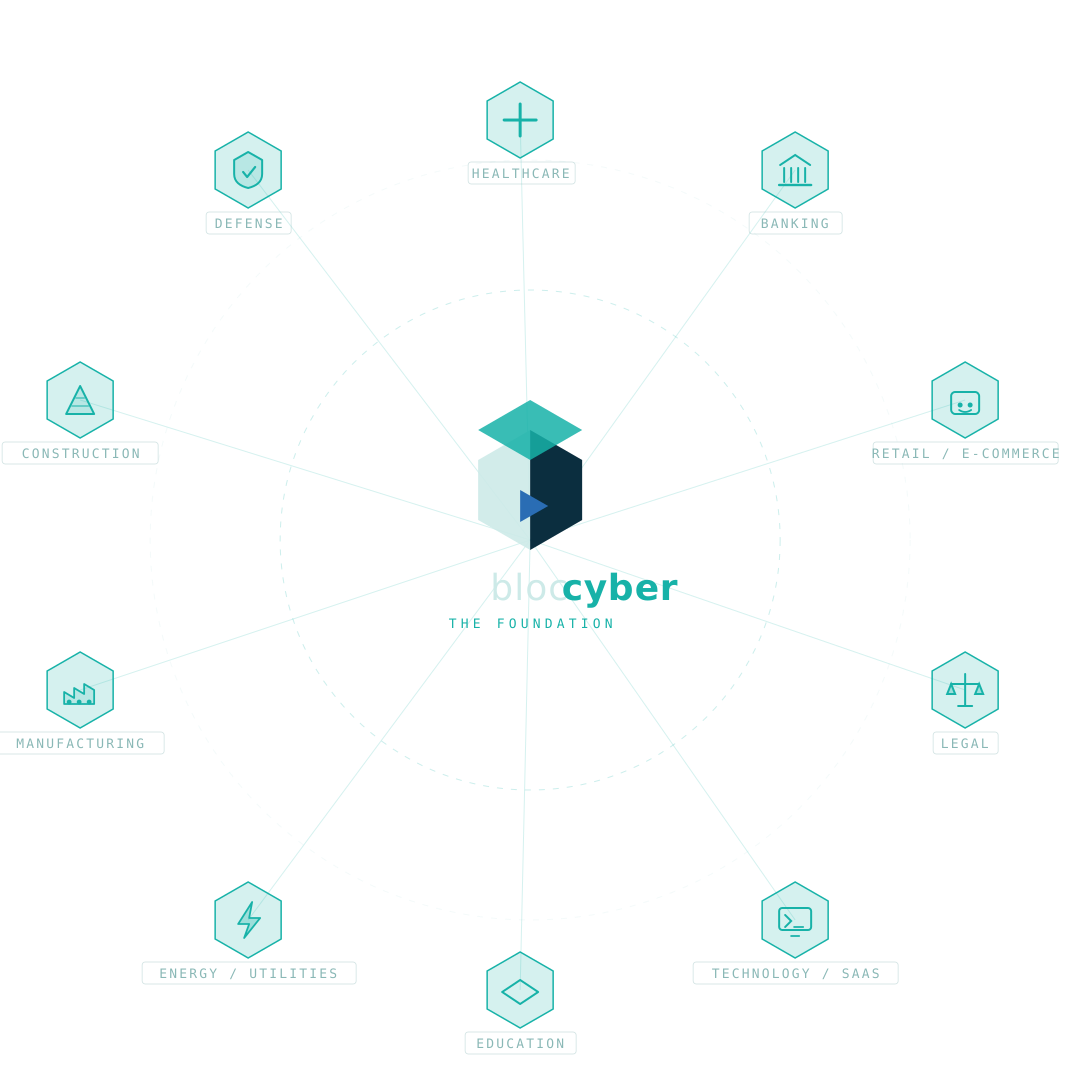
The Bloc system
One foundation.
Ten industry-specific builds.
The Bloc mark is built from stackable planes — each one a different angle on the same core structure. That’s how we place coverage: one underwriting discipline, tuned and re-tuned for every industry we serve.
Coverage
A policy you can actually read.
Structured in three clean blocs.
01
First-Party
Your direct losses when an incident hits your business.
✓
Incident response & forensics
✓
Business interruption
✓ Data restoration
✓ Cyber extortion / ransomware
✓ Funds transfer fraud
✓ Reputational harm
02
Third-Party
Your liability to clients, partners, and regulators.
✓
Network security liability
✓
Privacy liability (HIPAA, GDPR, state laws)
✓ Regulatory defense & fines
✓ PCI-DSS fines and assessments
✓ Media liability
✓ Breach notification costs
03
Specialty
Advanced coverages for complex risks and contracts.
✓
Technology E&O
✓
Social engineering fraud
✓ Contingent business interruption
✓ Systems failure
✓ Bricking & hardware replacement
✓ CMMC / regulatory-specific endorsements
Typical limits placed
$1M / $1M starter
$5M / $10M mid-market
$25M+ layered towers
Custom retentions
Common Questions
Cyber Liability Insurance, Explained
What does cyber insurance cover?
Cyber insurance covers the financial losses from a data breach or cyberattack. This includes breach response, legal fees, customer notification, ransomware, business interruption, and regulatory fines, depending on your policy.
Does my business really need cyber insurance?
Yes. Any business that stores customer data, processes payments, or relies on connected systems faces cyber risk. Small and mid-sized companies are frequent targets because they often have fewer defenses.
How much does cyber insurance cost?
Cost depends on your industry, revenue, data volume, and security practices. We market your risk to multiple carriers to find strong coverage at a competitive price. Request a quote for an exact figure.
What is the difference between first-party and third-party cyber coverage?
First-party coverage pays for your own losses, like data recovery and lost income. Third-party coverage pays for claims from others harmed by a breach on your systems.
How fast can I get a quote?
Most clients receive a quote in under 24 hours after we review the details of their business and exposure.
What should I do first after a cyberattack?
Contact us right away. We help you start breach response, connect you with forensic and legal support, and guide your claim so you contain the damage quickly.
Insights
Field notes from the placement desk.
What carriers are asking right now.



Start a quote
Tell us about your business.
We’ll come back with terms.
We’ll review your stack, your contracts, and your exposure — then place the program against the right markets. Most intakes get indicative terms back within one business day.
01
Quick intake
We only ask what the carriers actually need.
02
Benchmark
Side-by-side terms from 10+ specialty cyber carriers.
03
Bind
Plain-language policy review, e-signed and in force.