A single ransomware event can freeze operations for weeks, drain six figures from your accounts, and trigger regulatory scrutiny you did not anticipate. For small and mid-market companies across Michigan, the question is no longer whether a cyber extortion attempt will happen but how you will fund the response when it does. Ransomware insurance for Michigan businesses, covering ransom reimbursement, negotiation services, and data restoration, has moved from a nice-to-have line item to a financial necessity. Yet most owners, CFOs, and IT leads we speak with are unclear on what their policy actually pays, what it excludes, and where the sublimits quietly cap their recovery. This guide breaks down the coverage components, policy limits, and compliance considerations specific to Detroit, Grand Rapids, and Ann Arbor companies so you can evaluate your exposure with precision. Whether you are purchasing your first cyber liability policy or reviewing a renewal, the details below will help you ask the right questions before a claim forces the answers.
Understanding Michigan Ransomware Insurance and Local Risk
Michigan's regulatory environment is tightening. The state Department of Insurance and Financial Services has issued updated guidance on cybersecurity expectations for insurers and the businesses they cover. For companies operating under Michigan's Identity Theft Protection Act, a ransomware event that exposes personal data can trigger breach-notification obligations with strict timelines. Understanding those obligations before an incident occurs is part of responsible risk transfer planning.
The Ransomware Landscape in Detroit, Grand Rapids, and Ann Arbor
Ransomware attacks on Michigan-based companies increased by 40% in the first half of 2026, with the manufacturing sector being a primary target. Detroit's concentration of automotive suppliers, Grand Rapids' furniture and medical device manufacturers, and Ann Arbor's healthcare and education institutions each present distinct attack surfaces. Threat actors target these industries because operational downtime creates immediate pressure to pay.
A Grand Rapids manufacturer that loses access to its ERP system for five days faces not just recovery costs but contractual penalties from OEM customers. An Ann Arbor medical practice locked out of its electronic health records faces HIPAA enforcement on top of the extortion demand. The risk profile varies by city and sector, and so should the insurance response.
Why General Liability Isn't Enough for Cyber Extortion
General liability and commercial property policies were not written to respond to digital extortion. Most GL forms exclude electronic data from the definition of "tangible property," which means a ransomware event that destroys your files triggers no coverage at all. Even business owner policies (BOPs) with a cyber endorsement typically cap extortion coverage at $25,000 to $50,000, far below the average ransom demand in 2026.
A standalone cyber liability policy, placed at the insuring-agreement level rather than bundled as an afterthought, is the only reliable mechanism for transferring ransomware risk. This is precisely the kind of form-level review that a specialist agency like Bloc Cyber performs before binding: examining the extortion insuring agreement, the sublimits, the waiting periods, and the exclusions that determine whether the policy actually pays when you need it.

By: Caden Braly
Founder of Bloc Cyber Insurance
INDEX
Bloc Cyber and Its Licensed Producers Are Authorized to Place Cyber Coverage in All 50 U.S. States and The District of Columbia.
Cyber liability insurance covers the financial losses your business faces after a cyberattack or data breach. This page explains what the coverage includes, who needs it, what it costs, and how Bloc Cyber helps you get protected fast.
We start with a twenty-minute call to walk through your contracts, your draw process, your tech stack, and the last twelve months of attempted fraud. From there we go to market with ten-plus carriers, benchmark terms side-by-side, and present the options in plain language with recommended limits and retentions. Most intakes get indicative terms within one business day.
Core Components of Ransomware Coverage
Ransomware coverage is not a single line item. It is a collection of insuring agreements, each with its own trigger, limit, and conditions. Understanding the three primary components will help you evaluate any quote you receive.
Ransom Payment Reimbursement and Cryptocurrency Handling
Most cyber policies reimburse the actual ransom payment, but the mechanics matter. The policy form typically requires prior written consent from the carrier before any payment is made. If you pay first and report later, the claim may be denied. Cryptocurrency handling is another friction point: some forms cover the cost of acquiring Bitcoin or other digital currency at the exchange rate on the date of payment, while others cap reimbursement at the USD equivalent on the date the demand was made. The difference can be thousands of dollars depending on market volatility.
You should also confirm whether your policy covers payments to sanctioned entities. OFAC compliance screening is now standard practice among carriers, and a payment to a sanctioned group can void coverage entirely.
Professional Negotiation Services and Incident Response
A well-structured policy provides access to professional negotiators, typically through a pre-approved panel of incident response firms. These negotiators communicate directly with the threat actor, often reducing the demand by 40% to 60%. The policy should cover the cost of these services separately from the ransom payment itself, so negotiation fees do not erode your extortion sublimit.
Incident response also includes forensic investigation to determine how the attacker gained access, legal counsel to assess notification obligations, and crisis communications. Confirm whether your form provides these services on a first-party basis or requires you to retain vendors and seek reimbursement after the fact. The difference affects your cash flow during the most stressful week your company will ever experience.
Data Restoration and System Recovery Costs
Even after a decryption key is obtained, restoring data and rebuilding systems is expensive. Corrupted databases, re-imaging workstations, reconfiguring firewalls, and validating backup integrity all carry hard costs. A strong policy form covers these expenses under a "data restoration" or "digital asset" insuring agreement, separate from the extortion coverage.
One common gap: some forms exclude restoration costs if viable backups exist, on the theory that you should restore from backup rather than pay the ransom. If your backup strategy has gaps, or if the attacker compromised your backups before deploying the payload, this exclusion can leave you exposed. Michigan businesses with specific cyber insurance requirements should verify this language carefully.

We start with a twenty-minute call to walk through your contracts, your draw process, your tech stack, and the last twelve months of attempted fraud. From there we go to market with ten-plus carriers, benchmark terms side-by-side, and present the options in plain language with recommended limits and retentions. Most intakes get indicative terms within one business day.
Comparing Coverage: Basic vs. Comprehensive Cyber Policies
Not all cyber policies are built the same. The table below highlights the practical differences between a basic cyber endorsement and a comprehensive standalone form.
| Coverage Feature | Basic Cyber Endorsement | Comprehensive Standalone Policy |
|---|---|---|
| Ransom Payment Limit | $25,000 - $50,000 | $250,000 - $5,000,000+ |
| Negotiation Services | Not included | Pre-approved panel, carrier-funded |
| Data Restoration | Limited or excluded | Separate insuring agreement |
| Business Interruption | Rarely included | 72-hour to 12-hour waiting period |
| Regulatory Defense | Not included | Included with separate sublimit |
| Breach Notification Costs | Capped at $10,000 | Full statutory compliance coverage |
| OFAC Screening | Not addressed | Built into claims workflow |
| Forensic Investigation | Reimbursement only | Direct vendor engagement |
The gap between these two approaches is not subtle. A $50,000 endorsement on a BOP may satisfy a contract requirement, but it will not fund a real ransomware response. Small and mid-market Michigan businesses with 10 to 500 employees should evaluate standalone coverage as a baseline, not a luxury.
We start with a twenty-minute call to walk through your contracts, your draw process, your tech stack, and the last twelve months of attempted fraud. From there we go to market with ten-plus carriers, benchmark terms side-by-side, and present the options in plain language with recommended limits and retentions. Most intakes get indicative terms within one business day.
| Coverage Element | Commercial General Liability | Cyber Insurance |
|---|---|---|
| Data breach notification costs | Not covered | Covered under first-party |
| Ransomware payment | Not covered | Covered (subject to sublimit) |
| Regulatory defense | Not covered | Covered under third-party |
| Business interruption from cyberattack | Not covered | Covered with waiting period |
| Funds transfer fraud | Not covered | Covered via cyber crime endorsement |
| Third-party lawsuit over data loss | Excluded or severely limited | Covered under third-party liability |
| Technology product failure | Not covered | Covered under Tech E&O |
Navigating Policy Limits and Michigan Compliance
Policy limits and sublimits are where ransomware coverage gets complicated. The aggregate limit on your declarations page is not necessarily the amount available for an extortion event.
Determining Appropriate Sub-Limits for Extortion
Many carriers impose a sublimit on the extortion insuring agreement that is lower than the overall policy aggregate. A $1 million cyber policy might carry a $250,000 extortion sublimit, meaning your maximum recovery for a ransomware event is capped at one quarter of the stated limit. If the ransom demand is $400,000, you are self-insuring the remaining $150,000 regardless of your aggregate.
The retention, or deductible, also applies. A $25,000 retention on a $250,000 sublimit leaves you with $225,000 of effective coverage. Bloc Cyber reviews these sublimits and retentions at the form level before binding, so clients understand exactly what triggers the policy and where the coverage grant stops. Michigan's data security regulatory framework adds another layer: if a ransomware event triggers a breach-notification obligation, the costs of compliance may draw from a separate sublimit or share the same one.
Business Interruption and Lost Revenue Recovery
Ransomware does not just cost money to fix. It costs money every hour your systems are down. Business interruption coverage within a cyber policy reimburses lost net income and extra expenses incurred during the restoration period, but only after a waiting period expires. Waiting periods range from 6 to 24 hours depending on the form.
For a Grand Rapids distributor processing $200,000 in daily orders, a 12-hour waiting period represents $100,000 in unrecoverable revenue before coverage even begins. Negotiating a shorter waiting period at the time of placement, even if it increases the premium, is often worth the trade-off. The cyber insurance rate environment in Grand Rapids has stabilized enough in 2026 that this negotiation is realistic for most mid-market buyers.
We start with a twenty-minute call to walk through your contracts, your draw process, your tech stack, and the last twelve months of attempted fraud. From there we go to market with ten-plus carriers, benchmark terms side-by-side, and present the options in plain language with recommended limits and retentions. Most intakes get indicative terms within one business day.
Common Questions About Michigan Cyber Insurance
Does Michigan law require businesses to carry cyber insurance? No state statute mandates cyber insurance. However, Michigan's breach notification laws impose financial obligations after a data breach that most small businesses cannot fund out of pocket. A policy is the practical mechanism for meeting those obligations.
Will my cyber policy pay the ransom if the attacker is on the OFAC sanctions list? Most carriers will not authorize payment to a sanctioned entity. Your policy may still cover negotiation, forensic, and restoration costs, but the ransom itself would be excluded. This is a federal compliance issue, not a policy deficiency.
How long does it take to get a ransomware claim paid? Timelines vary, but most carriers begin funding incident response within 24 to 48 hours of notice. Ransom reimbursement typically follows within 30 to 60 days after the claim is documented and approved.
Can I choose my own incident response firm? Some policies require you to use a pre-approved panel. Others allow "consent" vendors at a reduced reimbursement rate. Check the form before you need it, not during the incident.
Do I need separate coverage for each Michigan office location? A single cyber policy typically covers all locations under one entity. If you operate separate legal entities in Detroit and Ann Arbor, each entity may need its own policy or be scheduled as a named insured.
What minimum cybersecurity controls do carriers require? Most carriers now require multi-factor authentication, endpoint detection and response, encrypted backups stored offline, and a documented incident response plan. Failing to maintain these controls can void coverage at the time of a claim. Michigan businesses should review current carrier requirements before applying.
We start with a twenty-minute call to walk through your contracts, your draw process, your tech stack, and the last twelve months of attempted fraud. From there we go to market with ten-plus carriers, benchmark terms side-by-side, and present the options in plain language with recommended limits and retentions. Most intakes get indicative terms within one business day.
| Coverage Element | Commercial General Liability | Cyber Insurance |
|---|---|---|
| Data breach notification costs | Not covered | Covered under first-party |
| Ransomware payment | Not covered | Covered (subject to sublimit) |
| Regulatory defense | Not covered | Covered under third-party |
| Business interruption from cyberattack | Not covered | Covered with waiting period |
| Funds transfer fraud | Not covered | Covered via cyber crime endorsement |
| Third-party lawsuit over data loss | Excluded or severely limited | Covered under third-party liability |
| Technology product failure | Not covered | Covered under Tech E&O |
It depends on your policy. Many standard policies require a specific "Cyber Crime" endorsement to cover losses from being tricked into sending money to a fraudster.
Does cyber insurance cover social engineering scams?
Your Next Steps for Securing Your Business
Ransomware coverage for Michigan businesses is not a commodity product you can purchase by price alone. The differences between policy forms, from extortion sublimits to waiting periods to OFAC compliance protocols, determine whether your coverage actually responds when a threat actor locks your systems. Detroit manufacturers, Grand Rapids distributors, and Ann Arbor healthcare organizations each face distinct exposures that demand form-level attention.
The single most valuable step you can take is having a specialist review the actual policy language before you bind. Not a summary, not a marketing brochure, but the insuring agreements and endorsements that define what your carrier will and will not pay. If you are evaluating ransomware and cyber extortion coverage for the first time, or if your renewal is approaching, request a coverage review so a Bloc Cyber specialist can walk through the form with you and identify any gaps before a claim does.
ABOUT THE AUTHOR
Caden Braly
— Founder, Bloc Cyber
I'm Caden Braly, founder of Bloc Cyber, the specialty cyber insurance arm of Braly Insurance. I built Bloc Cyber around one idea: businesses deserve coverage that actually responds when a cyberattack happens. I work closely with clients to understand their exposure, place the right policy through specialty carriers, and stand with them through the claim. My goal is simple — give every business straight answers and protection they can trust.
Full profile → caden@bloccyber.com LinkedIn
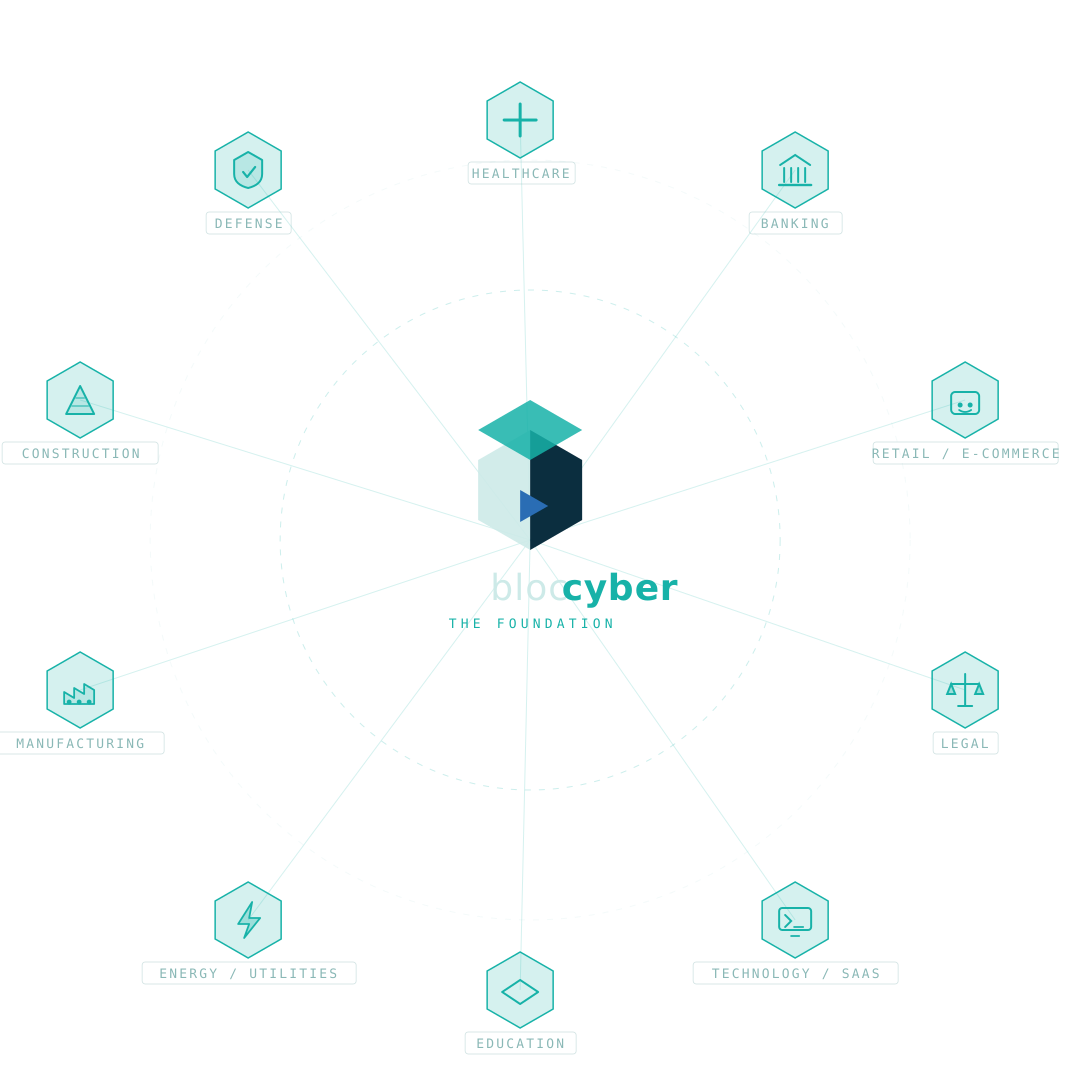
Industries We Protect
Cyber Coverage Built for Your Industry
Every industry faces a different cyber threat, from patient records in healthcare to wire fraud in construction. Bloc Cyber matches coverage to the risks your sector actually faces, drawing on specialty carriers that understand your business. Find your industry below to see how we protect it.
Healthcare
Banking
Retail / E-Commerce
Legal
Technology / SaaS
Education
Energy / Utilities
Manufacturing
Construction
Defense

Healthcare
HIPAA-grade protection for patient data
725
healthcare breaches disclosed in 2024
HIPAA-grade protection for patient data
▣ Ransomware on EHR systems
▣ PHI exfiltration
▣ Medical device exploits
▣ Business email compromise
Sub-sectors we place
Hospitals and health systems
Physician practices and specialty clinics
Dental practices and DSOs
Behavioral health and addiction treatment centers
Medical billing and revenue cycle management firms
Typical turnaround for indication of terms: 1 business day.

Banking
Coverage that meets FFIEC and NYDFS expectations
$5.9M
average cost of a financial sector breach
Common threats we underwrite against
▣ Wire fraud and BEC
▣ Credential stuffing
▣ Third-party vendor risk
▣ Ransomware
Sub-sectors we place
Community banks
Credit unions
Mortgage lenders and loan originators
Wealth management and RIAs
Payment processors and merchant acquirers
Typical turnaround for indication of terms: 1 business day.

Retail / E-Commerce
PCI-DSS aligned coverage for every checkout
42%
of retailers hit by ransomware in the last year
Common threats we underwrite against
▣ Magecart / card skimming
▣ POS malware
▣ Account takeover
▣ Supply-chain intrusion
Sub-sectors we place
Direct-to-consumer (DTC) brands
Shopify and marketplace sellers
Brick-and-mortar multi-location retailers
Restaurants and QSR franchises
Grocery and specialty food retail
Typical turnaround for indication of terms: 1 business day.

Legal
Privilege, client files, and trust-account safeguards
1 in 4
law firms reported a breach in 2024
Common threats we underwrite against
▣ Wire-transfer fraud
▣ Privileged data theft
▣ Email account compromise
▣ Ransomware
Sub-sectors we place
AmLaw / large firms
Boutique litigation firms
Personal injury and plaintiffs’ firms
Estate planning and trust attorneys
Title and real estate closing firms
Typical turnaround for indication of terms: 1 business day.

Technology / SaaS
SOC 2 and ISO-aligned risk transfer
$4.88M
avg. cost of a SaaS breach in 2024
Common threats we underwrite against
▣ Supply-chain attacks
▣ Cloud misconfiguration
▣ Token and key theft
▣ Zero-day exploits
Sub-sectors we place
B2B SaaS platforms
Managed service providers (MSPs) and MSSPs
Fintech startups
AI and machine learning companies
Cloud hosting and infrastructure providers
Typical turnaround for indication of terms: 1 business day.

Education
FERPA-aligned coverage for student and research data
80%
of K–12 districts hit by ransomware since 2022
Common threats we underwrite against
▣ Ransomware on district networks
▣ Student PII theft
▣ Fake invoice fraud
▣ DDoS on exam platforms
Sub-sectors we place
K-12 public school districts
Private and charter schools
Colleges and universities
EdTech platforms
Tutoring, test prep, and online learning providers
Typical turnaround for indication of terms: 1 business day.

Energy / Utilities
OT and IT coverage for critical infrastructure
24/7
operational-tech monitoring requirements
Common threats we underwrite against
▣ ICS/SCADA intrusion
▣ Nation-state actors
▣ Ransomware on OT
▣ Insider threat
Sub-sectors we place
Municipal utilities (water, electric, gas)
Oil and gas operators
Pipeline and midstream companies
Renewable energy (solar, wind) developers
Electric cooperatives and rural utilities
Typical turnaround for indication of terms: 1 business day.

Manufacturing
Business interruption protection for connected plants
25%
of all ransomware attacks target manufacturing
Common threats we underwrite against
▣ Ransomware halting production
▣ IP theft
▣ ICS exploits
▣ Vendor compromise
Sub-sectors we place
Industrial and heavy equipment manufacturers
Food and beverage processing
Pharmaceutical and medical device manufacturers
Automotive and parts suppliers
Aerospace component manufacturers
Typical turnaround for indication of terms: 1 business day.

Construction
Protection for project files, wires, and jobsite tech
$200K+
average wire-fraud loss in construction
Common threats we underwrite against
▣ Wire-transfer diversion
▣ BEC on project payments
▣ Stolen bid data
▣ Ransomware
Sub-sectors we place
General contractors
Commercial HVAC, electrical, and plumbing subs
Civil and infrastructure contractors
Homebuilders and residential developers
Architecture and engineering (A&E) firms
Typical turnaround for indication of terms: 1 business day.

Defense
CMMC, DFARS, and CUI-compliant risk transfer
CMMC
2.0 compliance required by 2026
Common threats we underwrite against
▣ CUI exfiltration
▣ Nation-state APTs
▣ Supply-chain compromise
▣ Cleared-personnel targeting
Sub-sectors we place
DoD prime contractors
CMMC-regulated subcontractors
Defense software and systems integrators
Aerospace and satellite contractors
Federal IT and cleared staffing firms
Typical turnaround for indication of terms: 1 business day.
The Bloc system
One foundation.
Ten industry-specific builds.
The Bloc mark is built from stackable planes — each one a different angle on the same core structure. That’s how we place coverage: one underwriting discipline, tuned and re-tuned for every industry we serve.
Coverage
A policy you can actually read.
Structured in three clean blocs.
01
First-Party
Your direct losses when an incident hits your business.
✓
Incident response & forensics
✓
Business interruption
✓ Data restoration
✓ Cyber extortion / ransomware
✓ Funds transfer fraud
✓ Reputational harm
02
Third-Party
Your liability to clients, partners, and regulators.
✓
Network security liability
✓
Privacy liability (HIPAA, GDPR, state laws)
✓ Regulatory defense & fines
✓ PCI-DSS fines and assessments
✓ Media liability
✓ Breach notification costs
03
Specialty
Advanced coverages for complex risks and contracts.
✓
Technology E&O
✓
Social engineering fraud
✓ Contingent business interruption
✓ Systems failure
✓ Bricking & hardware replacement
✓ CMMC / regulatory-specific endorsements
Typical limits placed
$1M / $1M starter
$5M / $10M mid-market
$25M+ layered towers
Custom retentions
Common Questions
Cyber Liability Insurance, Explained
What does cyber insurance cover?
Cyber insurance covers the financial losses from a data breach or cyberattack. This includes breach response, legal fees, customer notification, ransomware, business interruption, and regulatory fines, depending on your policy.
Does my business really need cyber insurance?
Yes. Any business that stores customer data, processes payments, or relies on connected systems faces cyber risk. Small and mid-sized companies are frequent targets because they often have fewer defenses.
How much does cyber insurance cost?
Cost depends on your industry, revenue, data volume, and security practices. We market your risk to multiple carriers to find strong coverage at a competitive price. Request a quote for an exact figure.
What is the difference between first-party and third-party cyber coverage?
First-party coverage pays for your own losses, like data recovery and lost income. Third-party coverage pays for claims from others harmed by a breach on your systems.
How fast can I get a quote?
Most clients receive a quote in under 24 hours after we review the details of their business and exposure.
What should I do first after a cyberattack?
Contact us right away. We help you start breach response, connect you with forensic and legal support, and guide your claim so you contain the damage quickly.
Insights
Field notes from the placement desk.
What carriers are asking right now.



Start a quote
Tell us about your business.
We’ll come back with terms.
We’ll review your stack, your contracts, and your exposure — then place the program against the right markets. Most intakes get indicative terms back within one business day.
01
Quick intake
We only ask what the carriers actually need.
02
Benchmark
Side-by-side terms from 10+ specialty cyber carriers.
03
Bind
Plain-language policy review, e-signed and in force.