Managing Ransomware and District-Wide Shutdowns
Ransomware attacks against schools rarely affect a single workstation. Attackers typically move laterally through the network before deploying encryption, locking down student information systems, email, grading platforms, and building access controls simultaneously. The operational disruption is immediate and total.
The start of the 2025 academic year was marked by a wave of cyberattacks that forced multiple districts into emergency response mode. Business interruption coverage in a cyber policy can respond to these events, but only if the waiting period and coverage trigger are properly structured. A 12-hour waiting period may be reasonable for a corporation; for a school district that must open its doors every morning, even a few hours of downtime creates cascading problems. The policy form matters here: the difference between "system failure" and "security event" as a trigger can determine whether the claim is paid.
A single ransomware incident can shut down a 50-person firm for two weeks, burn through six figures in forensic and legal fees, and trigger regulatory scrutiny that lasts months. For companies operating in Miami, Tampa, and Orlando, the exposure is compounded by Florida-specific notification deadlines, elevated fraud activity, and a regulatory environment that penalizes slow response. Cyber liability insurance built for Florida businesses is not a luxury line item: it is a financial backstop that determines whether a breach becomes a recoverable event or an existential one.
Florida firms pay roughly 18% more for cyber insurance premiums than the national average, driven by high fraud rates and regional disruption risks including hurricane-related infrastructure failures. That premium gap reflects real actuarial data, not arbitrary pricing. Understanding what your policy actually covers, where the coverage grant ends, and how Florida law shapes your obligations after a breach is the difference between buying protection and buying a false sense of security.
This guide breaks down breach response coverage, third-party privacy liability, and network security liability for Florida businesses, with specific attention to the compliance triggers, coverage limits, and policy gaps that matter most to companies in the state's three largest metro areas.
Understanding Cyber Risks for Florida Businesses
Florida ranks among the top five states for reported cybercrime losses year after year. The combination of a large population, heavy tourism-driven commerce, significant healthcare and financial services sectors, and frequent natural disasters creates a threat profile that is distinct from most other states. Hurricane seasons regularly force businesses onto backup systems, remote access configurations, and emergency communication channels, all of which expand the attack surface.
Small and mid-market companies, those with 10 to 500 employees, are disproportionately targeted because they hold valuable data but often lack dedicated security operations centers. A 2026 claims analysis showed that small business claims severity continues to rise, with ransomware and funds transfer fraud accounting for the largest share of losses.
The Florida Information Protection Act (FIPA) Compliance
FIPA imposes a 30-day deadline for breach notification once a breach is confirmed, one of the tighter windows in the country. If your breach affects more than 500 individuals, you must also notify the Florida Department of Legal Affairs. Failing to meet these deadlines can result in civil penalties of $1,000 per day, up to $500,000 for a single incident.
The statute covers "personal information" broadly, including name combined with Social Security numbers, financial account data, medical information, and online credentials. Healthcare organizations face overlapping obligations under HIPAA, and FIPA's requirements must be aligned with federal notification rules to avoid dual-track penalties. Your cyber liability policy should include regulatory defense coverage that responds specifically to FIPA investigations, not just general regulatory proceedings.
Why Miami, Tampa, and Orlando are High-Target Zones
Miami's concentration of international banking, trade finance, and real estate transactions makes it a prime target for business email compromise and wire fraud schemes. Tampa's growing technology corridor and defense contractor presence attract sophisticated threat actors seeking intellectual property and government-adjacent data. Orlando's tourism, hospitality, and theme park ecosystem processes enormous volumes of payment card data daily, creating persistent PCI DSS exposure.
Each metro area also has a distinct mix of regulated industries. A 100-employee medical practice in Tampa faces different breach notification triggers than a Miami-based fintech startup or an Orlando retail chain. The policy form needs to reflect those differences, and
managed SOC services tailored to Florida SMBs are increasingly part of the risk management conversation alongside insurance placement.

By: Caden Braly
Founder of Bloc Cyber Insurance
INDEX
Bloc Cyber and Its Licensed Producers Are Authorized to Place Cyber Coverage in All 50 U.S. States and The District of Columbia.
Cyber liability insurance covers the financial losses your business faces after a cyberattack or data breach. This page explains what the coverage includes, who needs it, what it costs, and how Bloc Cyber helps you get protected fast.
We start with a twenty-minute call to walk through your contracts, your draw process, your tech stack, and the last twelve months of attempted fraud. From there we go to market with ten-plus carriers, benchmark terms side-by-side, and present the options in plain language with recommended limits and retentions. Most intakes get indicative terms within one business day.
Statutory Notification and Breach Response Timelines
New York requires notification to affected individuals "in the most expedient time possible and without unreasonable delay." DFS-regulated entities face a tighter window: 72 hours to notify the superintendent after determining a cybersecurity event has occurred. Late 2024 amendments further tightened these notification obligations and expanded reporting triggers.
Your cyber policy's breach response coverage should include access to a panel of pre-approved breach counsel and forensic vendors who can mobilize within hours, not days. The retention (your deductible) on breach response costs matters here: a $25,000 retention on notification expenses can consume a significant portion of a small firm's incident budget before the policy begins to pay.
Core Components of a Cyber Liability Policy
A cyber liability policy is not a single coverage: it is a collection of insuring agreements, each with its own trigger, sublimit, retention, and set of conditions. Buying a policy without reading the form at the insuring-agreement level is like signing a lease without checking which utilities are included. The three pillars below form the backbone of most policies, but how each one is written varies enormously between carriers.
Breach Response and First-Party Expenses
First-party breach response coverage pays for the costs your company incurs directly after a cyber event. This typically includes forensic investigation, legal counsel to determine notification obligations, notification and credit monitoring services, public relations, and crisis management. Some forms also cover business interruption losses and extra expense during the restoration period.
The critical details live in the sublimits. A policy with a $1 million aggregate limit might cap forensic costs at $250,000 and business interruption at $500,000. If your forensic investigation alone exceeds that sublimit, you are paying the overage out of pocket. Bloc Cyber's approach is to review these sublimits before binding so you understand exactly where the coverage grant stops and what a gap would cost you during an actual claim.
Third-Party Privacy Liability and Legal Defense
Third-party coverage responds when someone else sues you or a regulator brings an action because of a privacy failure. This includes class action lawsuits from affected individuals, regulatory proceedings under FIPA or federal statutes, and contractual liability claims from business partners whose data you were holding. Defense costs are often included within the policy limit, meaning every dollar spent on lawyers reduces the amount available for settlements or judgments.
One common gap: many forms exclude claims arising from the insured's failure to comply with their own published privacy policy. If your website says you encrypt all customer data and you do not, the carrier may deny the claim. Florida's data breach notification requirements create specific obligations that, if missed, can become the basis for a regulatory action your policy was supposed to cover.
Network Security Liability and Data Recovery
Network security liability covers claims arising from a failure of your computer network security, including transmission of malware to third parties, denial-of-service attacks originating from your systems, and unauthorized access to third-party data stored on your network. Data recovery coverage pays to restore or recreate data that was corrupted or destroyed during an incident.
The waiting period for business interruption is a detail that catches many policyholders off guard. A 12-hour waiting period means you absorb the first 12 hours of downtime costs yourself. For a company processing $50,000 in daily revenue, that is a meaningful self-insured retention that does not appear as a dollar figure on the declarations page.

We start with a twenty-minute call to walk through your contracts, your draw process, your tech stack, and the last twelve months of attempted fraud. From there we go to market with ten-plus carriers, benchmark terms side-by-side, and present the options in plain language with recommended limits and retentions. Most intakes get indicative terms within one business day.
The distinction is not academic. A retailer relying on a BOP endorsement labeled "data breach" may find it provides only $50,000 in notification expense coverage with no provision for PCI assessments, forensic fees, or regulatory defense. That is not cyber insurance; it is a marketing feature.
Some regulatory proceedings involve parallel tracks: the regulator's formal action and an internal investigation your company runs simultaneously. Shadow defense counsel represents your company's interests during the regulatory process without formally appearing before the agency. Monitoring counsel may be appointed under a consent order to oversee your compliance.
The costs for these roles can be substantial. Certain policy forms cover shadow counsel fees as part of the defense cost grant, while others exclude them entirely. Court-appointed monitors in state enforcement actions have generated significant fees that strain organizational budgets, and whether your policy responds to those costs depends on how the form defines "defense costs" and "regulatory proceeding."
Shadow Defense and Monitoring Counsel Roles
Litigation Buyout: Ringfencing Known Legal Disputes
When a target company has pending or threatened litigation, the buyer faces a binary problem: either reduce the purchase price to account for the worst-case outcome or find a way to transfer the risk. A litigation buyout policy does the latter. The insurer assumes the financial exposure of the identified lawsuit in exchange for a one-time premium. Capital commitments in the litigation finance sector rebounded 23% after a two-year contraction, which has expanded insurer appetite for these placements.
| Coverage Element | Basic Cyber Policy | Comprehensive Cyber Policy |
|---|---|---|
| Breach notification costs | Included | Included |
| Forensic investigation | Included, often sublimited | Included with higher limits |
| Regulatory defense (state AG) | Included | Included |
| Government contract disputes | Typically excluded | May be covered by endorsement |
| DFARS 72-hour reporting costs | Not addressed | Can be included |
| Business interruption | Limited waiting period, sublimited** | Lower waiting period, full limit |
| Subcontractor/supply chain liability | Excluded | Available by endorsement |
| CUI-specific breach response | Not differentiated | Addressed in form language |
| False Claims Act defense | Excluded | May be available |
Comparing Coverage: General Liability vs. Cyber Insurance
Many business owners assume their general liability or business owner's policy covers cyber incidents. It does not. Standard GL and BOP forms contain explicit cyber exclusions, and even policies that once offered incidental cyber coverage have been amended to remove it. The ISO CG 21 06 and CG 21 07 endorsements, now standard on most GL forms, exclude liability arising out of electronic data loss.
Comparison Table: Identifying the Gaps
| Coverage Area | General Liability / BOP | Standalone Cyber Policy |
|---|---|---|
| Breach notification costs | Not covered | Covered under first-party |
| Forensic investigation | Not covered | Covered, subject to sublimit |
| Regulatory defense (FIPA) | Not covered | Covered under third-party |
| Business interruption from cyber event | Excluded | Covered after waiting period |
| Ransomware payment | Not covered | May be covered, varies by form |
| Third-party lawsuits (privacy) | Excluded by endorsement | Covered under privacy liability |
| Social engineering / wire fraud | Not covered | Optional endorsement |
| Data recovery | Not covered | Covered, subject to sublimit |
This table illustrates why a standalone cyber policy is not a duplication of existing coverage. It fills gaps that GL and property forms were never designed to address. State-level data breach notification laws create affirmative obligations that only a dedicated cyber form is structured to fund.
Real claims illustrate the exposure more clearly than abstract descriptions. Here are patterns that repeat across the technology sector:
- A SaaS company deploys a billing module that overcharges 12,000 end users over six months. The client demands $410,000 in restitution costs plus $150,000 in legal fees. The tech E&O form responds to the defense and indemnity obligation.
- An MSP fails to complete a server migration on schedule, causing a healthcare client to miss a compliance deadline. The healthcare company faces a regulatory fine and sues the MSP for $275,000. The policy form may respond, but only if the regulatory fine is not excluded as a penalty.
- A custom software vendor delivers an inventory management system that miscounts stock levels. The client loses $600,000 in downstream sales. The vendor's tech E&O policy covers defense costs and settlement, but a sublimit on the policy caps the payout at $500,000.
Average defense costs for technology professional liability claims range from $50,000 to $150,000 depending on complexity and jurisdiction. Settlement amounts vary widely, but six-figure demands are common even for small firms.
We start with a twenty-minute call to walk through your contracts, your draw process, your tech stack, and the last twelve months of attempted fraud. From there we go to market with ten-plus carriers, benchmark terms side-by-side, and present the options in plain language with recommended limits and retentions. Most intakes get indicative terms within one business day.
| Coverage Element | Commercial General Liability | Cyber Insurance |
|---|---|---|
| Data breach notification costs | Not covered | Covered under first-party |
| Ransomware payment | Not covered | Covered (subject to sublimit) |
| Regulatory defense | Not covered | Covered under third-party |
| Business interruption from cyberattack | Not covered | Covered with waiting period |
| Funds transfer fraud | Not covered | Covered via cyber crime endorsement |
| Third-party lawsuit over data loss | Excluded or severely limited | Covered under third-party liability |
| Technology product failure | Not covered | Covered under Tech E&O |
How much does a typical PCI forensic investigation cost?
PFI engagements range from $20,000 for a simple, small-merchant investigation to $120,000 or more for complex environments with multiple locations or e-commerce platforms. The card brands dictate the scope, and the merchant pays.
MFA for Remote Access and Privileged Accounts
Determining Coverage Limits and Policy Costs
Choosing the right limit is not about picking the highest number you can afford. It is about matching the limit to your actual exposure: the volume of records you hold, your revenue dependency on network uptime, your contractual obligations to clients, and your regulatory exposure under Florida law.
Factors Influencing Premiums for Florida Firms
Carriers evaluate several variables when pricing a Florida cyber policy:
- Annual revenue and industry classification
- Number of personally identifiable records stored or processed
- Security controls in place (MFA, endpoint detection, backup protocols)
- Prior claims history
- Whether the company has a written incident response plan
Florida's elevated premium environment means that demonstrating strong controls can yield meaningful savings. A company that has deployed multi-factor authentication across all remote access points and maintains offline backups will typically see a 10-20% reduction compared to a peer without those controls.
Calculating the Value of Your Digital Assets
Start by inventorying the data you hold. Count the records containing personal information, payment card data, or protected health information. Multiply by a per-record breach cost, the Ponemon Institute's 2025 figure was $169 per record for U.S. companies, and you have a rough floor for your first-party exposure.
Then add business interruption. Calculate your average daily revenue and estimate how many days a ransomware event would take you offline. A 200-employee professional services firm billing $80,000 per day that is down for seven days faces $560,000 in lost revenue before forensic, legal, or notification costs enter the picture. Bloc Cyber works through this math with clients during the placement process, ensuring the limit and sublimit structure reflects the company's actual financial exposure rather than an arbitrary round number.
We start with a twenty-minute call to walk through your contracts, your draw process, your tech stack, and the last twelve months of attempted fraud. From there we go to market with ten-plus carriers, benchmark terms side-by-side, and present the options in plain language with recommended limits and retentions. Most intakes get indicative terms within one business day.
No. A data breach or cyberattack is a cyber liability exposure, not a technology E&O exposure. You need a separate cyber liability policy form to cover breach response, notification costs, regulatory defense, and third-party claims arising from a security incident. Many technology companies carry both policies because the exposures are distinct.
FAQ: Does this cover me if I get hacked?
P2PE encrypts cardholder data from the point of interaction (the card reader) to the payment processor's secure decryption environment. A validated P2PE solution removes your systems from PCI scope for those transactions, which directly reduces both your compliance burden and your risk profile. Underwriters recognize P2PE as a meaningful risk reduction and may offer premium credits for merchants using validated solutions.
Implementing Point-to-Point Encryption (P2PE)
FAQ: Will my insurance pay for a CMMC assessment audit?
Standard cyber liability forms do not cover voluntary compliance audits. Some policies include a "cybersecurity improvement" sublimit after a covered incident, but pre-breach assessment costs are a business expense, not an insurable loss.
FAQ: How does NIST 800-171 compliance help if I get hacked?
Documented compliance demonstrates you took reasonable measures to protect CUI. This strengthens your defense in regulatory proceedings and can support your claim that the breach was not caused by negligence. It also reduces the likelihood of a carrier denying your claim based on failure to maintain represented security controls.
Common Questions About Florida Cyber Coverage
FAQ: What You Need to Know
Does my business need cyber insurance if I do not store customer data electronically? If you use email, process payments, or maintain any employee records digitally, you have cyber exposure. Even a compromised email account can lead to a wire fraud loss or a regulatory inquiry.
How quickly must I notify affected individuals under Florida law? FIPA requires notification within 30 days of confirming a breach. Missing this window can trigger statutory penalties and may also give your carrier grounds to dispute coverage if the delay worsened the loss.
Will my cyber policy cover a ransomware payment? Some policy forms include ransomware or cyber extortion coverage, but it is often subject to a separate sublimit and may require carrier consent before payment. The form language controls whether this coverage exists.
Does Florida's Digital Bill of Rights affect my obligations? Yes. The Florida Digital Bill of Rights grants consumers new data rights and imposes obligations on businesses meeting certain revenue or data-volume thresholds. Your cyber policy's regulatory defense coverage should account for these evolving requirements.
Can I add cyber coverage to my existing business owner's policy? Some carriers offer endorsements, but these are typically limited in scope, with low sublimits and narrow coverage grants. A standalone cyber policy provides broader protection and is the standard recommendation for any company with meaningful digital exposure.
What is the typical retention or deductible on a Florida cyber policy? Retentions for small and mid-market companies generally range from $2,500 to $25,000 depending on revenue, industry, and claims history. Higher retentions reduce premium but increase your out-of-pocket cost at claim time.
Real claims illustrate the exposure more clearly than abstract descriptions. Here are patterns that repeat across the technology sector:
- A SaaS company deploys a billing module that overcharges 12,000 end users over six months. The client demands $410,000 in restitution costs plus $150,000 in legal fees. The tech E&O form responds to the defense and indemnity obligation.
- An MSP fails to complete a server migration on schedule, causing a healthcare client to miss a compliance deadline. The healthcare company faces a regulatory fine and sues the MSP for $275,000. The policy form may respond, but only if the regulatory fine is not excluded as a penalty.
- A custom software vendor delivers an inventory management system that miscounts stock levels. The client loses $600,000 in downstream sales. The vendor's tech E&O policy covers defense costs and settlement, but a sublimit on the policy caps the payout at $500,000.
Average defense costs for technology professional liability claims range from $50,000 to $150,000 depending on complexity and jurisdiction. Settlement amounts vary widely, but six-figure demands are common even for small firms.
We start with a twenty-minute call to walk through your contracts, your draw process, your tech stack, and the last twelve months of attempted fraud. From there we go to market with ten-plus carriers, benchmark terms side-by-side, and present the options in plain language with recommended limits and retentions. Most intakes get indicative terms within one business day.
| Coverage Element | Commercial General Liability | Cyber Insurance |
|---|---|---|
| Data breach notification costs | Not covered | Covered under first-party |
| Ransomware payment | Not covered | Covered (subject to sublimit) |
| Regulatory defense | Not covered | Covered under third-party |
| Business interruption from cyberattack | Not covered | Covered with waiting period |
| Funds transfer fraud | Not covered | Covered via cyber crime endorsement |
| Third-party lawsuit over data loss | Excluded or severely limited | Covered under third-party liability |
| Technology product failure | Not covered | Covered under Tech E&O |
Will my policy pay for the fines if I'm not compliant?
This depends entirely on the policy form. Some forms cover PCI fines only if the merchant was making good-faith compliance efforts. Others exclude fines arising from known non-compliance. Read the exclusions carefully before binding.
How much does a typical PCI forensic investigation cost?
PFI engagements range from $20,000 for a simple, small-merchant investigation to $120,000 or more for complex environments with multiple locations or e-commerce platforms. The card brands dictate the scope, and the merchant pays.
What is the difference between a fine and an assessment?
A fine is a penalty for non-compliance with PCI DSS standards. An assessment is a cost-recovery mechanism: the card brands and issuing banks recoup their actual losses (fraud charges, card replacement costs) from the breached merchant. Both are financial obligations, but they arise from different triggers and may be treated differently under a policy form.
Making the Right Choice for Your Digital Protection
Florida businesses face a distinct combination of regulatory pressure, elevated threat activity, and natural disaster risk that makes cyber liability coverage a core part of any risk management program. The policy form itself, not the marketing brochure, determines whether you are protected. Sublimits, waiting periods, exclusions for failure to maintain security controls, and the scope of regulatory defense coverage all vary between carriers and between policy editions from the same carrier.
Your priority should be understanding what the policy actually says before you bind it. A form-level review that maps your specific exposure to the insuring agreements, sublimits, and conditions is the only way to know whether the coverage will perform when you need it. If you are purchasing or renewing a cyber policy for your Florida operation,
request a coverage review with a specialist who can walk through the policy form with you and identify where the gaps are before a claim finds them for you.
ABOUT THE AUTHOR
Caden Braly
— Founder, Bloc Cyber
I'm Caden Braly, founder of Bloc Cyber, the specialty cyber insurance arm of Braly Insurance. I built Bloc Cyber around one idea: businesses deserve coverage that actually responds when a cyberattack happens. I work closely with clients to understand their exposure, place the right policy through specialty carriers, and stand with them through the claim. My goal is simple — give every business straight answers and protection they can trust.
Full profile → caden@bloccyber.com LinkedIn
Industries We Protect
Cyber Coverage Built for Your Industry
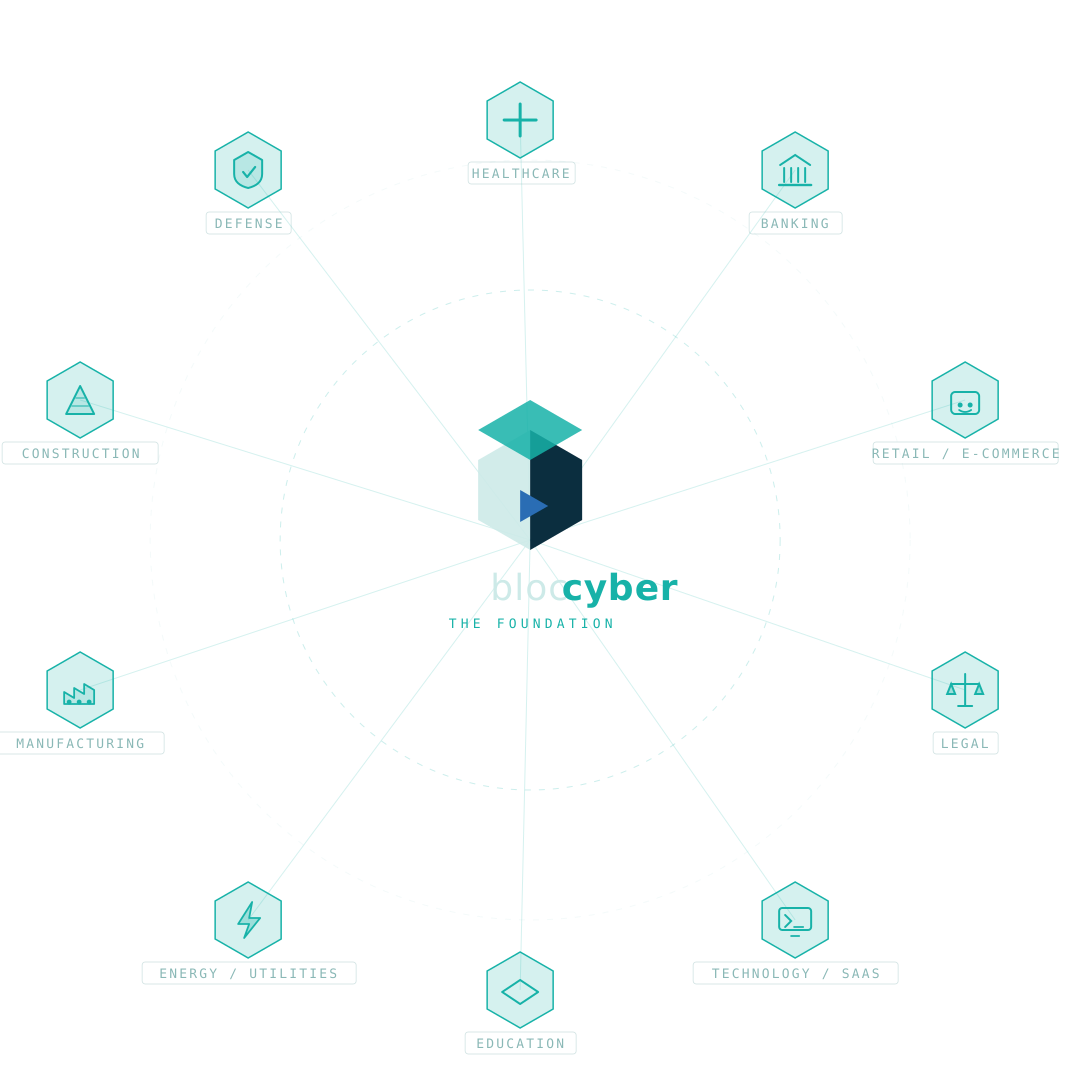
Every industry faces a different cyber threat, from patient records in healthcare to wire fraud in construction. Bloc Cyber matches coverage to the risks your sector actually faces, drawing on specialty carriers that understand your business. Find your industry below to see how we protect it.
Healthcare
Banking
Retail / E-Commerce
Legal
Technology / SaaS
Education
Energy / Utilities
Manufacturing
Construction
Defense

Healthcare
HIPAA-grade protection for patient data
725
healthcare breaches disclosed in 2024
HIPAA-grade protection for patient data
▣ Ransomware on EHR systems
▣ PHI exfiltration
▣ Medical device exploits
▣ Business email compromise
Sub-sectors we place
Hospitals and health systems
Physician practices and specialty clinics
Dental practices and DSOs
Behavioral health and addiction treatment centers
Medical billing and revenue cycle management firms
Typical turnaround for indication of terms: 1 business day.

Banking
Coverage that meets FFIEC and NYDFS expectations
$5.9M
average cost of a financial sector breach
Common threats we underwrite against
▣ Wire fraud and BEC
▣ Credential stuffing
▣ Third-party vendor risk
▣ Ransomware
Sub-sectors we place
Community banks
Credit unions
Mortgage lenders and loan originators
Wealth management and RIAs
Payment processors and merchant acquirers
Typical turnaround for indication of terms: 1 business day.

Retail / E-Commerce
PCI-DSS aligned coverage for every checkout
42%
of retailers hit by ransomware in the last year
Common threats we underwrite against
▣ Magecart / card skimming
▣ POS malware
▣ Account takeover
▣ Supply-chain intrusion
Sub-sectors we place
Direct-to-consumer (DTC) brands
Shopify and marketplace sellers
Brick-and-mortar multi-location retailers
Restaurants and QSR franchises
Grocery and specialty food retail
Typical turnaround for indication of terms: 1 business day.

Legal
Privilege, client files, and trust-account safeguards
1 in 4
law firms reported a breach in 2024
Common threats we underwrite against
▣ Wire-transfer fraud
▣ Privileged data theft
▣ Email account compromise
▣ Ransomware
Sub-sectors we place
AmLaw / large firms
Boutique litigation firms
Personal injury and plaintiffs’ firms
Estate planning and trust attorneys
Title and real estate closing firms
Typical turnaround for indication of terms: 1 business day.

Technology / SaaS
SOC 2 and ISO-aligned risk transfer
$4.88M
avg. cost of a SaaS breach in 2024
Common threats we underwrite against
▣ Supply-chain attacks
▣ Cloud misconfiguration
▣ Token and key theft
▣ Zero-day exploits
Sub-sectors we place
B2B SaaS platforms
Managed service providers (MSPs) and MSSPs
Fintech startups
AI and machine learning companies
Cloud hosting and infrastructure providers
Typical turnaround for indication of terms: 1 business day.

Education
FERPA-aligned coverage for student and research data
80%
of K–12 districts hit by ransomware since 2022
Common threats we underwrite against
▣ Ransomware on district networks
▣ Student PII theft
▣ Fake invoice fraud
▣ DDoS on exam platforms
Sub-sectors we place
K-12 public school districts
Private and charter schools
Colleges and universities
EdTech platforms
Tutoring, test prep, and online learning providers
Typical turnaround for indication of terms: 1 business day.

Energy / Utilities
OT and IT coverage for critical infrastructure
24/7
operational-tech monitoring requirements
Common threats we underwrite against
▣ ICS/SCADA intrusion
▣ Nation-state actors
▣ Ransomware on OT
▣ Insider threat
Sub-sectors we place
Municipal utilities (water, electric, gas)
Oil and gas operators
Pipeline and midstream companies
Renewable energy (solar, wind) developers
Electric cooperatives and rural utilities
Typical turnaround for indication of terms: 1 business day.

Manufacturing
Business interruption protection for connected plants
25%
of all ransomware attacks target manufacturing
Common threats we underwrite against
▣ Ransomware halting production
▣ IP theft
▣ ICS exploits
▣ Vendor compromise
Sub-sectors we place
Industrial and heavy equipment manufacturers
Food and beverage processing
Pharmaceutical and medical device manufacturers
Automotive and parts suppliers
Aerospace component manufacturers
Typical turnaround for indication of terms: 1 business day.

Construction
Protection for project files, wires, and jobsite tech
$200K+
average wire-fraud loss in construction
Common threats we underwrite against
▣ Wire-transfer diversion
▣ BEC on project payments
▣ Stolen bid data
▣ Ransomware
Sub-sectors we place
General contractors
Commercial HVAC, electrical, and plumbing subs
Civil and infrastructure contractors
Homebuilders and residential developers
Architecture and engineering (A&E) firms
Typical turnaround for indication of terms: 1 business day.

Defense
CMMC, DFARS, and CUI-compliant risk transfer
CMMC
2.0 compliance required by 2026
Common threats we underwrite against
▣ CUI exfiltration
▣ Nation-state APTs
▣ Supply-chain compromise
▣ Cleared-personnel targeting
Sub-sectors we place
DoD prime contractors
CMMC-regulated subcontractors
Defense software and systems integrators
Aerospace and satellite contractors
Federal IT and cleared staffing firms
Typical turnaround for indication of terms: 1 business day.
The Bloc system
One foundation.
Ten industry-specific builds.
The Bloc mark is built from stackable planes — each one a different angle on the same core structure. That’s how we place coverage: one underwriting discipline, tuned and re-tuned for every industry we serve.
Coverage
A policy you can actually read.
Structured in three clean blocs.
01
First-Party
Your direct losses when an incident hits your business.
✓
Incident response & forensics
✓
Business interruption
✓ Data restoration
✓ Cyber extortion / ransomware
✓ Funds transfer fraud
✓ Reputational harm
02
Third-Party
Your liability to clients, partners, and regulators.
✓
Network security liability
✓
Privacy liability (HIPAA, GDPR, state laws)
✓ Regulatory defense & fines
✓ PCI-DSS fines and assessments
✓ Media liability
✓ Breach notification costs
03
Specialty
Advanced coverages for complex risks and contracts.
✓
Technology E&O
✓
Social engineering fraud
✓ Contingent business interruption
✓ Systems failure
✓ Bricking & hardware replacement
✓ CMMC / regulatory-specific endorsements
Typical limits placed
$1M / $1M starter
$5M / $10M mid-market
$25M+ layered towers
Custom retentions
Common Questions
Cyber Liability Insurance, Explained
What does cyber insurance cover?
Cyber insurance covers the financial losses from a data breach or cyberattack. This includes breach response, legal fees, customer notification, ransomware, business interruption, and regulatory fines, depending on your policy.
Does my business really need cyber insurance?
Yes. Any business that stores customer data, processes payments, or relies on connected systems faces cyber risk. Small and mid-sized companies are frequent targets because they often have fewer defenses.
How much does cyber insurance cost?
Cost depends on your industry, revenue, data volume, and security practices. We market your risk to multiple carriers to find strong coverage at a competitive price. Request a quote for an exact figure.
What is the difference between first-party and third-party cyber coverage?
First-party coverage pays for your own losses, like data recovery and lost income. Third-party coverage pays for claims from others harmed by a breach on your systems.
How fast can I get a quote?
Most clients receive a quote in under 24 hours after we review the details of their business and exposure.
What should I do first after a cyberattack?
Contact us right away. We help you start breach response, connect you with forensic and legal support, and guide your claim so you contain the damage quickly.
Insights
Field notes from the placement desk.
What carriers are asking right now.



Start a quote
Tell us about your business.
We’ll come back with terms.
We’ll review your stack, your contracts, and your exposure — then place the program against the right markets. Most intakes get indicative terms back within one business day.
01
Quick intake
We only ask what the carriers actually need.
02
Benchmark
Side-by-side terms from 10+ specialty cyber carriers.
03
Bind
Plain-language policy review, e-signed and in force.