A Cambridge-based fintech startup deploys a credit-scoring model that systematically undervalues applicants from certain ZIP codes. A Worcester healthcare company's AI triage tool hallucinates a drug interaction that never existed, and a patient follows the advice. A Boston SaaS firm's autonomous agent executes a trade without human approval, triggering six-figure losses for a client. Each of these scenarios generates a liability claim, and in each case, the company's existing insurance portfolio almost certainly does not respond.
Massachusetts AI liability insurance is no longer a theoretical product category. It is a live coverage need for companies building, deploying, or reselling AI systems across the Commonwealth. The problem is that most commercial policies were written before large language models, agentic workflows, and algorithmic decision-making became standard business tools. The gap between what your policy says and what your AI actually does is where claims live. This guide breaks down the specific coverage areas that matter for businesses in Boston, Cambridge, Worcester, and across the state: hallucination and output errors, algorithmic bias claims, and autonomous AI decisions.
Navigating the AI Liability Landscape in Massachusetts
The Evolving Risk for Boston and Cambridge Tech Firms
Massachusetts is home to one of the densest concentrations of AI companies in the United States. The corridor running from Kendall Square through the Seaport District houses hundreds of firms whose primary product is an AI system or whose core operations depend on one. Worcester's growing tech sector adds another layer of exposure. For these businesses, AI is not a feature bolted onto an existing product; it is the product.
That distinction matters for insurance. Traditional technology errors and omissions policies were designed to cover software that behaves deterministically: if there is a bug, you can find it, reproduce it, and fix it. AI systems, particularly those built on large language models, produce probabilistic outputs. They can generate different answers to the same question, and some of those answers will be wrong. The risk profile is fundamentally different, and the insurance market is responding by pulling back. Major carriers have secured regulatory approval to exclude AI-related losses from standard commercial policies, with over 80% of such filings approved by Massachusetts regulators as of April 2026.
Regulatory Oversight and Massachusetts Privacy Standards
Massachusetts enforces some of the strictest data privacy and consumer protection standards in the country. The state's data security regulation, 201 CMR 17.00, imposes specific technical requirements on any entity handling personal information of Massachusetts residents. The Attorney General's office has been active in pursuing companies whose automated systems produce discriminatory outcomes, as demonstrated by a $2.5 million settlement involving AI-driven lending discrimination.
The Division of Insurance issued Bulletin 2024-10, which established expectations for insurers' own use of AI systems in underwriting and claims. While that bulletin targets carriers, it signals the regulatory direction for all industries. A growing body of existing Massachusetts laws already governs AI use across sectors, and companies that fail to align their coverage with these obligations face compounding exposure.

By: Caden Braly
Founder of Bloc Cyber Insurance
INDEX
Bloc Cyber and Its Licensed Producers Are Authorized to Place Cyber Coverage in All 50 U.S. States and The District of Columbia.
Cyber liability insurance covers the financial losses your business faces after a cyberattack or data breach. This page explains what the coverage includes, who needs it, what it costs, and how Bloc Cyber helps you get protected fast.
We start with a twenty-minute call to walk through your contracts, your draw process, your tech stack, and the last twelve months of attempted fraud. From there we go to market with ten-plus carriers, benchmark terms side-by-side, and present the options in plain language with recommended limits and retentions. Most intakes get indicative terms within one business day.
| Coverage Element | Commercial General Liability | Cyber Insurance |
|---|---|---|
| Data breach notification costs | Not covered | Covered under first-party |
| Ransomware payment | Not covered | Covered (subject to sublimit) |
| Regulatory defense | Not covered | Covered under third-party |
| Business interruption from cyberattack | Not covered | Covered with waiting period |
| Funds transfer fraud | Not covered | Covered via cyber crime endorsement |
| Third-party lawsuit over data loss | Excluded or severely limited | Covered under third-party liability |
| Technology product failure | Not covered | Covered under Tech E&O |
Core Coverage for AI Hallucinations and Output Errors
Protecting Against LLM Factual Inaccuracies
AI hallucinations are not edge cases. They are a known, recurring feature of large language model outputs. When your product generates a fabricated legal citation, an incorrect medical dosage, or a nonexistent regulatory requirement, the downstream harm to your client creates a liability event. The question is whether your policy form responds.
Most standard professional liability and tech E&O forms do not explicitly address AI-generated content errors. Some forms contain exclusions for "accuracy of data" or "content liability" that could eliminate coverage entirely. A hallucination claim often does not fit neatly into either a professional services failure or a software malfunction, which means it can fall into the gap between two policies. Specialized AI liability coverage addresses this by defining AI output errors as a covered peril, with clear triggering language tied to the system's generation of inaccurate, misleading, or fabricated information.
Professional Liability vs. Technology Errors and Omissions
Professional liability covers the advice or service you provide. Technology E&O covers the failure of your technology product. An AI system that generates advice blurs that line completely. If your chatbot gives a customer incorrect tax guidance, is that a professional services failure or a technology malfunction? The answer depends entirely on how the insuring agreements are written.
This is where form-level review matters. At Bloc Cyber, the practice is to read the actual policy language, identify where the coverage grant stops, and tell you what that gap will cost before a claim finds it. A bundled cyber policy sold as a checkbox will not distinguish between these two coverage triggers, and that ambiguity becomes the carrier's exit strategy at claim time.

We start with a twenty-minute call to walk through your contracts, your draw process, your tech stack, and the last twelve months of attempted fraud. From there we go to market with ten-plus carriers, benchmark terms side-by-side, and present the options in plain language with recommended limits and retentions. Most intakes get indicative terms within one business day.
Addressing Algorithmic Bias and Discrimination Claims
Fairness in Recruitment and Fintech Algorithms
Algorithmic bias claims are accelerating across two sectors in particular: hiring and financial services. If your company uses an AI tool to screen resumes, score candidates, or rank loan applicants, you face exposure under federal and state anti-discrimination statutes. Massachusetts has been especially aggressive here. The state AG's office has signaled that disparate impact caused by an algorithm carries the same legal weight as intentional discrimination.
State-level action targeting biased AI underwriting models is increasing across the country, and Massachusetts is at the front of that trend. Companies deploying hiring algorithms or credit-scoring models need coverage that explicitly names algorithmic discrimination as a covered claim. A general employment practices liability policy may not respond if the discriminatory act was committed by a machine rather than a human manager.
Coverage for Legal Defense and Settlement Costs
Bias claims are expensive to defend even when the underlying algorithm performed as designed. Expert witness costs for AI fairness audits, discovery involving proprietary model weights, and regulatory investigations by the Massachusetts Commission Against Discrimination all generate significant legal spend. A well-structured AI liability policy form may cover defense costs, regulatory fines where insurable by law, and settlement payments arising from algorithmic bias claims.
The retention structure matters as much as the limit. A $250,000 aggregate limit with a $50,000 retention might look adequate on paper, but a single MCAD investigation can consume both. You need to understand the per-claim and aggregate structure before binding, not after the demand letter arrives.
We start with a twenty-minute call to walk through your contracts, your draw process, your tech stack, and the last twelve months of attempted fraud. From there we go to market with ten-plus carriers, benchmark terms side-by-side, and present the options in plain language with recommended limits and retentions. Most intakes get indicative terms within one business day.
| Coverage Element | Commercial General Liability | Cyber Insurance |
|---|---|---|
| Data breach notification costs | Not covered | Covered under first-party |
| Ransomware payment | Not covered | Covered (subject to sublimit) |
| Regulatory defense | Not covered | Covered under third-party |
| Business interruption from cyberattack | Not covered | Covered with waiting period |
| Funds transfer fraud | Not covered | Covered via cyber crime endorsement |
| Third-party lawsuit over data loss | Excluded or severely limited | Covered under third-party liability |
| Technology product failure | Not covered | Covered under Tech E&O |
Insuring Agentic AI and Autonomous Decision-Making
Vicarious Liability for Autonomous Agent Actions
Agentic AI represents the sharpest edge of the liability question. When an AI system acts autonomously, executing transactions, sending communications, or making operational decisions without human approval, the company that deployed it bears responsibility for the outcome. Traditional liability frameworks assume a human decision-maker somewhere in the chain. Agentic AI removes that assumption.
The insurance industry's retreat from AI risk has created a vacuum that specialty markets are beginning to fill. Companies like those profiled by industry observers tracking AI insurance startups are writing policies specifically designed for autonomous agent liability. For a Boston or Cambridge firm deploying agentic systems, the question is not whether you need this coverage but how much autonomy your system exercises and what the maximum single-event loss looks like.
Setting Appropriate Coverage Limits for High-Stakes Automation
Limit adequacy depends on three variables: the value of the decisions your AI makes, the volume of those decisions, and the regulatory environment governing your sector. A healthcare AI making triage recommendations carries different exposure than a marketing AI personalizing email subject lines.
For firms in financial services or healthcare, $1 million in aggregate coverage may be insufficient for a single claim. The right approach is to model your worst realistic loss scenario, factor in defense costs (which often erode the limit), and set coverage accordingly. Bloc Cyber's practice of reviewing sublimits, retentions, and waiting periods at the form level before binding ensures you understand exactly what triggers the policy and where the ceiling sits.
A data breach is not a single event: it is a cascading series of expenses that can stretch over 12 to 18 months. The initial forensic investigation is just the beginning.
We start with a twenty-minute call to walk through your contracts, your draw process, your tech stack, and the last twelve months of attempted fraud. From there we go to market with ten-plus carriers, benchmark terms side-by-side, and present the options in plain language with recommended limits and retentions. Most intakes get indicative terms within one business day.
Comparing AI Coverage Levels
Comparison Table: Standard Cyber vs. Specialized AI Insurance
| Coverage Feature | Standard Cyber/Tech E&O | Specialized AI Liability |
|---|---|---|
| AI hallucination / output errors | Typically excluded or silent | Explicitly covered as a named peril |
| Algorithmic bias claims | Rarely addressed | Covered, including regulatory defense |
| Agentic AI autonomous actions | Not contemplated | Vicarious liability for agent decisions |
| Regulatory investigation costs | May include limited sublimit | Broader coverage, often full-limit defense |
| Retention structure | Bundled, less transparent | Per-claim and aggregate clearly defined |
| AI-specific exclusion risk | High (80%+ of filings approved in MA) | Policy designed around AI risk |
| Form-level transparency | Often sold as a package | Insuring agreements reviewed individually |
The gap between these two columns is where companies are left holding the risk when a claim materializes. A standard cyber policy was not designed to respond to an AI producing fabricated medical advice or an autonomous agent executing unauthorized trades.
We start with a twenty-minute call to walk through your contracts, your draw process, your tech stack, and the last twelve months of attempted fraud. From there we go to market with ten-plus carriers, benchmark terms side-by-side, and present the options in plain language with recommended limits and retentions. Most intakes get indicative terms within one business day.
| Coverage Element | Commercial General Liability | Cyber Insurance |
|---|---|---|
| Data breach notification costs | Not covered | Covered under first-party |
| Ransomware payment | Not covered | Covered (subject to sublimit) |
| Regulatory defense | Not covered | Covered under third-party |
| Business interruption from cyberattack | Not covered | Covered with waiting period |
| Funds transfer fraud | Not covered | Covered via cyber crime endorsement |
| Third-party lawsuit over data loss | Excluded or severely limited | Covered under third-party liability |
| Technology product failure | Not covered | Covered under Tech E&O |
Frequently Asked Questions About AI Insurance
Does my existing tech E&O policy cover AI hallucinations? Most likely not. The majority of standard tech E&O forms either exclude AI-generated content errors or are silent on them, which gives the carrier discretion to deny. You need to read the exclusion schedule on your current form.
What triggers an algorithmic bias claim in Massachusetts? A complaint to the Massachusetts Commission Against Discrimination, a lawsuit alleging disparate impact, or an AG investigation. The trigger does not require proof of intent; statistical evidence of disparate outcomes is sufficient.
How much AI liability coverage does a mid-market company need? There is no universal answer. A company whose AI makes financial or medical decisions faces higher exposure than one using AI for internal workflow automation. Model your worst single-event loss and add defense cost assumptions.
Can I add AI coverage as an endorsement to my cyber policy? Some carriers offer AI endorsements, but endorsement language varies widely. An endorsement that adds $100,000 in sublimited coverage with a broad exclusion for "accuracy of output" is not meaningful protection.
Are agentic AI decisions covered under general liability? No. Commercial general liability policies cover bodily injury and property damage, not financial losses from autonomous software decisions. You need a technology-specific or AI-specific form.
Is AI liability insurance available for Worcester-based manufacturers using automation? Yes. Specialty insurers are entering the AI risk market as major carriers withdraw. Coverage is available regardless of your location within Massachusetts, though your industry and AI use case will shape the terms.
We start with a twenty-minute call to walk through your contracts, your draw process, your tech stack, and the last twelve months of attempted fraud. From there we go to market with ten-plus carriers, benchmark terms side-by-side, and present the options in plain language with recommended limits and retentions. Most intakes get indicative terms within one business day.
Public Relations and Credit Monitoring Services
Crisis communications and credit monitoring are separate line items in most policy forms. PR costs can run $50,000 or more for a mid-sized breach, and credit monitoring for affected individuals is typically offered for 12 to 24 months. These expenses are often subject to their own sublimits within the policy.
The FBI's IC3 report documented billions in cybercrime losses in 2025, and a significant portion of those losses included post-breach expenses that businesses had not budgeted for. Your policy should cover these costs with sublimits that reflect actual market pricing, not arbitrary caps set years ago.
Making the Right Choice for Your Firm
Massachusetts businesses deploying AI systems face a coverage environment that is shifting rapidly against them. Standard policies are adding exclusions, carriers are retreating from AI risk, and the regulatory posture of the Commonwealth continues to tighten. The gap between your operational exposure and your policy's coverage grant is not something you want to discover during a claim.
The firms that will be positioned well are those that treat AI liability insurance as a distinct coverage line, not an afterthought bundled into a cyber package. That means reviewing the actual policy form, understanding the insuring agreements, and confirming that hallucination errors, bias claims, and autonomous agent decisions are explicitly addressed.
If your company builds, deploys, or resells AI systems in Massachusetts, a form-level policy review is the right starting point. You can request a coverage review with a specialist who will walk through the insuring agreements, identify the gaps, and help you place coverage that matches your actual risk profile.
ABOUT THE AUTHOR
Caden Braly
— Founder, Bloc Cyber
I'm Caden Braly, founder of Bloc Cyber, the specialty cyber insurance arm of Braly Insurance. I built Bloc Cyber around one idea: businesses deserve coverage that actually responds when a cyberattack happens. I work closely with clients to understand their exposure, place the right policy through specialty carriers, and stand with them through the claim. My goal is simple — give every business straight answers and protection they can trust.
Full profile → caden@bloccyber.com LinkedIn
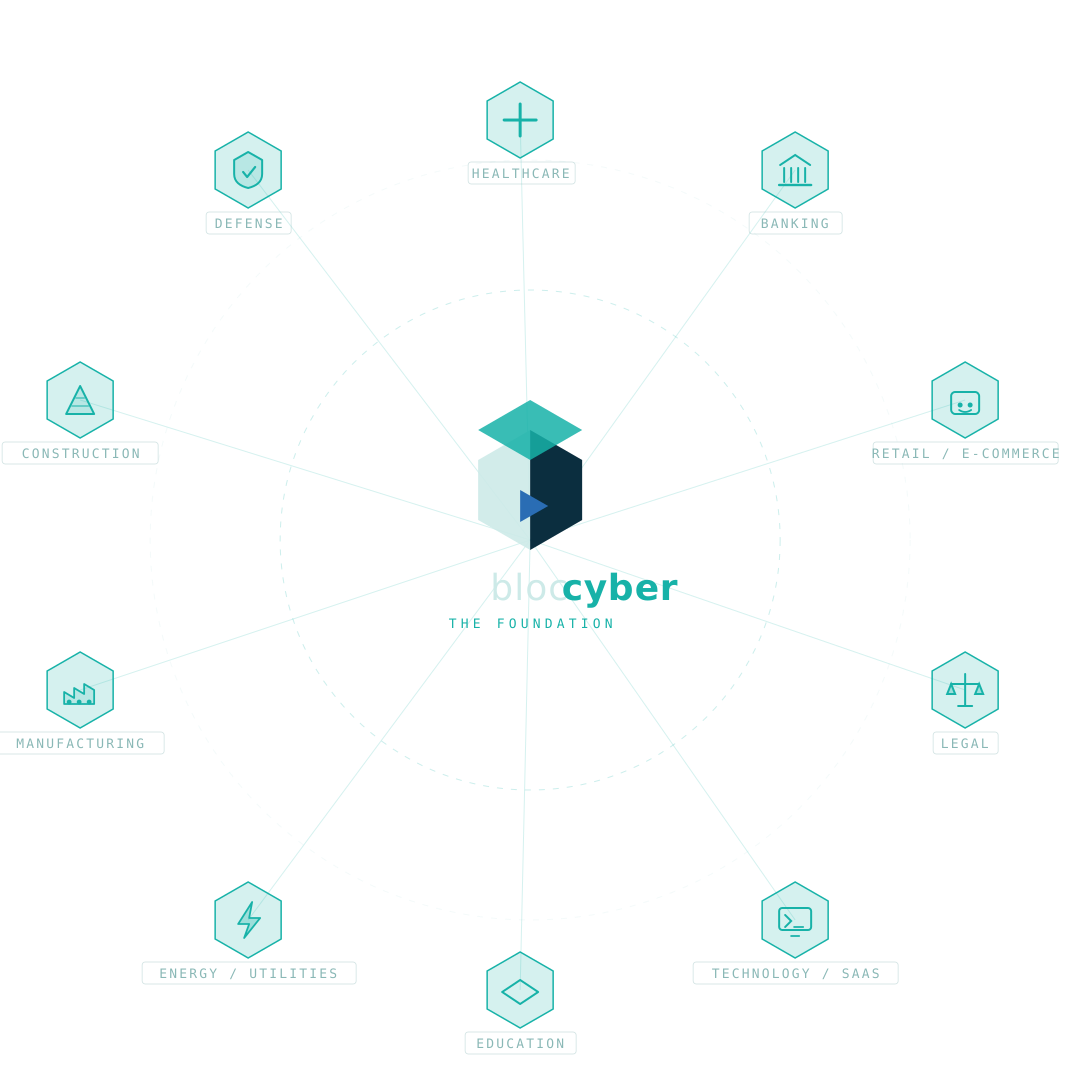
Industries We Protect
Cyber Coverage Built for Your Industry
Every industry faces a different cyber threat, from patient records in healthcare to wire fraud in construction. Bloc Cyber matches coverage to the risks your sector actually faces, drawing on specialty carriers that understand your business. Find your industry below to see how we protect it.
Healthcare
Banking
Retail / E-Commerce
Legal
Technology / SaaS
Education
Energy / Utilities
Manufacturing
Construction
Defense

Healthcare
HIPAA-grade protection for patient data
725
healthcare breaches disclosed in 2024
HIPAA-grade protection for patient data
▣ Ransomware on EHR systems
▣ PHI exfiltration
▣ Medical device exploits
▣ Business email compromise
Sub-sectors we place
Hospitals and health systems
Physician practices and specialty clinics
Dental practices and DSOs
Behavioral health and addiction treatment centers
Medical billing and revenue cycle management firms
Typical turnaround for indication of terms: 1 business day.

Banking
Coverage that meets FFIEC and NYDFS expectations
$5.9M
average cost of a financial sector breach
Common threats we underwrite against
▣ Wire fraud and BEC
▣ Credential stuffing
▣ Third-party vendor risk
▣ Ransomware
Sub-sectors we place
Community banks
Credit unions
Mortgage lenders and loan originators
Wealth management and RIAs
Payment processors and merchant acquirers
Typical turnaround for indication of terms: 1 business day.

Retail / E-Commerce
PCI-DSS aligned coverage for every checkout
42%
of retailers hit by ransomware in the last year
Common threats we underwrite against
▣ Magecart / card skimming
▣ POS malware
▣ Account takeover
▣ Supply-chain intrusion
Sub-sectors we place
Direct-to-consumer (DTC) brands
Shopify and marketplace sellers
Brick-and-mortar multi-location retailers
Restaurants and QSR franchises
Grocery and specialty food retail
Typical turnaround for indication of terms: 1 business day.

Legal
Privilege, client files, and trust-account safeguards
1 in 4
law firms reported a breach in 2024
Common threats we underwrite against
▣ Wire-transfer fraud
▣ Privileged data theft
▣ Email account compromise
▣ Ransomware
Sub-sectors we place
AmLaw / large firms
Boutique litigation firms
Personal injury and plaintiffs’ firms
Estate planning and trust attorneys
Title and real estate closing firms
Typical turnaround for indication of terms: 1 business day.

Technology / SaaS
SOC 2 and ISO-aligned risk transfer
$4.88M
avg. cost of a SaaS breach in 2024
Common threats we underwrite against
▣ Supply-chain attacks
▣ Cloud misconfiguration
▣ Token and key theft
▣ Zero-day exploits
Sub-sectors we place
B2B SaaS platforms
Managed service providers (MSPs) and MSSPs
Fintech startups
AI and machine learning companies
Cloud hosting and infrastructure providers
Typical turnaround for indication of terms: 1 business day.

Education
FERPA-aligned coverage for student and research data
80%
of K–12 districts hit by ransomware since 2022
Common threats we underwrite against
▣ Ransomware on district networks
▣ Student PII theft
▣ Fake invoice fraud
▣ DDoS on exam platforms
Sub-sectors we place
K-12 public school districts
Private and charter schools
Colleges and universities
EdTech platforms
Tutoring, test prep, and online learning providers
Typical turnaround for indication of terms: 1 business day.

Energy / Utilities
OT and IT coverage for critical infrastructure
24/7
operational-tech monitoring requirements
Common threats we underwrite against
▣ ICS/SCADA intrusion
▣ Nation-state actors
▣ Ransomware on OT
▣ Insider threat
Sub-sectors we place
Municipal utilities (water, electric, gas)
Oil and gas operators
Pipeline and midstream companies
Renewable energy (solar, wind) developers
Electric cooperatives and rural utilities
Typical turnaround for indication of terms: 1 business day.

Manufacturing
Business interruption protection for connected plants
25%
of all ransomware attacks target manufacturing
Common threats we underwrite against
▣ Ransomware halting production
▣ IP theft
▣ ICS exploits
▣ Vendor compromise
Sub-sectors we place
Industrial and heavy equipment manufacturers
Food and beverage processing
Pharmaceutical and medical device manufacturers
Automotive and parts suppliers
Aerospace component manufacturers
Typical turnaround for indication of terms: 1 business day.

Construction
Protection for project files, wires, and jobsite tech
$200K+
average wire-fraud loss in construction
Common threats we underwrite against
▣ Wire-transfer diversion
▣ BEC on project payments
▣ Stolen bid data
▣ Ransomware
Sub-sectors we place
General contractors
Commercial HVAC, electrical, and plumbing subs
Civil and infrastructure contractors
Homebuilders and residential developers
Architecture and engineering (A&E) firms
Typical turnaround for indication of terms: 1 business day.

Defense
CMMC, DFARS, and CUI-compliant risk transfer
CMMC
2.0 compliance required by 2026
Common threats we underwrite against
▣ CUI exfiltration
▣ Nation-state APTs
▣ Supply-chain compromise
▣ Cleared-personnel targeting
Sub-sectors we place
DoD prime contractors
CMMC-regulated subcontractors
Defense software and systems integrators
Aerospace and satellite contractors
Federal IT and cleared staffing firms
Typical turnaround for indication of terms: 1 business day.
The Bloc system
One foundation.
Ten industry-specific builds.
The Bloc mark is built from stackable planes — each one a different angle on the same core structure. That’s how we place coverage: one underwriting discipline, tuned and re-tuned for every industry we serve.
Coverage
A policy you can actually read.
Structured in three clean blocs.
01
First-Party
Your direct losses when an incident hits your business.
✓
Incident response & forensics
✓
Business interruption
✓ Data restoration
✓ Cyber extortion / ransomware
✓ Funds transfer fraud
✓ Reputational harm
02
Third-Party
Your liability to clients, partners, and regulators.
✓
Network security liability
✓
Privacy liability (HIPAA, GDPR, state laws)
✓ Regulatory defense & fines
✓ PCI-DSS fines and assessments
✓ Media liability
✓ Breach notification costs
03
Specialty
Advanced coverages for complex risks and contracts.
✓
Technology E&O
✓
Social engineering fraud
✓ Contingent business interruption
✓ Systems failure
✓ Bricking & hardware replacement
✓ CMMC / regulatory-specific endorsements
Typical limits placed
$1M / $1M starter
$5M / $10M mid-market
$25M+ layered towers
Custom retentions
Common Questions
Cyber Liability Insurance, Explained
What does cyber insurance cover?
Cyber insurance covers the financial losses from a data breach or cyberattack. This includes breach response, legal fees, customer notification, ransomware, business interruption, and regulatory fines, depending on your policy.
Does my business really need cyber insurance?
Yes. Any business that stores customer data, processes payments, or relies on connected systems faces cyber risk. Small and mid-sized companies are frequent targets because they often have fewer defenses.
How much does cyber insurance cost?
Cost depends on your industry, revenue, data volume, and security practices. We market your risk to multiple carriers to find strong coverage at a competitive price. Request a quote for an exact figure.
What is the difference between first-party and third-party cyber coverage?
First-party coverage pays for your own losses, like data recovery and lost income. Third-party coverage pays for claims from others harmed by a breach on your systems.
How fast can I get a quote?
Most clients receive a quote in under 24 hours after we review the details of their business and exposure.
What should I do first after a cyberattack?
Contact us right away. We help you start breach response, connect you with forensic and legal support, and guide your claim so you contain the damage quickly.
Insights
Field notes from the placement desk.
What carriers are asking right now.



Start a quote
Tell us about your business.
We’ll come back with terms.
We’ll review your stack, your contracts, and your exposure — then place the program against the right markets. Most intakes get indicative terms back within one business day.
01
Quick intake
We only ask what the carriers actually need.
02
Benchmark
Side-by-side terms from 10+ specialty cyber carriers.
03
Bind
Plain-language policy review, e-signed and in force.