Three scenarios dominate the claims data. First, a compromised vendor email chain leads your AP team to redirect a legitimate invoice payment to a new bank account controlled by a criminal. Second, a spoofed executive email instructs your controller to wire funds for a confidential acquisition or urgent tax payment. Third, a threat actor compromises your company's own email system and intercepts outbound payment instructions to your clients, redirecting incoming payments. Each scenario triggers a different coverage grant, and some policies cover only one or two of the three.
Common Wire Transfer Loss Scenarios
The gap between these two policy types is where most uninsured AI losses land. A company that only carries general liability and a basic tech E&O policy may find itself with no coverage for the specific claims AI systems generate.
A Miami healthcare startup deploys a diagnostic AI that confidently recommends a treatment based on fabricated clinical data. A Tampa fintech firm's credit-scoring algorithm systematically denies applications from minority zip codes. An Orlando logistics company's autonomous purchasing agent commits the firm to a six-figure contract no human approved. Each scenario generates real liability, and none of them is adequately addressed by a standard commercial general liability or cyber policy. Florida businesses building or deploying AI systems need coverage designed for the specific risks these technologies create: hallucination errors, algorithmic bias claims, and decisions made by autonomous agents. This guide breaks down how AI liability insurance works for companies in Miami, Tampa, and Orlando, what the policy forms actually cover, how to set appropriate limits, and where the gaps hide.
Understanding AI Liability Risks for Florida's Growing Tech Hubs
Florida's three largest metro areas have become magnets for AI-driven companies. The state's favorable tax environment, growing talent pool, and proximity to Latin American markets have drawn thousands of technology firms south. But rapid adoption has outpaced the insurance market's ability to respond with standardized products, leaving many businesses exposed to claims their existing policies were never designed to handle.
The Rise of Agentic AI in Miami and Tampa Business Operations
Local Law 144 requires employers in New York City that use automated employment decision tools to conduct annual bias audits and provide notice to candidates. Violations carry fines of $500 to $1,500 per incident, and class-based claims can compound that exposure rapidly. If your company uses AI in hiring, promotion, or compensation decisions within the five boroughs, your policy form should explicitly address regulatory defense and penalty sublimits tied to bias audit failures.
The law also creates a documentation trail. If a bias audit reveals disparate impact and you continue using the tool, plaintiffs' counsel will argue that subsequent discriminatory outputs were foreseeable. That foreseeability argument can erode policy defenses. A policy placed through a specialist like Bloc Cyber would be reviewed at the insuring-agreement level to confirm whether regulatory proceedings under Local Law 144 fall within the coverage grant or sit in an exclusion gap.
Why Standard General Liability Falls Short for Florida AI Firms
A commercial general liability policy responds to bodily injury and property damage. It was not written to address a chatbot fabricating legal advice, a hiring algorithm discriminating against protected classes, or an autonomous agent executing unauthorized transactions. The "professional services" exclusion in most GL forms eliminates coverage for errors in technology-delivered advice or outputs. Even if your GL carrier does not explicitly exclude AI, the policy's triggering mechanism requires a physical occurrence or tangible injury, not an erroneous data output. That structural mismatch leaves a coverage void that grows wider as your AI systems become more autonomous.

By: Caden Braly
Founder of Bloc Cyber Insurance
INDEX
Understanding AI Liability Risks for Florida's Growing Tech Hubs
Core Coverage: Hallucinations, Errors, and Algorithmic Bias
Comparing Policy Types: General Liability vs. Specialized AI Coverage
Setting Coverage Limits for Orlando and Miami Enterprises
Bloc Cyber and Its Licensed Producers Are Authorized to Place Cyber Coverage in All 50 U.S. States and The District of Columbia.
Cyber liability insurance covers the financial losses your business faces after a cyberattack or data breach. This page explains what the coverage includes, who needs it, what it costs, and how Bloc Cyber helps you get protected fast.
We start with a twenty-minute call to walk through your contracts, your draw process, your tech stack, and the last twelve months of attempted fraud. From there we go to market with ten-plus carriers, benchmark terms side-by-side, and present the options in plain language with recommended limits and retentions. Most intakes get indicative terms within one business day.
Forensic Investigations: Identifying the Source and Scope
Forensic investigators determine how the attacker got in, what data was accessed, whether exfiltration occurred, and whether the threat actor is still present in the network. Their report drives every downstream decision: which individuals must be notified, whether payment card brands must be alerted, and what remediation steps are necessary. Forensic engagements for mid-market companies commonly run between $30,000 and $150,000, depending on the complexity of the environment. The policy form may impose a separate sublimit on forensic costs or bundle them under a single breach response aggregate. Bloc Cyber reviews these sublimits at the insuring-agreement level before binding, so clients understand exactly how much forensic coverage they are purchasing and where the cap sits relative to their actual exposure.
SLA disputes represent a growing category of tech E&O claims, particularly for managed service providers and SaaS companies. When your contract guarantees 99.9% uptime and your platform experiences extended outages, the financial exposure extends beyond the service credits written into the SLA. Clients may claim consequential damages: lost sales, regulatory penalties, or reputational harm tied to the downtime.
Not every tech E&O policy covers SLA-related claims. Some forms treat SLA penalties as liquidated damages, which are typically excluded. Others classify SLA failures as a failure to perform professional services, which brings them within the coverage grant. You need to know which version your policy form uses before you sign a contract that includes uptime guarantees.
Missed Service Level Agreements (SLAs) and Uptime Requirements
Core Coverage: Hallucinations, Errors, and Algorithmic Bias
AI liability insurance addresses three distinct risk categories, each requiring its own insuring agreement within the policy form. Understanding how each coverage grant works, and where it stops, is essential before you bind.
Protecting Against Financial Loss from AI Hallucinations
AI hallucinations occur when a model generates plausible but factually incorrect outputs. A customer-facing chatbot that invents product specifications, a legal research tool that cites nonexistent case law, or a medical AI that fabricates drug interaction data can each trigger claims for financial loss, professional negligence, or consumer protection violations. New insurance products now specifically cover damages caused by AI, but the scope varies dramatically between forms. Some policies cover only third-party claims arising from hallucinated outputs, while others extend to first-party remediation costs like customer notification and data correction. Florida small businesses face an average data breach cost of $149,000, and hallucination-related claims can compound that figure when incorrect outputs affect multiple customers simultaneously.
Mitigating Algorithmic Bias and Discrimination Claims
Bias claims represent the fastest-growing exposure category for AI-deploying businesses. If your hiring algorithm, lending model, or tenant-screening tool produces outcomes that disproportionately affect a protected class, you face potential claims under federal civil rights statutes, the Florida Civil Rights Act, and municipal anti-discrimination ordinances in Miami-Dade, Hillsborough, and Orange counties. Algorithmic discrimination settlements for mid-sized firms are now exceeding seven figures in some cases. A properly structured AI liability policy should respond to defense costs and indemnity for discrimination claims arising from algorithmic outputs. The policy form matters here: look for explicit coverage for "algorithmic bias" or "discriminatory output" rather than relying on a general professional liability grant that may not contemplate these claims.
Liability for Autonomous Decisions Made by Agentic AI
When an AI agent executes a decision without human approval, the liability chain becomes complicated. Florida's proposed legislation regarding AI use reflects growing concern about autonomous systems making consequential decisions in regulated industries. Your policy form needs to address whether the insuring agreement covers autonomous actions or only human-directed AI outputs. Many early AI liability forms were written for recommendation engines, not for agents that independently execute contracts, authorize payments, or deny claims. If your business deploys agentic AI, confirm that the policy form explicitly covers autonomous decision-making, not just advisory outputs.

The gap between a basic crime policy and a comprehensive fraud protection program is significant. The table below highlights key differences.
We start with a twenty-minute call to walk through your contracts, your draw process, your tech stack, and the last twelve months of attempted fraud. From there we go to market with ten-plus carriers, benchmark terms side-by-side, and present the options in plain language with recommended limits and retentions. Most intakes get indicative terms within one business day.
This comparison illustrates why a general liability policy, even one with a broad "personal and advertising injury" grant, will not respond to a regulatory proceeding. The coverage must be placed specifically under a cyber or technology E&O form that includes regulatory defense as a named insuring agreement.
| Coverage Feature | Basic Crime Policy | Comprehensive Cyber with Fraud Coverage |
|---|---|---|
| Computer Fraud | Typically included | Included |
| Social Engineering | Optional endorsement, low sublimit | Included, higher sublimits available |
| Push Payment Fraud | Often excluded | May be covered as separate grant |
| Account Takeover | May fall under computer fraud | Explicitly covered |
| Forensic Investigation | Not covered | First-party expense coverage |
| Legal and Regulatory Costs | Not covered | Included |
| Callback Verification Required | Yes, strict condition | Yes, but terms vary by form |
| Typical Sublimit Range | $100K - $250K | $250K - $1M+ |
R&W retentions function similarly to a deductible but are typically structured as a percentage of enterprise value. A common retention for mid-market deals sits between 1% and 3% of the transaction value. On a $50 million deal, that means the buyer absorbs the first $500,000 to $1.5 million of covered losses before the insurer pays anything. The retention exists because underwriters expect the buyer's own diligence to catch smaller issues. Retention levels are negotiable and vary by carrier, deal size, and the quality of the diligence package presented during underwriting.
How Retention Works as a Deductible
The Transition from Retention to Drop-Down Coverage
Most R&W policies include a drop-down feature that reduces the retention, often by half, after a specified period, typically 12 months post-closing. If the original retention is $1 million, it drops to $500,000 after the first year. This mechanism reflects the assumption that the most significant breaches surface early. The reduced retention in the later period provides the buyer with more accessible coverage for claims that emerge after the initial post-closing adjustment period. Some policies offer a full drop to zero retention after 18 or 24 months, though this depends on the specific terms negotiated with the underwriter.
| Area | SOC 2 Requirement | Typical Cyber Insurance Requirement |
|---|---|---|
| Multi-Factor Authentication | Required under Security criterion for logical access | Required on all remote access, email, and admin consoles |
| Endpoint Detection & Response | Recommended but not always mandated | Frequently required; some carriers mandate specific vendors |
| Encryption | Required for data in transit; recommended at rest | Required for both in transit and at rest on most applications |
| Incident Response Plan | Required under Security criterion | Required; some carriers want to see tabletop exercise records |
| Backup & Recovery | Covered under Availability criterion | Required with tested restoration procedures |
| Vendor Management | Covered under Confidentiality or Security | Asked about in applications; subcontractor liability coverage may depend on it |
| Employee Training | Required under Security criterion | Required; frequency and phishing simulation results often requested |
A breach-response insuring agreement typically covers the cost of retaining a forensic investigation firm to determine the scope of the intrusion, identify compromised data, and recommend remediation. It also covers breach counsel: attorneys who manage notification obligations, coordinate with regulators, and advise on litigation exposure.
The sequencing matters. Engaging breach counsel first, before the forensic firm, can place the forensic report under attorney-client privilege. This is a practical consideration that affects your litigation posture. Your policy form should not restrict you to a single panel firm if that firm has a conflict or lacks capacity during a widespread event. Bloc Cyber evaluates panel flexibility and pre-approval processes during the placement process so clients are not surprised after an incident.
The Role of Forensic Investigators and Legal Counsel
The difference between these two categories is not academic. A standard professional liability form written for consultants or accountants will contain exclusions that gut coverage for a software company. Technology-specific forms are underwritten with code delivery, SaaS operations, and IT services in mind. The endorsements and exclusion language reflect the actual risk profile of a tech firm.
| Coverage Feature | Standard Professional Liability | Specialized Tech E&O |
|---|---|---|
| Negligent acts/omissions | Covered | Covered |
| Breach of contract (standalone) | Often excluded | Typically included |
| SLA failure claims | Excluded or silent | May be covered depending on form |
| Intellectual property infringement | Rarely included | Usually included |
| Network security liability | Not included | Available as combined form |
| Rectification/mitigation costs | Not included | Available on select forms |
| Defense cost structure | Inside the limit | Inside or outside the limit (varies) |
| Technology-specific exclusions | Broad | Narrower, negotiable |
Comparing Policy Types: General Liability vs. Specialized AI Coverage
Not all policies marketed as "AI insurance" provide the same coverage. The difference between a cyber liability endorsement and a standalone AI liability form can determine whether a claim is paid or denied.
Comparison Chart: Basic Cyber vs. Comprehensive AI Liability
| Coverage Element | Basic Cyber Liability | Comprehensive AI Liability |
|---|---|---|
| Data breach response | Included | Included |
| AI hallucination claims | Typically excluded | Covered under errors grant |
| Algorithmic bias defense | Not addressed | Explicit coverage available |
| Agentic AI decisions | Not addressed | Covered if endorsed |
| Regulatory defense (AI-specific) | Limited to privacy laws | Extends to AI regulation |
| First-party remediation | Breach costs only | Includes output correction |
| Typical retention | $5,000-$25,000 | $10,000-$50,000 |
| Policy form basis | Claims-made | Claims-made |
A cyber liability policy protects against data breaches, network security failures, and privacy violations. It was not built to respond when your AI generates a wrong answer that causes a client financial harm. An AI-specific form adds insuring agreements for technology errors, hallucinated outputs, biased algorithmic decisions, and autonomous agent actions. Bloc Cyber's approach is to review these forms at the insuring-agreement level, identifying where sublimits, retentions, and exclusions create gaps before a claim exposes them.
We start with a twenty-minute call to walk through your contracts, your draw process, your tech stack, and the last twelve months of attempted fraud. From there we go to market with ten-plus carriers, benchmark terms side-by-side, and present the options in plain language with recommended limits and retentions. Most intakes get indicative terms within one business day.
| Coverage Element | Commercial General Liability | Cyber Insurance |
|---|---|---|
| Data breach notification costs | Not covered | Covered under first-party |
| Ransomware payment | Not covered | Covered (subject to sublimit) |
| Regulatory defense | Not covered | Covered under third-party |
| Business interruption from cyberattack | Not covered | Covered with waiting period |
| Funds transfer fraud | Not covered | Covered via cyber crime endorsement |
| Third-party lawsuit over data loss | Excluded or severely limited | Covered under third-party liability |
| Technology product failure | Not covered | Covered under Tech E&O |
Most states have not passed explicit statutes declaring regulatory fines insurable or uninsurable. Instead, the question turns on public policy: courts in some jurisdictions hold that allowing insurance to pay a punitive or regulatory fine would undermine the fine's deterrent purpose. New York, for example, has case law suggesting that certain regulatory penalties are uninsurable on public policy grounds. Texas and California courts have taken different positions depending on the type of fine and the regulatory scheme involved.
Your policy form will typically include language stating that fines and penalties are covered "to the extent insurable under applicable law." This shifts the jurisdictional analysis to the time of claim. Bloc Cyber maintains state-by-state fluency in breach-notification triggers and regulatory defense exposure, which matters when your operations span multiple states with different public policy positions on fine insurability.
State-by-State Variations in Public Policy and Uninsurable Fines
Companies with operations in the EU, UK, or Asia-Pacific face additional complexity. GDPR fines imposed by European data protection authorities can reach four percent of global annual revenue. Whether a US-placed policy can respond to a GDPR fine depends on the policy's territorial scope, the choice-of-law provisions, and whether the jurisdiction where the fine is imposed permits its insurance.
Many standard cyber forms limit territorial coverage to the United States and its territories. If your company has employees, customers, or data processing activities in Europe, you need a form with international regulatory coverage or a locally admitted policy in the relevant jurisdiction. The cost of getting this wrong is not theoretical: monitor and compliance fees in cross-border enforcement actions can compound rapidly when multiple regulators coordinate investigations.
International Considerations for Multinational Regulatory Risks
Addressing Known Issues and Exclusions
Any issue identified during diligence that is disclosed to the underwriter becomes a known issue and is excluded from coverage. This is a fundamental principle of R&W insurance: it covers unknown breaches, not problems you already know about. Buyers sometimes assume they can disclose a problem and still obtain coverage for it. They cannot. The underwriter will carve out any known matter, and the buyer must negotiate a specific indemnity from the seller or accept the risk. This is where the interplay between your diligence process and your insurance placement becomes critical: thoroughness in diligence improves your coverage, but every issue you find narrows it.
For companies that carry cyber liability or technology E&O policies, this dynamic should feel familiar. At Bloc Cyber, we see a parallel in how cyber insurers evaluate a company's security posture before binding coverage: known vulnerabilities get excluded or trigger higher retentions, just as known issues do in R&W underwriting.
How much does cyber insurance cost for a small firm?
A firm of 10 to 25 attorneys can typically expect premiums in the range of $3,000 to $12,000 annually for $1 million in coverage, depending on practice areas, security controls in place, and claims history. Firms handling real estate closings or M&A work will pay more because of the wire-fraud exposure.
General liability responds to tangible harm. AI professional liability responds to financial loss caused by your technology's performance. You need both, and one does not substitute for the other.
Setting Coverage Limits for Orlando and Miami Enterprises
Selecting the right coverage limits requires more than picking a round number. Your limit should reflect the volume of data your AI processes, the industries you serve, and the regulatory environment you operate within.
Determining Appropriate Limits Based on Data Volume
Companies processing higher volumes of data through AI systems face proportionally greater exposure. A Miami marketing firm running AI-generated content for 50 clients carries different risk than an Orlando SaaS company whose AI processes 10 million customer records monthly. Start with your maximum plausible single-event loss: how much financial damage could one hallucinated output or one biased decision cause across your entire user base? Then consider aggregation: AI errors can cost a single company over $1 million when incorrect outputs affect thousands of end users before detection. Your aggregate limit should account for multiple claims arising from a single model flaw.
Industry-Specific Requirements for Healthcare and Fintech AI
Healthcare AI in Tampa and Orlando faces HIPAA-related exposures on top of standard AI liability risks. A hallucinated diagnosis or treatment recommendation triggers both professional liability and regulatory defense costs. Your policy form should carry limits sufficient to cover OCR investigations, patient notification, and malpractice defense simultaneously. Fintech AI in Miami's banking corridor faces similar compounding: a biased lending algorithm can trigger ECOA and Fair Housing Act claims alongside state-level regulatory actions. For these regulated industries, a $1 million per-occurrence limit with a $3 million aggregate represents a starting point, not a ceiling. The retention structure matters as much as the limit: a $50,000 retention on a $1 million policy means you absorb the first $50,000 of every claim, so ensure your balance sheet can handle that exposure.
We start with a twenty-minute call to walk through your contracts, your draw process, your tech stack, and the last twelve months of attempted fraud. From there we go to market with ten-plus carriers, benchmark terms side-by-side, and present the options in plain language with recommended limits and retentions. Most intakes get indicative terms within one business day.
FAQ: Does my general business insurance cover hacking?
Almost certainly not. Standard CGL and BOP policies contain electronic data exclusions. Even if your policy has a small "data breach" endorsement, it is typically capped at $50,000 to $100,000, which will not cover a meaningful incident. A standalone cyber liability form provides the breadth and limits required for a real claim.
FAQ: How does a consent order affect my future premiums?
A consent order signals increased risk to underwriters. Expect premium increases at renewal, potentially 25 to 100 percent or more depending on the severity of the order and your compliance track record. Some carriers may decline to renew entirely if the consent order reveals systemic compliance failures.
Law firm cyber coverage is not a commodity product you can purchase by checking a box on a general liability application. The risks are specific: trust account fraud, privileged document exposure, deal data theft, multi-state notification obligations, and business interruption measured in lost billable hours. Your policy needs to reflect those risks at the insuring-agreement level, with sub-limits and retentions that match your actual exposure.
Do not wait for a breach to discover that your social engineering sub-limit is $100,000 on a $1.2 million wire or that your business-interruption waiting period is 24 hours when your systems were down for a week. If you are purchasing your first cyber policy or renewing an existing one, have a specialist review the actual policy form with you. Bloc Cyber's practice is built entirely around cyber, technology E&O, and AI liability placement. You can
request a coverage review to have a specialist walk through the insuring agreements, sub-limits, and exclusions specific to your firm's risk profile before you bind.
Matching Limits to Client Contract Requirements
Most enterprise contracts specify minimum E&O limits, commonly $1 million per claim and $2 million aggregate. Government contracts and healthcare clients often require $5 million or higher. Your policy limits should match or exceed the highest contractual requirement you carry, because a limit that falls short leaves you personally exposed for the difference.
If you are bidding on contracts with $5 million indemnification clauses, carrying $1 million in coverage creates a gap that no amount of contract negotiation will fully close. Review your largest three to five client contracts annually and adjust your limits accordingly.
Comparison Table: Standard Tech E&O vs. Comprehensive AI Liability
Frequently Asked Questions About Florida AI Insurance
What does AI hallucination coverage actually pay for?
A policy form written to cover hallucination claims typically responds to third-party financial losses caused by factually incorrect AI outputs, plus your defense costs. Some forms also cover first-party costs like correcting erroneous outputs and notifying affected users. The specifics depend entirely on how the insuring agreement is written.
Do I need a separate policy if I already have Cyber Liability?
In most cases, yes. Cyber liability responds to data breaches and network security events, not to errors in AI-generated content or biased algorithmic decisions. New proposed legislation in Florida is creating additional regulatory exposures that fall outside standard cyber forms. A standalone AI liability policy or a specifically endorsed tech E&O form fills these gaps.
How does Florida law view liability for autonomous AI agents?
Florida has not yet enacted a comprehensive AI liability statute, but legislative activity is accelerating. The current legal framework applies existing negligence, product liability, and consumer protection standards to AI-related harms. Companies deploying autonomous agents should assume they will bear liability for the agent's actions until the legal framework says otherwise.
Can insurance protect me if my AI makes a biased hiring decision?
A policy form with explicit algorithmic bias coverage may respond to defense costs and settlements arising from discriminatory hiring outcomes. The coverage grant must specifically address employment-related algorithmic decisions, as many forms exclude employment practices claims. Review the exclusions carefully before assuming protection exists.
We start with a twenty-minute call to walk through your contracts, your draw process, your tech stack, and the last twelve months of attempted fraud. From there we go to market with ten-plus carriers, benchmark terms side-by-side, and present the options in plain language with recommended limits and retentions. Most intakes get indicative terms within one business day.
| Coverage Element | Commercial General Liability | Cyber Insurance |
|---|---|---|
| Data breach notification costs | Not covered | Covered under first-party |
| Ransomware payment | Not covered | Covered (subject to sublimit) |
| Regulatory defense | Not covered | Covered under third-party |
| Business interruption from cyberattack | Not covered | Covered with waiting period |
| Funds transfer fraud | Not covered | Covered via cyber crime endorsement |
| Third-party lawsuit over data loss | Excluded or severely limited | Covered under third-party liability |
| Technology product failure | Not covered | Covered under Tech E&O |
Most states have not passed explicit statutes declaring regulatory fines insurable or uninsurable. Instead, the question turns on public policy: courts in some jurisdictions hold that allowing insurance to pay a punitive or regulatory fine would undermine the fine's deterrent purpose. New York, for example, has case law suggesting that certain regulatory penalties are uninsurable on public policy grounds. Texas and California courts have taken different positions depending on the type of fine and the regulatory scheme involved.
Your policy form will typically include language stating that fines and penalties are covered "to the extent insurable under applicable law." This shifts the jurisdictional analysis to the time of claim. Bloc Cyber maintains state-by-state fluency in breach-notification triggers and regulatory defense exposure, which matters when your operations span multiple states with different public policy positions on fine insurability.
State-by-State Variations in Public Policy and Uninsurable Fines
Companies with operations in the EU, UK, or Asia-Pacific face additional complexity. GDPR fines imposed by European data protection authorities can reach four percent of global annual revenue. Whether a US-placed policy can respond to a GDPR fine depends on the policy's territorial scope, the choice-of-law provisions, and whether the jurisdiction where the fine is imposed permits its insurance.
Many standard cyber forms limit territorial coverage to the United States and its territories. If your company has employees, customers, or data processing activities in Europe, you need a form with international regulatory coverage or a locally admitted policy in the relevant jurisdiction. The cost of getting this wrong is not theoretical: monitor and compliance fees in cross-border enforcement actions can compound rapidly when multiple regulators coordinate investigations.
International Considerations for Multinational Regulatory Risks
Addressing Known Issues and Exclusions
Any issue identified during diligence that is disclosed to the underwriter becomes a known issue and is excluded from coverage. This is a fundamental principle of R&W insurance: it covers unknown breaches, not problems you already know about. Buyers sometimes assume they can disclose a problem and still obtain coverage for it. They cannot. The underwriter will carve out any known matter, and the buyer must negotiate a specific indemnity from the seller or accept the risk. This is where the interplay between your diligence process and your insurance placement becomes critical: thoroughness in diligence improves your coverage, but every issue you find narrows it.
For companies that carry cyber liability or technology E&O policies, this dynamic should feel familiar. At Bloc Cyber, we see a parallel in how cyber insurers evaluate a company's security posture before binding coverage: known vulnerabilities get excluded or trigger higher retentions, just as known issues do in R&W underwriting.
Post-Incident Forensic and Legal Obligations
After a SCADA or OT intrusion, you will likely face parallel investigations: your own internal forensic team, your insurer's panel forensics firm, CISA, and potentially your state public utility commission. A coordinated attack on Minnesota water utilities demonstrated how quickly a regional incident can trigger multi-agency scrutiny.
Your policy should not restrict your choice of forensic investigators to a panel that lacks OT expertise. If the form requires you to use a pre-approved vendor, confirm that vendor has ICS forensic capability. The wrong forensic team can miss artifacts specific to industrial protocols like Modbus or DNP3, leaving you with an incomplete investigation and a disputed claim.
How much does cyber insurance cost for a small firm?
A firm of 10 to 25 attorneys can typically expect premiums in the range of $3,000 to $12,000 annually for $1 million in coverage, depending on practice areas, security controls in place, and claims history. Firms handling real estate closings or M&A work will pay more because of the wire-fraud exposure.
Making the Right Choice for Your Business
AI liability coverage for Florida businesses is not a commodity product you can purchase off a shelf. The difference between a policy that pays a hallucination claim and one that denies it often comes down to a single clause in the insuring agreement. Miami, Tampa, and Orlando companies deploying AI systems need coverage that matches their specific risk profile: the type of AI they use, the data they process, the industries they serve, and the regulatory obligations they carry.
Bloc Cyber's practice is built around reading the actual policy form before binding, identifying where coverage grants stop and where gaps will cost you money. If your business deploys AI in any capacity, a form-level review of your current coverage is the most practical step you can take. Request a coverage review so a specialist can walk through the policy language with you and confirm whether your current program responds to the risks your AI systems actually create.
ABOUT THE AUTHOR
Caden Braly
— Founder, Bloc Cyber
I'm Caden Braly, founder of Bloc Cyber, the specialty cyber insurance arm of Braly Insurance. I built Bloc Cyber around one idea: businesses deserve coverage that actually responds when a cyberattack happens. I work closely with clients to understand their exposure, place the right policy through specialty carriers, and stand with them through the claim. My goal is simple — give every business straight answers and protection they can trust.
Full profile → caden@bloccyber.com LinkedIn
Industries We Protect
Cyber Coverage Built for Your Industry
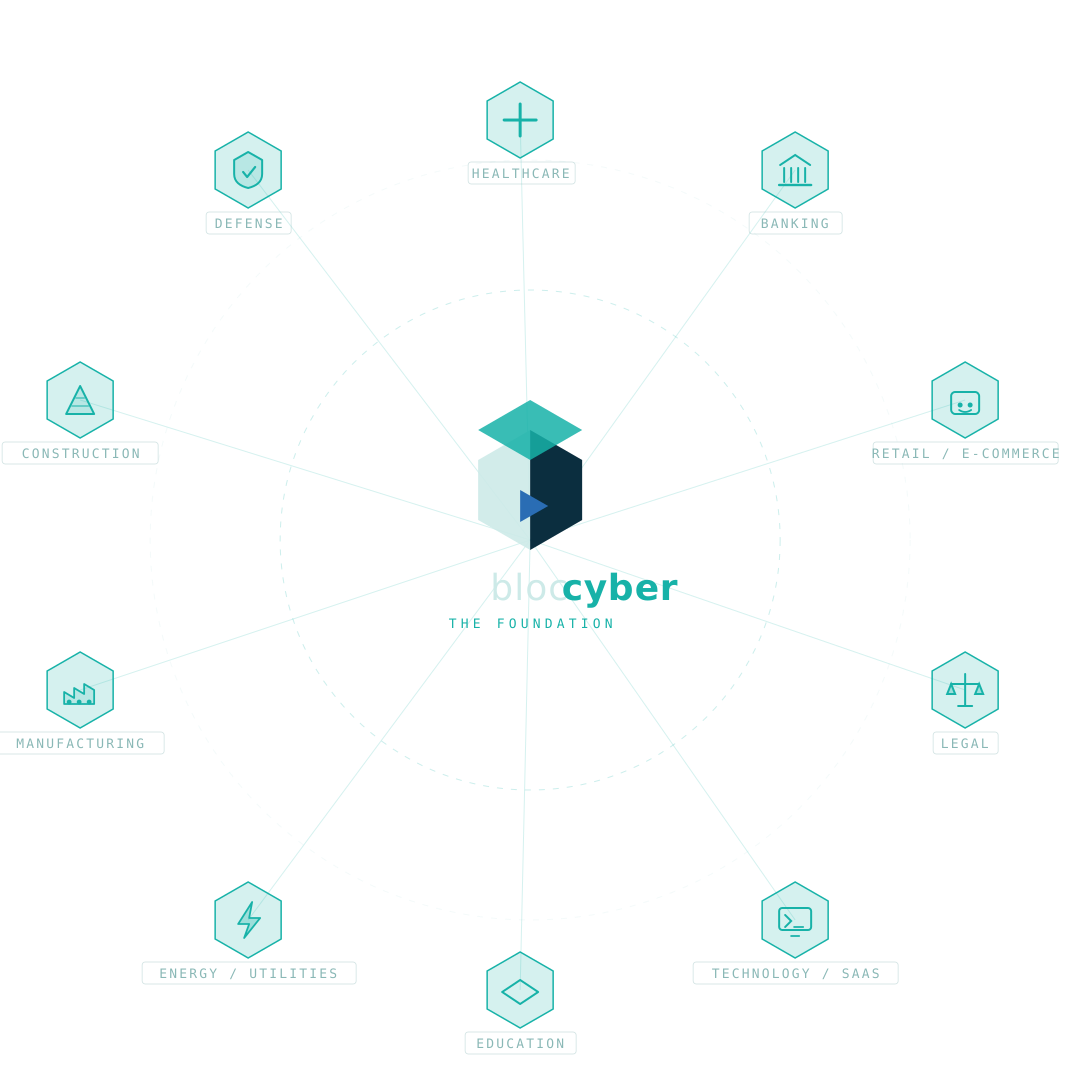
Every industry faces a different cyber threat, from patient records in healthcare to wire fraud in construction. Bloc Cyber matches coverage to the risks your sector actually faces, drawing on specialty carriers that understand your business. Find your industry below to see how we protect it.
Healthcare
Banking
Retail / E-Commerce
Legal
Technology / SaaS
Education
Energy / Utilities
Manufacturing
Construction
Defense

Healthcare
HIPAA-grade protection for patient data
725
healthcare breaches disclosed in 2024
HIPAA-grade protection for patient data
▣ Ransomware on EHR systems
▣ PHI exfiltration
▣ Medical device exploits
▣ Business email compromise
Sub-sectors we place
Hospitals and health systems
Physician practices and specialty clinics
Dental practices and DSOs
Behavioral health and addiction treatment centers
Medical billing and revenue cycle management firms
Typical turnaround for indication of terms: 1 business day.

Banking
Coverage that meets FFIEC and NYDFS expectations
$5.9M
average cost of a financial sector breach
Common threats we underwrite against
▣ Wire fraud and BEC
▣ Credential stuffing
▣ Third-party vendor risk
▣ Ransomware
Sub-sectors we place
Community banks
Credit unions
Mortgage lenders and loan originators
Wealth management and RIAs
Payment processors and merchant acquirers
Typical turnaround for indication of terms: 1 business day.

Retail / E-Commerce
PCI-DSS aligned coverage for every checkout
42%
of retailers hit by ransomware in the last year
Common threats we underwrite against
▣ Magecart / card skimming
▣ POS malware
▣ Account takeover
▣ Supply-chain intrusion
Sub-sectors we place
Direct-to-consumer (DTC) brands
Shopify and marketplace sellers
Brick-and-mortar multi-location retailers
Restaurants and QSR franchises
Grocery and specialty food retail
Typical turnaround for indication of terms: 1 business day.

Legal
Privilege, client files, and trust-account safeguards
1 in 4
law firms reported a breach in 2024
Common threats we underwrite against
▣ Wire-transfer fraud
▣ Privileged data theft
▣ Email account compromise
▣ Ransomware
Sub-sectors we place
AmLaw / large firms
Boutique litigation firms
Personal injury and plaintiffs’ firms
Estate planning and trust attorneys
Title and real estate closing firms
Typical turnaround for indication of terms: 1 business day.

Technology / SaaS
SOC 2 and ISO-aligned risk transfer
$4.88M
avg. cost of a SaaS breach in 2024
Common threats we underwrite against
▣ Supply-chain attacks
▣ Cloud misconfiguration
▣ Token and key theft
▣ Zero-day exploits
Sub-sectors we place
B2B SaaS platforms
Managed service providers (MSPs) and MSSPs
Fintech startups
AI and machine learning companies
Cloud hosting and infrastructure providers
Typical turnaround for indication of terms: 1 business day.

Education
FERPA-aligned coverage for student and research data
80%
of K–12 districts hit by ransomware since 2022
Common threats we underwrite against
▣ Ransomware on district networks
▣ Student PII theft
▣ Fake invoice fraud
▣ DDoS on exam platforms
Sub-sectors we place
K-12 public school districts
Private and charter schools
Colleges and universities
EdTech platforms
Tutoring, test prep, and online learning providers
Typical turnaround for indication of terms: 1 business day.

Energy / Utilities
OT and IT coverage for critical infrastructure
24/7
operational-tech monitoring requirements
Common threats we underwrite against
▣ ICS/SCADA intrusion
▣ Nation-state actors
▣ Ransomware on OT
▣ Insider threat
Sub-sectors we place
Municipal utilities (water, electric, gas)
Oil and gas operators
Pipeline and midstream companies
Renewable energy (solar, wind) developers
Electric cooperatives and rural utilities
Typical turnaround for indication of terms: 1 business day.

Manufacturing
Business interruption protection for connected plants
25%
of all ransomware attacks target manufacturing
Common threats we underwrite against
▣ Ransomware halting production
▣ IP theft
▣ ICS exploits
▣ Vendor compromise
Sub-sectors we place
Industrial and heavy equipment manufacturers
Food and beverage processing
Pharmaceutical and medical device manufacturers
Automotive and parts suppliers
Aerospace component manufacturers
Typical turnaround for indication of terms: 1 business day.

Construction
Protection for project files, wires, and jobsite tech
$200K+
average wire-fraud loss in construction
Common threats we underwrite against
▣ Wire-transfer diversion
▣ BEC on project payments
▣ Stolen bid data
▣ Ransomware
Sub-sectors we place
General contractors
Commercial HVAC, electrical, and plumbing subs
Civil and infrastructure contractors
Homebuilders and residential developers
Architecture and engineering (A&E) firms
Typical turnaround for indication of terms: 1 business day.

Defense
CMMC, DFARS, and CUI-compliant risk transfer
CMMC
2.0 compliance required by 2026
Common threats we underwrite against
▣ CUI exfiltration
▣ Nation-state APTs
▣ Supply-chain compromise
▣ Cleared-personnel targeting
Sub-sectors we place
DoD prime contractors
CMMC-regulated subcontractors
Defense software and systems integrators
Aerospace and satellite contractors
Federal IT and cleared staffing firms
Typical turnaround for indication of terms: 1 business day.
The Bloc system
One foundation.
Ten industry-specific builds.
The Bloc mark is built from stackable planes — each one a different angle on the same core structure. That’s how we place coverage: one underwriting discipline, tuned and re-tuned for every industry we serve.
Coverage
A policy you can actually read.
Structured in three clean blocs.
01
First-Party
Your direct losses when an incident hits your business.
✓
Incident response & forensics
✓
Business interruption
✓ Data restoration
✓ Cyber extortion / ransomware
✓ Funds transfer fraud
✓ Reputational harm
02
Third-Party
Your liability to clients, partners, and regulators.
✓
Network security liability
✓
Privacy liability (HIPAA, GDPR, state laws)
✓ Regulatory defense & fines
✓ PCI-DSS fines and assessments
✓ Media liability
✓ Breach notification costs
03
Specialty
Advanced coverages for complex risks and contracts.
✓
Technology E&O
✓
Social engineering fraud
✓ Contingent business interruption
✓ Systems failure
✓ Bricking & hardware replacement
✓ CMMC / regulatory-specific endorsements
Typical limits placed
$1M / $1M starter
$5M / $10M mid-market
$25M+ layered towers
Custom retentions
Common Questions
Cyber Liability Insurance, Explained
What does cyber insurance cover?
Cyber insurance covers the financial losses from a data breach or cyberattack. This includes breach response, legal fees, customer notification, ransomware, business interruption, and regulatory fines, depending on your policy.
Does my business really need cyber insurance?
Yes. Any business that stores customer data, processes payments, or relies on connected systems faces cyber risk. Small and mid-sized companies are frequent targets because they often have fewer defenses.
How much does cyber insurance cost?
Cost depends on your industry, revenue, data volume, and security practices. We market your risk to multiple carriers to find strong coverage at a competitive price. Request a quote for an exact figure.
What is the difference between first-party and third-party cyber coverage?
First-party coverage pays for your own losses, like data recovery and lost income. Third-party coverage pays for claims from others harmed by a breach on your systems.
How fast can I get a quote?
Most clients receive a quote in under 24 hours after we review the details of their business and exposure.
What should I do first after a cyberattack?
Contact us right away. We help you start breach response, connect you with forensic and legal support, and guide your claim so you contain the damage quickly.
Insights
Field notes from the placement desk.
What carriers are asking right now.



Start a quote
Tell us about your business.
We’ll come back with terms.
We’ll review your stack, your contracts, and your exposure — then place the program against the right markets. Most intakes get indicative terms back within one business day.
01
Quick intake
We only ask what the carriers actually need.
02
Benchmark
Side-by-side terms from 10+ specialty cyber carriers.
03
Bind
Plain-language policy review, e-signed and in force.