A mid-size fintech company in Jersey City deploys a customer-facing chatbot that hallucinates a loan rate, triggering a wave of complaints and a regulatory inquiry. A Princeton-based HR tech firm's screening algorithm disproportionately filters out candidates over 40, and the New Jersey Division on Civil Rights opens an investigation. A Newark logistics startup's agentic AI autonomously reroutes shipments based on flawed demand data, costing a client six figures in spoiled inventory. None of these scenarios is hypothetical anymore. Each one represents a live exposure that a standard professional liability or general liability policy was never designed to cover.
New Jersey AI liability insurance has become a distinct coverage category because the state is actively regulating how companies build, deploy, and oversee artificial intelligence. If your company touches AI in any meaningful way, whether you are training models, integrating third-party APIs, or simply using an AI-powered SaaS tool to make decisions that affect customers or employees, you need a policy form that actually responds to these exposures. This guide breaks down the three primary risk categories: hallucination and output errors, algorithmic bias claims, and agentic AI decisions. It also addresses how coverage and limits apply specifically to businesses operating in Newark, Jersey City, and Princeton.
Navigating AI Liability in New Jersey's Tech Hubs
New Jersey's regulatory posture toward AI is among the most aggressive on the East Coast. The state adopted the NAIC model bulletin through Bulletin 25-03, requiring all insurers to implement a written Artificial Intelligence Systems (AIS) Program governing how AI is used in underwriting, rating, and claims. That regulatory attention does not stop at insurance companies themselves. It signals a broader state-level commitment to holding all businesses accountable for the AI systems they deploy.
The Risk Landscape for Newark and Jersey City Startups
Newark and Jersey City have become magnets for fintech, healthtech, and logistics startups. Many of these companies embed AI into core product functionality: credit decisioning, patient triage recommendations, route optimization, customer service automation. The density of regulated industries in these corridors, financial services, healthcare, consumer lending, means that an AI error does not just create a disappointed customer. It creates a regulatory event.
A credit-scoring model that produces inaccurate outputs could trigger scrutiny under the New Jersey Consumer Fraud Act. A healthtech chatbot that hallucinates a diagnosis could generate a malpractice-adjacent claim. The risk profile is compounded by the fact that many of these companies are pre-revenue or early-stage, operating with thin balance sheets that cannot absorb a six-figure defense bill.
Why Standard Professional Liability Isn't Enough
Traditional professional liability and general liability forms were drafted for human errors and tangible property damage. They do not contemplate a scenario where software autonomously generates false information or makes a biased decision at scale. Many carriers have begun adding explicit AI exclusions at renewal, which means your existing GL or E&O policy may already have a gap you have not been told about.
The distinction matters. A technology E&O form might cover a software bug that causes financial harm. It will not necessarily cover an LLM hallucination that generates defamatory content about a third party, or an agentic system that executes a transaction without human approval. These are different risk mechanisms, and they require different insuring agreements.
By: Caden Braly
Founder of Bloc Cyber Insurance
INDEX
Bloc Cyber and Its Licensed Producers Are Authorized to Place Cyber Coverage in All 50 U.S. States and The District of Columbia.
Cyber liability insurance covers the financial losses your business faces after a cyberattack or data breach. This page explains what the coverage includes, who needs it, what it costs, and how Bloc Cyber helps you get protected fast.
We start with a twenty-minute call to walk through your contracts, your draw process, your tech stack, and the last twelve months of attempted fraud. From there we go to market with ten-plus carriers, benchmark terms side-by-side, and present the options in plain language with recommended limits and retentions. Most intakes get indicative terms within one business day.
Protecting Against LLM Hallucinations and Output Errors
Core Coverage for AI Hallucinations and Output Errors
AI hallucinations occur when a model generates plausible but factually wrong outputs. For companies using generative AI in customer-facing applications, this is not a theoretical concern. It is a claims driver.
Protecting Against Financial Loss from Incorrect Data
A policy form designed for AI liability will typically include an insuring agreement covering third-party financial loss arising from erroneous AI-generated outputs. The key variables to examine are the definition of "AI output," whether the form requires the error to be in a product you built versus one you integrated, and how the retention applies.
For example, if your SaaS platform uses a third-party LLM to generate financial summaries for clients, and one of those summaries contains fabricated data points, the resulting claim could fall outside a standard tech E&O form. A dedicated AI liability insuring agreement would respond to the third-party loss, subject to the policy's retention and aggregate limit. Bloc Cyber reviews these insuring agreements at the form level before binding, so you understand exactly which triggers activate coverage and which do not.
Vicarious Liability for LLM-Generated Content
One of the more complex exposures involves vicarious liability for content generated by a large language model embedded in your product. If your platform publishes AI-generated content that defames a person, infringes a copyright, or violates a right of publicity, you may face a claim even though no human at your company wrote the offending text.
Some insurers are pulling back from AI risk entirely, while others are carving out narrow coverage grants. The policy language around "content liability" or "media liability" in an AI context varies dramatically from form to form. A blanket exclusion for AI-generated content could leave you exposed to the exact claim scenario your product creates.

We start with a twenty-minute call to walk through your contracts, your draw process, your tech stack, and the last twelve months of attempted fraud. From there we go to market with ten-plus carriers, benchmark terms side-by-side, and present the options in plain language with recommended limits and retentions. Most intakes get indicative terms within one business day.
Addressing Algorithmic Bias and Discrimination Claims
Algorithmic bias is not just an ethical concern. In New Jersey, it is a legal liability with teeth.
New Jersey Regulatory Compliance for Hiring and Lending AI
New Jersey has taken a leading position on AI accountability in the workplace, with proposed legislation that would require employers using automated employment decision tools to conduct bias audits and provide notice to candidates. Companies using AI for hiring, promotion, or termination decisions face exposure under both state civil rights law and federal anti-discrimination statutes.
The lending sector faces parallel scrutiny. If your AI model produces disparate outcomes across protected classes in credit decisions, the New Jersey Division on Civil Rights and federal regulators can both pursue enforcement actions. Employers and lenders operating in Newark, Jersey City, or Princeton need to understand that algorithmic discrimination is already drawing regulatory attention in the state, regardless of whether pending bills have been signed into law.
Defense Costs for Civil Rights and Fair Practice Violations
Defense costs in algorithmic bias cases are substantial. These matters often involve expert witnesses in data science, statistical analysis of model outputs, and protracted discovery over training data and model architecture. A single EEOC complaint or state civil rights investigation can generate $150,000 to $400,000 in defense costs before any settlement is discussed.
An AI liability policy form should cover regulatory defense costs as a defined coverage grant, not buried in a sublimit that caps out at $50,000. You want to confirm whether the form covers administrative proceedings, not just lawsuits, since many bias claims begin as agency complaints rather than court filings. Insurance litigation trends in New Jersey suggest that coverage disputes over AI-related claims will increase as more carriers attempt to narrow their exposure through endorsement language.
We start with a twenty-minute call to walk through your contracts, your draw process, your tech stack, and the last twelve months of attempted fraud. From there we go to market with ten-plus carriers, benchmark terms side-by-side, and present the options in plain language with recommended limits and retentions. Most intakes get indicative terms within one business day.
| Coverage Element | Commercial General Liability | Cyber Insurance |
|---|---|---|
| Data breach notification costs | Not covered | Covered under first-party |
| Ransomware payment | Not covered | Covered (subject to sublimit) |
| Regulatory defense | Not covered | Covered under third-party |
| Business interruption from cyberattack | Not covered | Covered with waiting period |
| Funds transfer fraud | Not covered | Covered via cyber crime endorsement |
| Third-party lawsuit over data loss | Excluded or severely limited | Covered under third-party liability |
| Technology product failure | Not covered | Covered under Tech E&O |
The Evolution of Agentic AI Decision Coverage
Agentic AI represents a fundamentally different risk profile than traditional software. These systems do not just recommend actions. They execute them.
Insuring Autonomous Actions and API Triggers
An agentic AI system that autonomously initiates a purchase order, cancels a customer account, or modifies a financial position creates liability exposure that sits outside the typical "failure to perform professional services" insuring agreement. The system is not assisting a human decision-maker. It is the decision-maker.
Policy forms addressing agentic AI liability need to define what constitutes an "autonomous action," whether coverage extends to decisions made through API calls to third-party systems, and how the chain of causation is evaluated when multiple AI agents interact. This is an area where generative AI insurance exclusions are becoming more common, and where the gap between what a buyer assumes is covered and what the policy actually pays can be enormous.
Bloc Cyber's approach to AI liability placement involves reading the actual policy form and identifying where the coverage grant stops. For agentic AI, that means confirming whether the form covers autonomous execution, not just recommendation, and whether there is a human-in-the-loop requirement that could void coverage if your system operates without manual oversight.
We start with a twenty-minute call to walk through your contracts, your draw process, your tech stack, and the last twelve months of attempted fraud. From there we go to market with ten-plus carriers, benchmark terms side-by-side, and present the options in plain language with recommended limits and retentions. Most intakes get indicative terms within one business day.
Comparing AI Insurance Tiers and Limits
Not all AI liability policies are structured the same way. The difference between a basic endorsement and a comprehensive standalone form can determine whether a claim is paid or denied.
Comparison Table: Basic vs. Comprehensive AI Coverage
| Coverage Element | Basic AI Endorsement | Comprehensive AI Liability Form |
|---|---|---|
| Hallucination / Output Errors | Sublimited, often $100K-$250K | Full policy limits, typically $1M-$5M |
| Algorithmic Bias Defense | Excluded or sublimited at $50K | Included with regulatory proceeding coverage |
| Agentic AI Decisions | Excluded | Covered, subject to autonomy definitions |
| Third-Party Content Liability | Excluded or silent | Defined insuring agreement |
| Retention | $10K-$25K | $25K-$75K, varies by risk class |
| Bias Audit Cost Coverage | Not included | May include pre-claim mitigation |
| Multi-State Regulatory Defense | Limited to named state | Covers all US jurisdictions |
The premium difference between these tiers is meaningful, but so is the coverage gap. A $250K sublimit on AI output errors will not cover a class action arising from a chatbot that provided incorrect financial advice to thousands of users.
We start with a twenty-minute call to walk through your contracts, your draw process, your tech stack, and the last twelve months of attempted fraud. From there we go to market with ten-plus carriers, benchmark terms side-by-side, and present the options in plain language with recommended limits and retentions. Most intakes get indicative terms within one business day.
| Coverage Element | Commercial General Liability | Cyber Insurance |
|---|---|---|
| Data breach notification costs | Not covered | Covered under first-party |
| Ransomware payment | Not covered | Covered (subject to sublimit) |
| Regulatory defense | Not covered | Covered under third-party |
| Business interruption from cyberattack | Not covered | Covered with waiting period |
| Funds transfer fraud | Not covered | Covered via cyber crime endorsement |
| Third-party lawsuit over data loss | Excluded or severely limited | Covered under third-party liability |
| Technology product failure | Not covered | Covered under Tech E&O |
Common Questions About AI Insurance in NJ
Does my existing tech E&O policy cover AI hallucinations? It depends entirely on the policy form. Many tech E&O forms were drafted before generative AI existed, and some carriers have added exclusions. Have the form reviewed before assuming coverage exists.
Is algorithmic bias covered under employment practices liability insurance? EPLI forms may cover some discrimination claims, but they typically do not address the AI-specific exposures: training data bias, model architecture flaws, or failure to conduct bias audits. A dedicated AI liability form fills that gap.
What limits should a mid-size company in Newark or Jersey City carry? Most companies with 50 to 500 employees deploying customer-facing AI should consider $1M to $5M in dedicated AI liability limits. The right number depends on your revenue, the volume of AI-driven decisions, and the regulatory environment you operate in.
Are defense costs inside or outside the limit? This varies by form. Defense costs eroding the aggregate limit, known as "burning limits," can leave you underinsured after a protracted regulatory investigation. Confirm this before binding.
Do I need separate coverage if I only use third-party AI tools? Yes. Integrating a third-party AI model into your product or workflow does not transfer liability to the model provider. You are responsible for the outputs your customers receive.
Does New Jersey require AI liability insurance? No state currently mandates AI-specific liability coverage. However, New Jersey's regulatory stance on AI in hiring and lending creates de facto pressure to carry it, since the cost of an uninsured claim far exceeds the premium.
We start with a twenty-minute call to walk through your contracts, your draw process, your tech stack, and the last twelve months of attempted fraud. From there we go to market with ten-plus carriers, benchmark terms side-by-side, and present the options in plain language with recommended limits and retentions. Most intakes get indicative terms within one business day.
Your Next Steps for Securing Coverage
AI liability insurance for New Jersey businesses is not a future consideration. It is a present necessity for any company building, deploying, or integrating AI systems. The three core exposures, hallucination errors, algorithmic bias claims, and agentic AI decisions, each require specific insuring agreements that standard policies were not designed to provide.
Your priority should be a form-level review of your current coverage. Identify whether your existing tech E&O or GL policy contains AI exclusions, whether your limits are adequate for the AI-driven decisions your company makes, and whether regulatory defense costs are covered as a standalone grant or buried in a sublimit.
If you are operating in Newark, Jersey City, Princeton, or anywhere in New Jersey and your business relies on AI, request a coverage review so a specialist can walk through the policy form with you. Understanding where your coverage stops is the only way to know what a claim will actually cost.
ABOUT THE AUTHOR
Caden Braly
— Founder, Bloc Cyber
I'm Caden Braly, founder of Bloc Cyber, the specialty cyber insurance arm of Braly Insurance. I built Bloc Cyber around one idea: businesses deserve coverage that actually responds when a cyberattack happens. I work closely with clients to understand their exposure, place the right policy through specialty carriers, and stand with them through the claim. My goal is simple — give every business straight answers and protection they can trust.
Full profile → caden@bloccyber.com LinkedIn
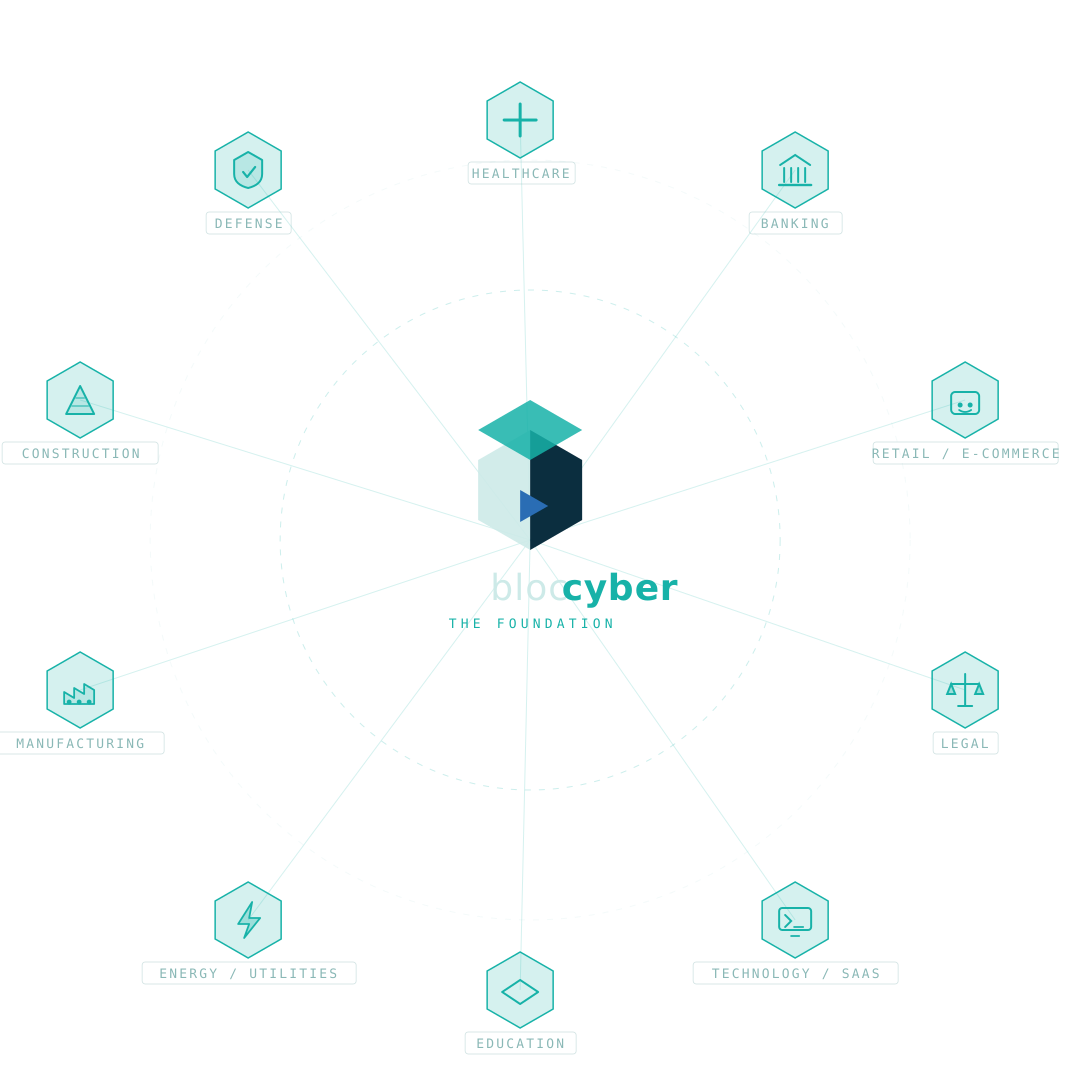
Industries We Protect
Cyber Coverage Built for Your Industry
Every industry faces a different cyber threat, from patient records in healthcare to wire fraud in construction. Bloc Cyber matches coverage to the risks your sector actually faces, drawing on specialty carriers that understand your business. Find your industry below to see how we protect it.
Healthcare
Banking
Retail / E-Commerce
Legal
Technology / SaaS
Education
Energy / Utilities
Manufacturing
Construction
Defense

Healthcare
HIPAA-grade protection for patient data
725
healthcare breaches disclosed in 2024
HIPAA-grade protection for patient data
▣ Ransomware on EHR systems
▣ PHI exfiltration
▣ Medical device exploits
▣ Business email compromise
Sub-sectors we place
Hospitals and health systems
Physician practices and specialty clinics
Dental practices and DSOs
Behavioral health and addiction treatment centers
Medical billing and revenue cycle management firms
Typical turnaround for indication of terms: 1 business day.

Banking
Coverage that meets FFIEC and NYDFS expectations
$5.9M
average cost of a financial sector breach
Common threats we underwrite against
▣ Wire fraud and BEC
▣ Credential stuffing
▣ Third-party vendor risk
▣ Ransomware
Sub-sectors we place
Community banks
Credit unions
Mortgage lenders and loan originators
Wealth management and RIAs
Payment processors and merchant acquirers
Typical turnaround for indication of terms: 1 business day.

Retail / E-Commerce
PCI-DSS aligned coverage for every checkout
42%
of retailers hit by ransomware in the last year
Common threats we underwrite against
▣ Magecart / card skimming
▣ POS malware
▣ Account takeover
▣ Supply-chain intrusion
Sub-sectors we place
Direct-to-consumer (DTC) brands
Shopify and marketplace sellers
Brick-and-mortar multi-location retailers
Restaurants and QSR franchises
Grocery and specialty food retail
Typical turnaround for indication of terms: 1 business day.

Legal
Privilege, client files, and trust-account safeguards
1 in 4
law firms reported a breach in 2024
Common threats we underwrite against
▣ Wire-transfer fraud
▣ Privileged data theft
▣ Email account compromise
▣ Ransomware
Sub-sectors we place
AmLaw / large firms
Boutique litigation firms
Personal injury and plaintiffs’ firms
Estate planning and trust attorneys
Title and real estate closing firms
Typical turnaround for indication of terms: 1 business day.

Technology / SaaS
SOC 2 and ISO-aligned risk transfer
$4.88M
avg. cost of a SaaS breach in 2024
Common threats we underwrite against
▣ Supply-chain attacks
▣ Cloud misconfiguration
▣ Token and key theft
▣ Zero-day exploits
Sub-sectors we place
B2B SaaS platforms
Managed service providers (MSPs) and MSSPs
Fintech startups
AI and machine learning companies
Cloud hosting and infrastructure providers
Typical turnaround for indication of terms: 1 business day.

Education
FERPA-aligned coverage for student and research data
80%
of K–12 districts hit by ransomware since 2022
Common threats we underwrite against
▣ Ransomware on district networks
▣ Student PII theft
▣ Fake invoice fraud
▣ DDoS on exam platforms
Sub-sectors we place
K-12 public school districts
Private and charter schools
Colleges and universities
EdTech platforms
Tutoring, test prep, and online learning providers
Typical turnaround for indication of terms: 1 business day.

Energy / Utilities
OT and IT coverage for critical infrastructure
24/7
operational-tech monitoring requirements
Common threats we underwrite against
▣ ICS/SCADA intrusion
▣ Nation-state actors
▣ Ransomware on OT
▣ Insider threat
Sub-sectors we place
Municipal utilities (water, electric, gas)
Oil and gas operators
Pipeline and midstream companies
Renewable energy (solar, wind) developers
Electric cooperatives and rural utilities
Typical turnaround for indication of terms: 1 business day.

Manufacturing
Business interruption protection for connected plants
25%
of all ransomware attacks target manufacturing
Common threats we underwrite against
▣ Ransomware halting production
▣ IP theft
▣ ICS exploits
▣ Vendor compromise
Sub-sectors we place
Industrial and heavy equipment manufacturers
Food and beverage processing
Pharmaceutical and medical device manufacturers
Automotive and parts suppliers
Aerospace component manufacturers
Typical turnaround for indication of terms: 1 business day.

Construction
Protection for project files, wires, and jobsite tech
$200K+
average wire-fraud loss in construction
Common threats we underwrite against
▣ Wire-transfer diversion
▣ BEC on project payments
▣ Stolen bid data
▣ Ransomware
Sub-sectors we place
General contractors
Commercial HVAC, electrical, and plumbing subs
Civil and infrastructure contractors
Homebuilders and residential developers
Architecture and engineering (A&E) firms
Typical turnaround for indication of terms: 1 business day.

Defense
CMMC, DFARS, and CUI-compliant risk transfer
CMMC
2.0 compliance required by 2026
Common threats we underwrite against
▣ CUI exfiltration
▣ Nation-state APTs
▣ Supply-chain compromise
▣ Cleared-personnel targeting
Sub-sectors we place
DoD prime contractors
CMMC-regulated subcontractors
Defense software and systems integrators
Aerospace and satellite contractors
Federal IT and cleared staffing firms
Typical turnaround for indication of terms: 1 business day.
The Bloc system
One foundation.
Ten industry-specific builds.
The Bloc mark is built from stackable planes — each one a different angle on the same core structure. That’s how we place coverage: one underwriting discipline, tuned and re-tuned for every industry we serve.
Coverage
A policy you can actually read.
Structured in three clean blocs.
01
First-Party
Your direct losses when an incident hits your business.
✓
Incident response & forensics
✓
Business interruption
✓ Data restoration
✓ Cyber extortion / ransomware
✓ Funds transfer fraud
✓ Reputational harm
02
Third-Party
Your liability to clients, partners, and regulators.
✓
Network security liability
✓
Privacy liability (HIPAA, GDPR, state laws)
✓ Regulatory defense & fines
✓ PCI-DSS fines and assessments
✓ Media liability
✓ Breach notification costs
03
Specialty
Advanced coverages for complex risks and contracts.
✓
Technology E&O
✓
Social engineering fraud
✓ Contingent business interruption
✓ Systems failure
✓ Bricking & hardware replacement
✓ CMMC / regulatory-specific endorsements
Typical limits placed
$1M / $1M starter
$5M / $10M mid-market
$25M+ layered towers
Custom retentions
Common Questions
Cyber Liability Insurance, Explained
What does cyber insurance cover?
Cyber insurance covers the financial losses from a data breach or cyberattack. This includes breach response, legal fees, customer notification, ransomware, business interruption, and regulatory fines, depending on your policy.
Does my business really need cyber insurance?
Yes. Any business that stores customer data, processes payments, or relies on connected systems faces cyber risk. Small and mid-sized companies are frequent targets because they often have fewer defenses.
How much does cyber insurance cost?
Cost depends on your industry, revenue, data volume, and security practices. We market your risk to multiple carriers to find strong coverage at a competitive price. Request a quote for an exact figure.
What is the difference between first-party and third-party cyber coverage?
First-party coverage pays for your own losses, like data recovery and lost income. Third-party coverage pays for claims from others harmed by a breach on your systems.
How fast can I get a quote?
Most clients receive a quote in under 24 hours after we review the details of their business and exposure.
What should I do first after a cyberattack?
Contact us right away. We help you start breach response, connect you with forensic and legal support, and guide your claim so you contain the damage quickly.
Insights
Field notes from the placement desk.
What carriers are asking right now.



Start a quote
Tell us about your business.
We’ll come back with terms.
We’ll review your stack, your contracts, and your exposure — then place the program against the right markets. Most intakes get indicative terms back within one business day.
01
Quick intake
We only ask what the carriers actually need.
02
Benchmark
Side-by-side terms from 10+ specialty cyber carriers.
03
Bind
Plain-language policy review, e-signed and in force.