| Feature | Commercial General Liability (CGL) | Cyber Privacy Liability |
|---|---|---|
| Covers bodily injury/property damage | Yes | No |
| Covers wrongful collection of data | No (excluded by most ISO forms) | Yes |
| Responds to BIPA claims | Typically excluded or sublimited | Yes, if biometric coverage is included |
| Covers regulatory defense | No | Yes, under most forms |
| Covers class action defense costs | Only for covered claims (rare for privacy) | Yes, subject to policy terms |
| Duty to defend vs. duty to reimburse | Duty to defend (standard) | Varies by form: check your policy |
A single IRS determination can erase millions of dollars in expected tax benefit. For any company acquiring transferable energy tax credits, the financial exposure is real: a disqualified project, an inflated cost basis, or a post-transfer recapture event can turn a profitable transaction into a loss. Tax credit insurance exists to absorb that risk, and the market for it is growing fast. The tax credit insurance market saw 1,917 global tax submissions in 2025 alone, a 25% year-over-year increase, signaling just how seriously buyers and developers take these exposures. This guide walks through the core risks covered by these policies, the diligence standards buyers should expect, the protection terms that separate strong coverage from weak coverage, and how this product fits alongside the broader insurance strategy your company already maintains. Whether you are a CFO evaluating your first credit purchase or a risk manager stress-testing a portfolio of renewable energy investments, the mechanics here apply directly to your transaction.
What is Tax Credit Insurance and Why Does It Matter?
Tax credit insurance is a specialty policy that indemnifies the buyer or holder of a tax credit against financial loss if the IRS challenges or disallows the credit. The policy responds when a covered tax position fails, whether because the underlying project did not qualify, the credit amount was overstated, or a recapture event occurs after the credit was claimed. It is not a guarantee of tax treatment. It is a risk transfer mechanism that shifts the financial consequences of an adverse determination from the insured to the carrier.
The product matters because transferable tax credits now trade in a secondary market where buyers have limited visibility into the projects generating those credits. A buyer purchasing Section 45X manufacturing credits or Section 48 investment tax credits from a project developer is relying on representations about project eligibility, cost basis, and compliance with prevailing wage and apprenticeship requirements. If any of those representations prove wrong, the buyer bears the financial loss unless insurance or contractual indemnity covers it.
The Rise of Transferability Under the Inflation Reduction Act
Before the Inflation Reduction Act of 2022, most energy tax credits could only be monetized through tax equity partnerships. The IRA changed that by allowing direct transfer of credits under Section 6418, creating a liquid market where corporate taxpayers purchase credits at a discount to face value. This transferability mechanism opened the door for thousands of companies that had never participated in renewable energy finance.
That expansion brought new participants who lack the institutional knowledge of traditional tax equity investors. The result is a buyer population that needs third-party verification and risk transfer. Tax credit insurance fills that gap by providing a backstop against losses that the buyer cannot diligence away entirely.
Core Benefits for Tax Credit Buyers and Project Developers
For buyers, the primary benefit is certainty. A well-structured policy allows you to book the credit with confidence, knowing that a covered disallowance triggers an indemnity payment rather than a write-off. For project developers, offering insurance alongside a credit sale makes the transaction more attractive and can narrow the discount buyers demand.
The policy also satisfies internal risk committees and audit teams. A CFO presenting a $5 million credit purchase to the board can point to an insurance policy as evidence that downside exposure has been quantified and transferred. That governance benefit is often as valuable as the financial protection itself.

By: Caden Braly
Founder of Bloc Cyber Insurance
INDEX
Bloc Cyber and Its Licensed Producers Are Authorized to Place Cyber Coverage in All 50 U.S. States and The District of Columbia.
Cyber liability insurance covers the financial losses your business faces after a cyberattack or data breach. This page explains what the coverage includes, who needs it, what it costs, and how Bloc Cyber helps you get protected fast.
We start with a twenty-minute call to walk through your contracts, your draw process, your tech stack, and the last twelve months of attempted fraud. From there we go to market with ten-plus carriers, benchmark terms side-by-side, and present the options in plain language with recommended limits and retentions. Most intakes get indicative terms within one business day.
This comparison underscores why relying on a single policy form without reading the endorsements creates dangerous gaps. A thorough form-level review, the kind Bloc Cyber performs before placement, identifies whether your social engineering sublimit actually matches your average outbound wire size.
This comparison underscores why relying on a single policy form without reading the endorsements creates dangerous gaps. A thorough form-level review, the kind Bloc Cyber performs before placement, identifies whether your social engineering sublimit actually matches your average outbound wire size.
Understanding the Primary Risks Covered
Tax credit insurance policies typically address three categories of risk: qualification risk, recapture risk, and structure and basis risk. Each responds to a different failure mode, and the scope of coverage varies by carrier and policy form. Understanding what each risk category includes, and what it excludes, is essential before binding.
Qualification Risk: Ensuring the Project Meets IRS Eligibility
Qualification risk is the exposure that arises when the underlying project does not meet the statutory requirements for the credit. A solar installation might fail to satisfy the domestic content bonus requirements. A clean hydrogen facility might not meet the lifecycle greenhouse gas emissions thresholds. Newly applicable foreign entity of concern restrictions have added complexity to eligibility determinations, particularly for battery storage and critical mineral projects.
A qualification risk policy indemnifies the buyer if the IRS determines that the project was ineligible for the credit claimed. The policy form typically defines the "covered tax position" with specificity, referencing the applicable IRC section, the project, and the credit year. Exclusions often apply to risks the insured knew about at binding or to positions that lack substantial authority.
Recapture Risk: Protecting Against Credit Reversal Post-Issuance
Recapture risk is distinct from qualification risk. Even if a project properly qualifies at the time the credit is claimed, certain post-issuance events can trigger a partial or full recapture of the credit. The most common trigger is a change in ownership or use of the project asset within the five-year recapture period under Section 50(a).
For credit buyers, recapture risk is particularly concerning because the triggering event often occurs at the project level, outside the buyer's control. A developer who sells the project assets or fails to maintain compliance with prevailing wage requirements can create a recapture liability that flows to the credit holder. Insurance covering recapture risk shifts that exposure to the carrier, though policy forms vary in how broadly they define covered recapture events. Recent legislative proposals to restrict clean energy credits further have heightened attention to this category.
Structure and Basis Risk: Validating Project Valuation and Costs
Structure and basis risk addresses the possibility that the credit amount was calculated incorrectly because the eligible basis of the project was overstated or the transaction structure did not support the claimed credit. If a project developer inflates construction costs or includes ineligible expenses in the basis calculation, the resulting credit exceeds what the IRS would allow.
This risk category also covers structural issues: whether the transfer itself was properly executed under Section 6418, whether the parties complied with registration requirements, and whether the credit was properly allocated. A policy covering basis risk will typically require a third-party cost segregation study or independent engineer's report as a condition of coverage.

We start with a twenty-minute call to walk through your contracts, your draw process, your tech stack, and the last twelve months of attempted fraud. From there we go to market with ten-plus carriers, benchmark terms side-by-side, and present the options in plain language with recommended limits and retentions. Most intakes get indicative terms within one business day.
| Coverage Element | Standard Policy | Comprehensive Policy |
|---|---|---|
| Ransom Payment Sublimit | $100,000 - $250,000 | Full policy limit |
| Negotiation Services | Panel vendor only | Choice of vendor with pre-approval |
| Sanctions Screening | Included | Included with legal counsel |
| Data Restoration | Subject to separate sublimit | Included in aggregate limit |
| System Rebuild | Limited to like-kind replacement | Includes upgrades if required by regulation |
| Business Interruption Waiting Period | 12 - 24 hours | 6 - 8 hours |
| Dependent Business Interruption | Excluded | Included with sublimit |
Internal Threats: When Employee Information is Compromised
Employee data exposure is often overlooked in privacy liability planning. Your HR systems hold Social Security numbers, direct deposit information, health records, and sometimes biometric data. A breach of employee records triggers notification obligations under state law and can generate lawsuits from your own workforce.
Insider threats, whether from a disgruntled employee exfiltrating data or a payroll vendor suffering a breach, create exposure that sits at the intersection of cyber liability and employment practices liability. Not every cyber form covers claims brought by employees: some policies contain an "insured vs. insured" exclusion that bars coverage when the claimant is also an employee. This is a gap that must be identified during the placement process, not discovered during a claim.
Managing Non-Practicing Entity (NPE) Litigation
Non-practicing entities, sometimes called patent trolls, hold patents they do not practice and generate revenue exclusively through licensing demands and litigation. These entities continue to present significant uncertainty for IP holders across technology, healthcare, and financial services sectors. NPE lawsuits are particularly costly because the plaintiff has no business operations to protect, which removes the usual incentives for early settlement.
Some IP insurance policies include specific NPE defense endorsements. Others exclude NPE claims entirely or apply reduced sublimits. If your company has received a licensing demand letter from an entity you have never heard of, that is the scenario these endorsements are designed to address.
Critical Buyer Protection Terms and Diligence
The value of any insurance policy lives in its terms. Two policies covering the same transaction can differ dramatically in how they define a loss, what triggers a claim, and how much of the loss the insured must absorb before the carrier pays. Reading the policy form at the insuring-agreement level is not optional.
Key Policy Provisions: Indemnity, Retention, and Loss Definitions
The indemnity provision defines what the carrier pays. Most tax credit insurance policies indemnify the insured for the credit amount disallowed, plus interest and penalties assessed by the IRS, plus defense costs incurred in contesting the disallowance. Some forms cap the penalty coverage or exclude penalties for fraud or willful misconduct.
Retention is the portion of the loss the insured bears before the policy responds. Retentions in this market typically range from zero to a modest percentage of the credit value, depending on the risk profile. The loss definition matters just as much: a policy that defines "loss" narrowly, excluding consequential damages or opportunity costs, leaves gaps that may surprise you at claim time.
The Role of Independent Diligence in Underwriting
Carriers underwriting tax credit insurance require substantial diligence before issuing a policy. That diligence typically includes a legal opinion from independent tax counsel, an independent engineer's report on the project, a review of the purchase agreement and transfer documentation, and verification of foreign entity restrictions applicable to energy credits.
The diligence process is not a formality. It is the underwriting itself. A carrier that binds coverage without reviewing the tax opinion or the cost basis documentation is either underpricing the risk or excluding more than you realize. Buyers should view the diligence requirements as a quality signal: rigorous underwriting correlates with reliable claims payment.
Does my general liability policy cover invoice fraud? No. General liability responds to bodily injury and property damage claims, not financial losses from social engineering. You need a crime policy endorsement or a cyber liability policy with funds transfer fraud coverage.
What if my vendor's email was hacked, not mine? Many cyber forms still respond because the loss resulted from a social engineering attack directed at your employee. The key is whether the policy requires the compromise to originate from your own systems or simply requires that your employee was deceived into transferring funds.
Will the carrier pay if my team did not follow callback procedures? Possibly not. Callback verification is a common policy condition. If your form requires a phone call to a pre-established number before changing wire instructions and your team skipped it, the carrier has grounds to deny the claim.
Are there waiting periods for funds transfer fraud? Some forms impose a waiting period, typically 8 to 24 hours, before coverage attaches. This gives banks time to process recall requests. Ask your broker to confirm whether a waiting period applies to your form.
How much coverage do I need? Look at your largest single outbound payment over the past 12 months. Your sublimit should at least match that figure. A $100,000 sublimit is inadequate if you routinely wire $500,000 to a single vendor.
Can I buy standalone invoice fraud coverage? Standalone social engineering policies exist but are uncommon. Most buyers obtain this coverage through a cyber liability policy or a crime policy endorsement. The cyber route typically offers broader terms and higher sublimits.
We start with a twenty-minute call to walk through your contracts, your draw process, your tech stack, and the last twelve months of attempted fraud. From there we go to market with ten-plus carriers, benchmark terms side-by-side, and present the options in plain language with recommended limits and retentions. Most intakes get indicative terms within one business day.
| Coverage Element | Commercial General Liability | Cyber Insurance |
|---|---|---|
| Data breach notification costs | Not covered | Covered under first-party |
| Ransomware payment | Not covered | Covered (subject to sublimit) |
| Regulatory defense | Not covered | Covered under third-party |
| Business interruption from cyberattack | Not covered | Covered with waiting period |
| Funds transfer fraud | Not covered | Covered via cyber crime endorsement |
| Third-party lawsuit over data loss | Excluded or severely limited | Covered under third-party liability |
| Technology product failure | Not covered | Covered under Tech E&O |
Carriers view social engineering as a high-frequency, controllable-risk exposure. Unlike a data breach that may involve millions of records, a wire fraud loss is often the result of a single procedural failure. Insurers price and limit accordingly. A company with a $1 million crime policy might carry only $250,000 in social engineering coverage. If a single BEC attack costs $400,000, the policy pays $250,000 and the insured absorbs the rest. Some endorsements also apply co-insurance, meaning the carrier pays only 50% or 75% of the loss up to the sublimit. On a $250,000 sublimit with 50% co-insurance, your maximum recovery is $125,000.
Why Social Engineering Limits are Lower Than Policy Aggregate
Social engineering losses are almost always first-party: your company sent money to a criminal. The loss belongs to you, not to a customer or third party filing a claim against you. This distinction matters because third-party liability coverage on a cyber form will not respond. You need a first-party coverage grant, either within a crime policy or as a standalone endorsement, that explicitly names social engineering or fraudulent impersonation as a covered peril.
The Importance of First-Party vs. Third-Party Loss
| Feature | Defense-Only Policy | Enforcement-Only Policy | Combined Policy |
|---|---|---|---|
| Covers claims against you | Yes | No | Yes |
| Covers your enforcement actions | No | Yes | Yes |
| Patent infringement defense | Typically included | N/A | Typically included |
| Trade secret coverage | Varies by form | Varies by form | Varies by form |
| NPE/patent troll defense | Sometimes excluded | N/A | Sometimes sublimited |
| Typical limits range | $250K - $10M | $250K - $5M | $500K - $10M |
| Retention range | $10K - $250K | $25K - $250K | $25K - $500K |
Defense Costs and Legal Fees
Comparison of Coverage Scenarios
Comparison: Seller Indemnity vs. Third-Party Insurance
| Feature | Seller Indemnity Only | Third-Party Tax Credit Insurance |
|---|---|---|
| Counterparty risk | Depends on seller's creditworthiness | Backed by rated insurance carrier |
| Duration | Typically limited to statute of limitations | Matches policy term, often 7-10 year |
| Scope of coverage | Negotiated; often narrow | Defined by policy form; can include penalties and defense costs |
| Independence of diligence | Seller controls the narrative | Carrier requires independent verification |
| Enforcement | Breach of contract claim against seller | Insurance claim under policy terms |
| Cost | Built into credit pricing discount | Separate premium, typically 2-5% of credit value |
A seller indemnity alone leaves you exposed to the seller's ability to pay years after the transaction closes. A project developer that becomes insolvent or dissolves the selling entity renders that indemnity worthless. Insurance from a rated carrier eliminates that counterparty dependency. The coverage trends in 2025 showed increasing buyer preference for layering insurance on top of contractual indemnity rather than relying on either alone.
We start with a twenty-minute call to walk through your contracts, your draw process, your tech stack, and the last twelve months of attempted fraud. From there we go to market with ten-plus carriers, benchmark terms side-by-side, and present the options in plain language with recommended limits and retentions. Most intakes get indicative terms within one business day.
Common Questions About Tax Credit Insurance
Does tax credit insurance guarantee my credit will survive an IRS audit? No. The policy does not prevent an audit or guarantee a favorable outcome. It indemnifies you for financial losses if the IRS disallows the credit and the disallowance falls within the policy's covered tax position.
How long does coverage last? Most policies provide coverage through the applicable statute of limitations, typically six to seven years from the filing date. Some forms extend to ten years to account for extended audit periods.
Can I purchase a policy after I have already acquired the credit? Yes, though carriers will require the same diligence they would demand pre-closing. Binding post-closing may limit available coverage or increase premium if new risk factors have emerged.
Who pays for the insurance: the buyer or the seller? Either party can pay. In practice, the cost is often shared or reflected in the credit purchase price. The allocation depends on negotiation and which party benefits most from the coverage.
What happens if the IRS changes the rules after I purchase the credit? Most policies cover the tax law as it existed at the time of binding. A retroactive change in law may or may not be covered depending on the policy's change-in-law provision. Read that clause carefully.
Is tax credit insurance the same as tax opinion reliance? No. A tax opinion provides legal analysis supporting the credit position. Insurance provides financial indemnity if that position fails. They serve different functions and are most effective when used together, as the fundamentals of ITC insurance make clear.
We start with a twenty-minute call to walk through your contracts, your draw process, your tech stack, and the last twelve months of attempted fraud. From there we go to market with ten-plus carriers, benchmark terms side-by-side, and present the options in plain language with recommended limits and retentions. Most intakes get indicative terms within one business day.
| Coverage Element | Commercial General Liability | Cyber Insurance |
|---|---|---|
| Data breach notification costs | Not covered | Covered under first-party |
| Ransomware payment | Not covered | Covered (subject to sublimit) |
| Regulatory defense | Not covered | Covered under third-party |
| Business interruption from cyberattack | Not covered | Covered with waiting period |
| Funds transfer fraud | Not covered | Covered via cyber crime endorsement |
| Third-party lawsuit over data loss | Excluded or severely limited | Covered under third-party liability |
| Technology product failure | Not covered | Covered under Tech E&O |
It depends on your policy. Many standard policies require a specific "Cyber Crime" endorsement to cover losses from being tricked into sending money to a fraudster.
Does cyber insurance cover social engineering scams?
Is deepfake fraud covered under standard impersonation terms?
It depends entirely on the policy language. Many forms written before 2024 reference only email or written communication. If the endorsement does not explicitly include voice or video impersonation, a deepfake-based claim may fall outside the coverage grant. Ask your broker to confirm the form addresses synthetic media.
Making the Right Choice for Your Transaction
The decision to purchase tax credit insurance should follow the same discipline you apply to any risk transfer: identify the exposure, quantify the potential loss, evaluate the cost of transfer, and compare it to the cost of retention. For a mid-market company acquiring its first tranche of transferable credits, the exposure can represent a material portion of annual tax liability. Leaving that exposure uninsured is a bet on the project, the seller, and the IRS simultaneously.
Your broader insurance program matters here, too. Companies that already work with a specialist agency on their cyber liability or technology E&O coverage understand the value of form-level review before binding. The same principle applies to tax credit insurance: the policy wording determines whether you have real protection or an expensive certificate. At Bloc Cyber, the practice of reading the actual policy form, identifying where coverage stops, and quantifying the gap before a claim finds it applies across every line of coverage a company carries.
If you are evaluating a credit purchase and want a specialist to review the policy form alongside your transaction documents, request a coverage review to understand exactly what your policy will and will not pay before you bind.
ABOUT THE AUTHOR
Caden Braly
— Founder, Bloc Cyber
I'm Caden Braly, founder of Bloc Cyber, the specialty cyber insurance arm of Braly Insurance. I built Bloc Cyber around one idea: businesses deserve coverage that actually responds when a cyberattack happens. I work closely with clients to understand their exposure, place the right policy through specialty carriers, and stand with them through the claim. My goal is simple — give every business straight answers and protection they can trust.
Full profile → caden@bloccyber.com LinkedIn
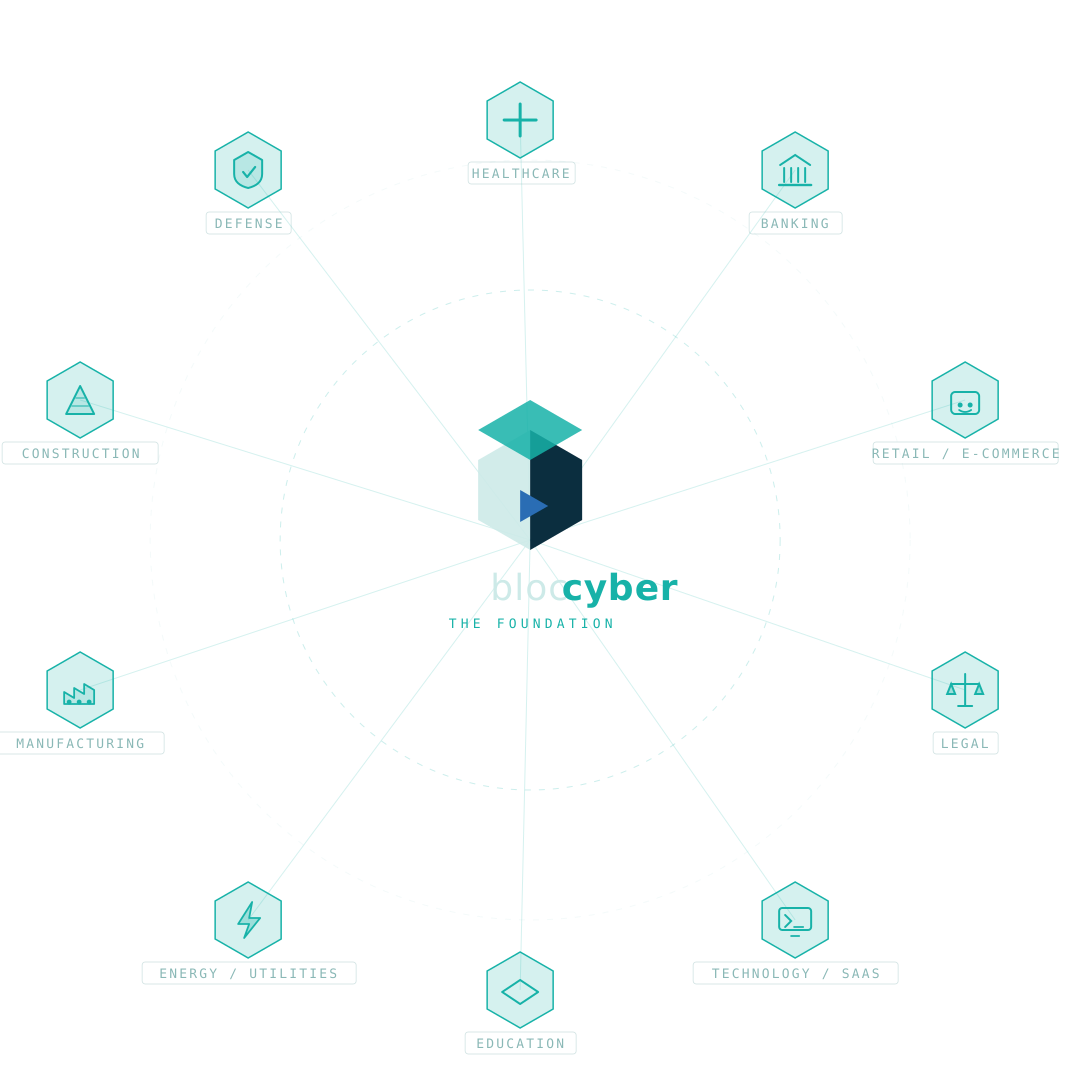
Industries We Protect
Cyber Coverage Built for Your Industry
Every industry faces a different cyber threat, from patient records in healthcare to wire fraud in construction. Bloc Cyber matches coverage to the risks your sector actually faces, drawing on specialty carriers that understand your business. Find your industry below to see how we protect it.
Healthcare
Banking
Retail / E-Commerce
Legal
Technology / SaaS
Education
Energy / Utilities
Manufacturing
Construction
Defense

Healthcare
HIPAA-grade protection for patient data
725
healthcare breaches disclosed in 2024
HIPAA-grade protection for patient data
▣ Ransomware on EHR systems
▣ PHI exfiltration
▣ Medical device exploits
▣ Business email compromise
Sub-sectors we place
Hospitals and health systems
Physician practices and specialty clinics
Dental practices and DSOs
Behavioral health and addiction treatment centers
Medical billing and revenue cycle management firms
Typical turnaround for indication of terms: 1 business day.

Banking
Coverage that meets FFIEC and NYDFS expectations
$5.9M
average cost of a financial sector breach
Common threats we underwrite against
▣ Wire fraud and BEC
▣ Credential stuffing
▣ Third-party vendor risk
▣ Ransomware
Sub-sectors we place
Community banks
Credit unions
Mortgage lenders and loan originators
Wealth management and RIAs
Payment processors and merchant acquirers
Typical turnaround for indication of terms: 1 business day.

Retail / E-Commerce
PCI-DSS aligned coverage for every checkout
42%
of retailers hit by ransomware in the last year
Common threats we underwrite against
▣ Magecart / card skimming
▣ POS malware
▣ Account takeover
▣ Supply-chain intrusion
Sub-sectors we place
Direct-to-consumer (DTC) brands
Shopify and marketplace sellers
Brick-and-mortar multi-location retailers
Restaurants and QSR franchises
Grocery and specialty food retail
Typical turnaround for indication of terms: 1 business day.

Legal
Privilege, client files, and trust-account safeguards
1 in 4
law firms reported a breach in 2024
Common threats we underwrite against
▣ Wire-transfer fraud
▣ Privileged data theft
▣ Email account compromise
▣ Ransomware
Sub-sectors we place
AmLaw / large firms
Boutique litigation firms
Personal injury and plaintiffs’ firms
Estate planning and trust attorneys
Title and real estate closing firms
Typical turnaround for indication of terms: 1 business day.

Technology / SaaS
SOC 2 and ISO-aligned risk transfer
$4.88M
avg. cost of a SaaS breach in 2024
Common threats we underwrite against
▣ Supply-chain attacks
▣ Cloud misconfiguration
▣ Token and key theft
▣ Zero-day exploits
Sub-sectors we place
B2B SaaS platforms
Managed service providers (MSPs) and MSSPs
Fintech startups
AI and machine learning companies
Cloud hosting and infrastructure providers
Typical turnaround for indication of terms: 1 business day.

Education
FERPA-aligned coverage for student and research data
80%
of K–12 districts hit by ransomware since 2022
Common threats we underwrite against
▣ Ransomware on district networks
▣ Student PII theft
▣ Fake invoice fraud
▣ DDoS on exam platforms
Sub-sectors we place
K-12 public school districts
Private and charter schools
Colleges and universities
EdTech platforms
Tutoring, test prep, and online learning providers
Typical turnaround for indication of terms: 1 business day.

Energy / Utilities
OT and IT coverage for critical infrastructure
24/7
operational-tech monitoring requirements
Common threats we underwrite against
▣ ICS/SCADA intrusion
▣ Nation-state actors
▣ Ransomware on OT
▣ Insider threat
Sub-sectors we place
Municipal utilities (water, electric, gas)
Oil and gas operators
Pipeline and midstream companies
Renewable energy (solar, wind) developers
Electric cooperatives and rural utilities
Typical turnaround for indication of terms: 1 business day.

Manufacturing
Business interruption protection for connected plants
25%
of all ransomware attacks target manufacturing
Common threats we underwrite against
▣ Ransomware halting production
▣ IP theft
▣ ICS exploits
▣ Vendor compromise
Sub-sectors we place
Industrial and heavy equipment manufacturers
Food and beverage processing
Pharmaceutical and medical device manufacturers
Automotive and parts suppliers
Aerospace component manufacturers
Typical turnaround for indication of terms: 1 business day.

Construction
Protection for project files, wires, and jobsite tech
$200K+
average wire-fraud loss in construction
Common threats we underwrite against
▣ Wire-transfer diversion
▣ BEC on project payments
▣ Stolen bid data
▣ Ransomware
Sub-sectors we place
General contractors
Commercial HVAC, electrical, and plumbing subs
Civil and infrastructure contractors
Homebuilders and residential developers
Architecture and engineering (A&E) firms
Typical turnaround for indication of terms: 1 business day.

Defense
CMMC, DFARS, and CUI-compliant risk transfer
CMMC
2.0 compliance required by 2026
Common threats we underwrite against
▣ CUI exfiltration
▣ Nation-state APTs
▣ Supply-chain compromise
▣ Cleared-personnel targeting
Sub-sectors we place
DoD prime contractors
CMMC-regulated subcontractors
Defense software and systems integrators
Aerospace and satellite contractors
Federal IT and cleared staffing firms
Typical turnaround for indication of terms: 1 business day.
The Bloc system
One foundation.
Ten industry-specific builds.
The Bloc mark is built from stackable planes — each one a different angle on the same core structure. That’s how we place coverage: one underwriting discipline, tuned and re-tuned for every industry we serve.
Coverage
A policy you can actually read.
Structured in three clean blocs.
01
First-Party
Your direct losses when an incident hits your business.
✓
Incident response & forensics
✓
Business interruption
✓ Data restoration
✓ Cyber extortion / ransomware
✓ Funds transfer fraud
✓ Reputational harm
02
Third-Party
Your liability to clients, partners, and regulators.
✓
Network security liability
✓
Privacy liability (HIPAA, GDPR, state laws)
✓ Regulatory defense & fines
✓ PCI-DSS fines and assessments
✓ Media liability
✓ Breach notification costs
03
Specialty
Advanced coverages for complex risks and contracts.
✓
Technology E&O
✓
Social engineering fraud
✓ Contingent business interruption
✓ Systems failure
✓ Bricking & hardware replacement
✓ CMMC / regulatory-specific endorsements
Typical limits placed
$1M / $1M starter
$5M / $10M mid-market
$25M+ layered towers
Custom retentions
Common Questions
Cyber Liability Insurance, Explained
What does cyber insurance cover?
Cyber insurance covers the financial losses from a data breach or cyberattack. This includes breach response, legal fees, customer notification, ransomware, business interruption, and regulatory fines, depending on your policy.
Does my business really need cyber insurance?
Yes. Any business that stores customer data, processes payments, or relies on connected systems faces cyber risk. Small and mid-sized companies are frequent targets because they often have fewer defenses.
How much does cyber insurance cost?
Cost depends on your industry, revenue, data volume, and security practices. We market your risk to multiple carriers to find strong coverage at a competitive price. Request a quote for an exact figure.
What is the difference between first-party and third-party cyber coverage?
First-party coverage pays for your own losses, like data recovery and lost income. Third-party coverage pays for claims from others harmed by a breach on your systems.
How fast can I get a quote?
Most clients receive a quote in under 24 hours after we review the details of their business and exposure.
What should I do first after a cyberattack?
Contact us right away. We help you start breach response, connect you with forensic and legal support, and guide your claim so you contain the damage quickly.
Insights
Field notes from the placement desk.
What carriers are asking right now.



Start a quote
Tell us about your business.
We’ll come back with terms.
We’ll review your stack, your contracts, and your exposure — then place the program against the right markets. Most intakes get indicative terms back within one business day.
01
Quick intake
We only ask what the carriers actually need.
02
Benchmark
Side-by-side terms from 10+ specialty cyber carriers.
03
Bind
Plain-language policy review, e-signed and in force.